Fox Rage Showgirl: the spinnerbait you drop instead of reeling
One lure, endless conditions. CarnaFish reads your spot from a photo so you are not just guessing.
The spinnerbait suffers from a reputation that costs it dearly: the spring lure you wind straight back half a metre under the surface, over the weed, for six weeks a year. Fished that way it is excellent — and it becomes useless the moment pike drop deeper.
Yet pike spend most of the year lower than that. Late autumn, winter, early spring: they sit on drop-offs, at the foot of steep banks, in three to five metres of water, often tight to structure. A light spinnerbait wound fast never reaches them.
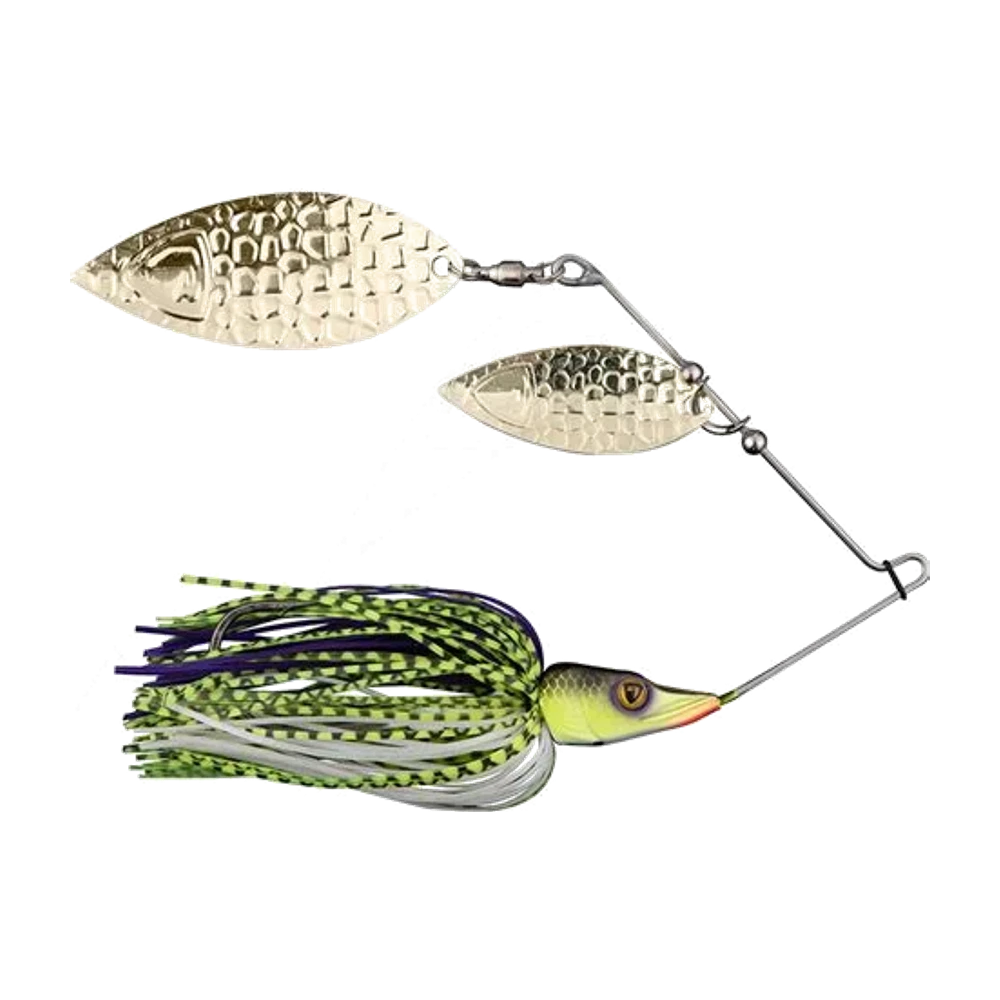
The Showgirl belongs to the family of spinnerbaits heavy enough to be fished vertically. The weights available and the wire-arm build let you drop it straight down over a spot with the blades turning throughout the fall. That is no longer the same style of fishing, and no longer the same season.
Why a spinnerbait can be fished on the drop
This is the key technical point and it is badly understood. When a spinnerbait falls vertically on a controlled line, the water flowing up along the body turns the blades — more slowly than on the retrieve, but they turn. The lure then descends in a slow spiral, with three simultaneous signals:
- The flash of the blades, thrown upwards and sideways, visible to a fish holding below as well as to one that is following.
- The low-frequency vibration carried by the arm, which pike pick up on the lateral line even in coloured water.
- The silicone skirt opening and closing on every twitch of the fall, giving the lure a pulsing volume.
Two build details make this possible. First the weight: under about fifteen grams the fall is too slow and the lure swings away instead of dropping straight. Second the arm angle: a more open arm holds the blades clear of the body during the fall and stops them fouling the line.
The dropping retrieve down a steep bank
This sequence works from a boat or from a high bank with depth right in front of you.
- Get above, or directly over, the drop-off. The cast is short, sometimes only a few metres: you are not after distance, you are after angle.
- Cast slightly beyond the top edge of the drop and let the lure reach the bottom once.
- Pull with one long sweep to lift the lure a metre or two, rod from nine o'clock to twelve.
- Follow the fall on a semi-tight line, rod tip tracking the line down. Do not give it everything: on a completely slack line you feel nothing and the blades turn badly.
- Let the lure touch bottom again, wait a second, then repeat. You work your way down the bank step by step.
- Every three or four cycles, slip in a slow straight retrieve over five metres, then go back to dropping. That change of register triggers followers.
The bite almost always comes during the fall, and it shows up as an abnormal stop in the line: the lure appears to "hit bottom" too early.
On the water: with a spinnerbait on the drop, always count the falling time. If your lure takes nine seconds to reach the bottom on the first cycle and six on the next, it is not that the bottom has risen — it is that a pike intercepted it halfway. Strike on the missing second, not on the feel.
Weight, blades and speed
| Situation | Weight | Blades | Retrieve |
|---|---|---|---|
| Weed edge, 1 to 2 m, warm water | 15 g | Tandem willow | Slow and straight, just under the surface |
| Drop-off 2 to 3 m, stained water | 20 to 25 g | Colorado + willow | Straight, in contact, with lifts |
| Steep bank 4 to 5 m, cold water | 30 to 35 g | Tandem willow | Controlled drop, little straight retrieving |
| Strong wind, fast drift | Heaviest available | Either | Strictly vertical |
The blade choice follows simple logic: the willow flashes a lot and vibrates little, so it suits clear water and faster retrieves. The colorado (round) vibrates a lot and flashes little, so it is built for stained water and slow retrieves. A combination of the two covers the middle ground, which explains its popularity.
Adding a soft trailer — an 8 to 12 cm shad or grub on the hook — changes two things: it slows the fall by about a third, and it lengthens the silhouette. Useful in cold water, counterproductive when you want to drop fast in wind.
Line-wise: a wire trace or 0.60 mm fluorocarbon leader is compulsory, with 0.20 to 0.30 mm braid as mainline. The hookset on a heavy spinnerbait has to be firm — the stiff arm wire absorbs part of the movement.
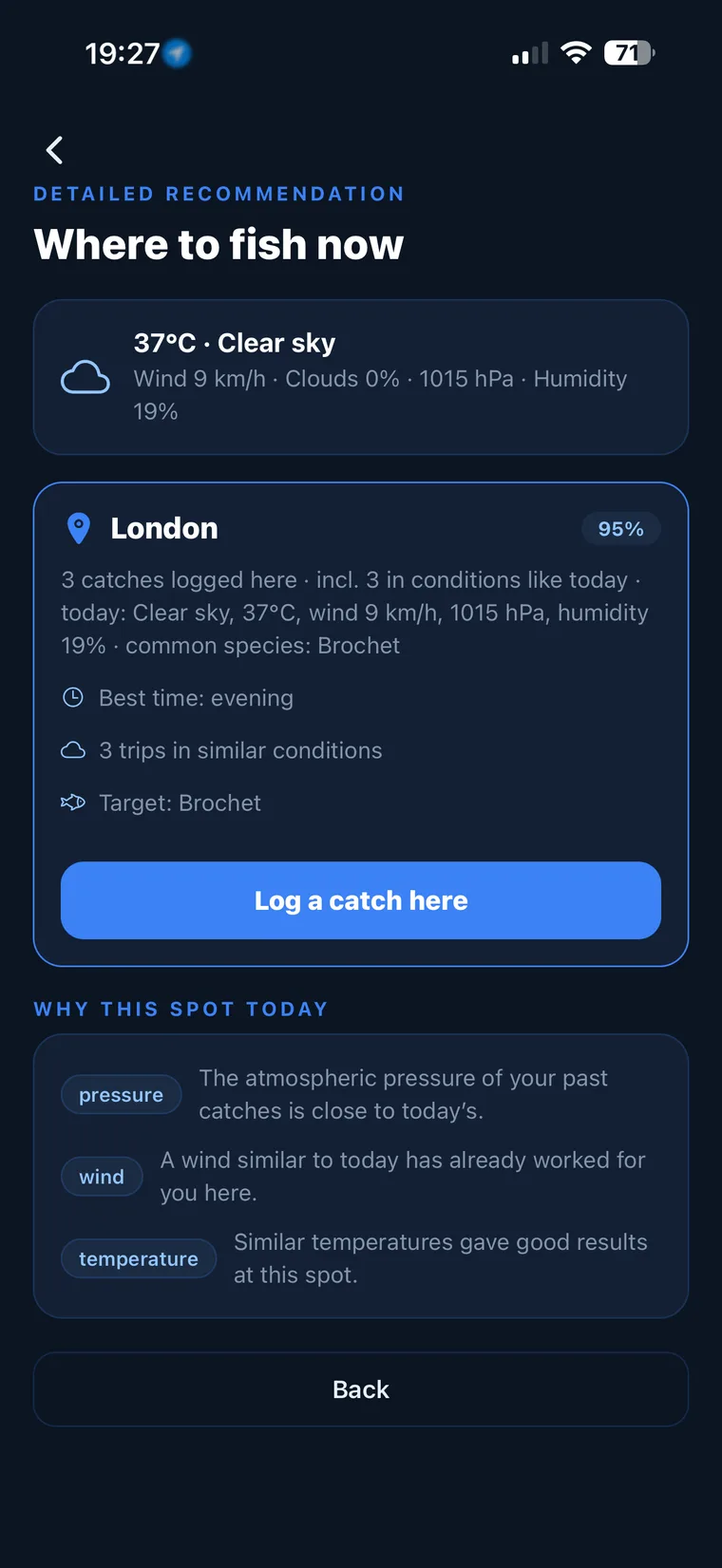
Not sure what to tie on?
Photograph your spot: CarnaFish reads the scene, cross-checks the conditions and gives you the zone, the lure and the retrieve. Free on iOS and Android.
Where it shines, where it should stay in the box
It shines on vertical structure: dam walls, bridge pilings, dug-out gravel pit margins, river holes, sloping rock armour. It also shines in winter, when pike are deep and static and you have to keep something in the same cubic metre for a long time.
It is poorly suited to horizontal searching over a large flat: over three metres of featureless, uniform water you spend your time dropping into nothing. It is also a poor fit over dense surface weed, where a lighter spinnerbait comes through cleanly without fouling. Finally, in very clear water under bright sun on wary fish, the flash of two blades spiralling can work against you; there a discreet soft plastic takes over.
Showgirl or a searching spinnerbait
The Booyah Covert Spinnerbait is built for the spinnerbait's traditional job: compact profile, discreet arm, clean passage through wood and branches, straight retrieve at shallow depth. It is the right choice for working a cluttered bank a metre under the surface. The Showgirl is not after that: it is heavier, bulkier, and it is built to go down.
The War Eagle Double Colorado fills a third niche, that of maximum vibration in very dirty water on a slow retrieve just above the bottom. Its two round blades create a lot of lift, which is exactly what stops it dropping well — it is a lure that planes, not one that dives.
In short: Covert for tracking a bank, Double Colorado for vibrating low and slow, Showgirl for going down a vertical face. Our guide to choosing a pike lure places these three uses in the calendar. And if you are unsure what weight to tie on in front of an unknown drop-off, CarnaFish analyses a photo of the spot and answers.
Key takeaways
- The blades keep turning during the fall: the spinnerbait becomes a vertical lure.
- You need weight — at least fifteen grams, more like 25 to 35 g on a real drop-off.
- Semi-tight line during the fall, never slack, or you lose both flash and feel.
- Count the seconds of the fall: a shortened drop is a bite.
- A lure for vertical structure and cold water, not for searching big flats.
FAQ
Can a spinnerbait really be fished deep?
Yes, provided it is heavy enough. Above about twenty grams the lure drops straight and the blades turn during the fall, which makes it a vertical lure usable down to four or five metres alongside structure.
What weight for pike in winter?
Rather 25 to 35 g. In cold water the fish are deep and not moving: you need to get down to their layer quickly and stay there. A light model will pass too high and too far from the spot.
Willow or colorado blades for pike?
Willow when the water is clear and you want flash and a straighter drop; colorado when the water is stained and you are fishing slowly, because it vibrates more. A tandem combination is the most versatile compromise.
Should I add a soft trailer?
In cold water, yes: it slows the fall and lengthens the silhouette, giving the pike more time to decide. When you want to drop fast, in wind or down a deep face, take it off.
How do I detect a bite during the fall?
By timing it. Note the falling time to the bottom on the first cycle, then compare. A drop that stops earlier than expected, or a line that moves off to the side, is a bite: strike straight away.
Is a wire trace essential?
For pike, yes. The spinnerbait's arm wire does not protect the knot, and a sideways attack puts teeth straight onto the line. Soft wire, or fluorocarbon of at least 0.60 mm if you want it subtler.
The full pike lure guideSeason-by-season strategy: which family of lure, when, and why.Go from theory to fish
CarnaFish reads your spot from a photo and gives you the game plan: zone, lure, retrieve. Free on iOS and Android.