War Eagle Finesse Spinnerbait: the compact size for hard days
This lure shines under specific conditions. CarnaFish tells you in 10 seconds if today is one of them.
There are days when nothing works and the only change that genuinely matters is going smaller. A cold front the night before, water clearing up, fishing pressure on a small lake: the half ounce spinnerbait that hammered them last week brings nothing back, while the same lure in a compact size produces three fish in an hour. That is the whole point of this model, built to find bites when conditions close down.
Why downsizing works
A compact spinnerbait does not simply fish less hard than a big one. It fishes differently, on three fronts at once.
First the silhouette. A shorter skirt and a smaller head give a visual mass that matches fry and young of the year, not a fifteen centimetre baitfish. In late summer and autumn, when fry pour out of the grass beds, that is exactly the size predators are hunting.
Then the fall rate. A lighter lure sinks more slowly and stays longer in the useful layer during a pause. On an inactive fish that will not rise, that extra hang time is the difference.
Finally the noise level. Smaller blades move less water and put out a less aggressive vibration. In clear, calm water, that step back in volume is often what separates a fish that follows from a fish that eats.
The Colorado and willow tandem, and what each blade does
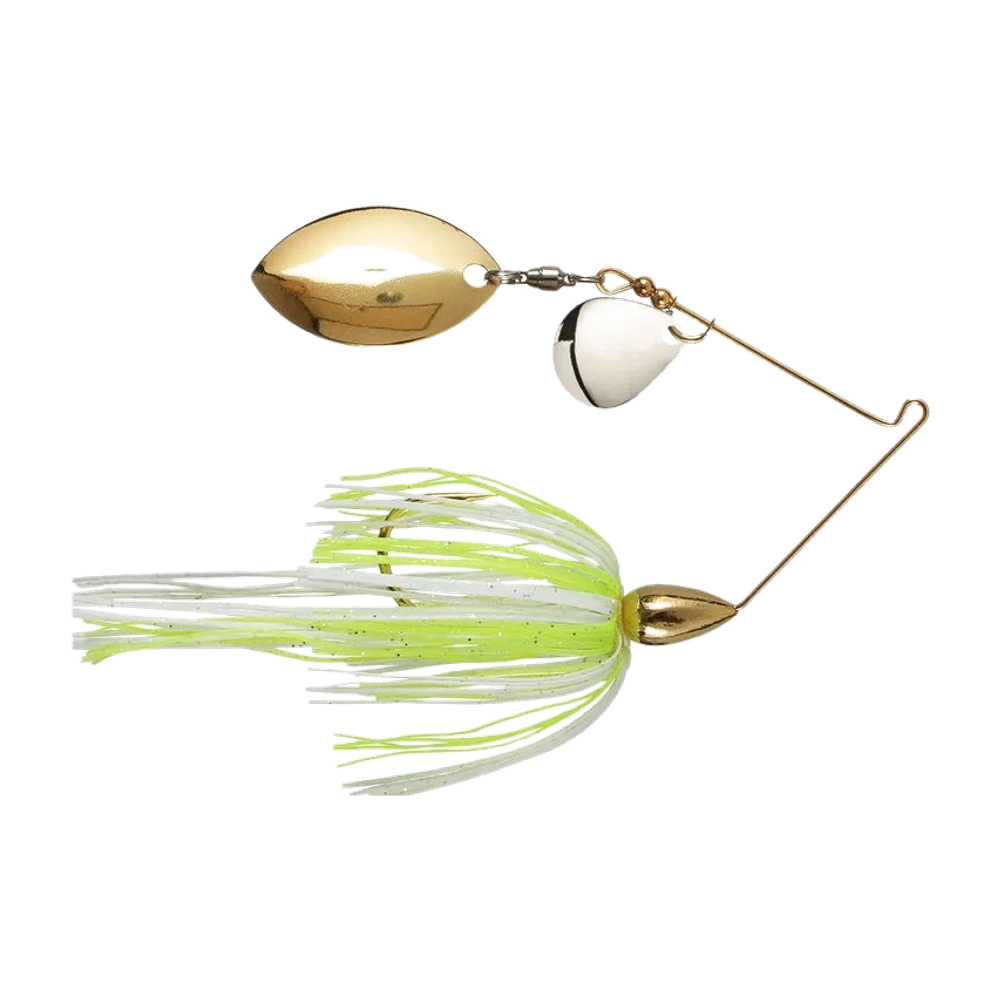
The model in the photo pairs a small nickel Colorado at the front with a big gold willow at the rear. That is not a random build, it is a division of labour.
The Colorado, round and deeply cupped, grabs a lot of water and swings wide around the arm. It produces most of the low frequency vibration, the kind that travels a long way in stained water and that a fish picks up on its lateral line before it sees anything. It is also what provides lift and lets you retrieve very slowly without the lure nosing down.
The willow, long and narrow, spins fast and tight. It makes little vibration but plenty of flash, and above all it creates little drag, which is what keeps the lure tracking properly when you speed up to cross dead water.
If you keep one rule, keep this one: the Colorado sets the depth and the slowest usable speed, the willow sets the fastest. When you hesitate between two models, look at the size of the front blade before you look at the colour of the skirt.
The dual length skirt
War Eagle uses a skirt on this model whose strands are not all the same length. The short strands fill the volume right behind the head, while the long ones run past and wave freely.
The effect is twofold. Visually, the silhouette stays compact and dense in the middle while keeping a mobile tail, so the lure looks smaller than it really is, which is precisely the goal in finesse. Hydraulically, the long strands fold back under acceleration and reopen on the pause, creating a breathing effect that is clearly visible to a fish following in sight.
That skirt is also what hides the factory Mustad Ultra Power Point hook. On a compact lure, a hook that shows too much spooks wary fish in clear water: skirt density matters as much as skirt colour.
Swivels, the detail nobody sees
The blades run on Sampo swivels. That is not marketing but a critical wear part: a swivel that seizes stops the blade turning halfway through the retrieve without you noticing. You then fish a dead lure for twenty minutes.
Get into the habit of spinning the blades by hand between sets of casts. If one resists, a drop of light oil on the shaft usually fixes it, and failing that the swivel can be replaced in two minutes with a split ring.
Not sure what to tie on?
Photograph your spot: CarnaFish reads the scene, cross-checks the conditions and gives you the zone, the lure and the retrieve. Free on iOS and Android.
How to fish it
Slow rolling is the signature retrieve for this lure. Cast, let the spinnerbait sink while you count the seconds, then reel just fast enough to feel the blades turning constantly. The aim is to track the bottom or the top of a grass bed without ever leaving the useful zone.
Two variations are worth the trouble. The first is contact: deliberately let the lure touch a branch, a rock or a weed top, then accelerate sharply to clear it. That change of rhythm triggers a great many strikes, and the bite usually comes in the second that follows. The second is a controlled fall down a vertical face, a bridge piling, a drowned tree or a quay wall, where the Colorado brakes enough for the lure to drop flat with the blades still turning.
The classic mistake
Fishing this lure like a standard spinnerbait, meaning too fast. A compact model rises very quickly as soon as you speed up, and you end up fishing half a metre under the surface without realising it. Always count the sink time before you start reeling, and check from time to time that the lure is still touching what you think it is.
Colours by conditions
- Stained water, overcast, wind: chartreuse and white as pictured, with the nickel and gold tandem. The contrast stays readable when visibility drops to half a metre.
- Clear water, visible baitfish: white and silver with two nickel blades, for a more literal and less shouty imitation.
- Low light, dawn or dusk: a black skirt with copper or matt blades. Silhouette beats colour as soon as the light drops.
In Europe this compact format has a use American pages never mention: it becomes an excellent perch lure along reed lines and docks, where a standard spinnerbait is simply too bulky. Our guide to lure fishing for perch covers the spots and the speeds that go with it. And to know where to cast before deciding what to cast, CarnaFish reads a photo of your swim and suggests the zone and the lure family that suit the day.
In the same box, the War Eagle Double Colorado takes over when you need even more vibration and even less speed, the Booyah Covert Spinnerbait offers a more versatile standard size, and the War Eagle Buzzbait covers the surface when fish agree to come up.
Key takeaways
- A compact spinnerbait is not the same lure made smaller: it sinks slower, vibrates less and imitates fry rather than an adult baitfish.
- The front Colorado sets the vibration and the slowest usable speed, the rear willow sets the flash and the top speed.
- The dual length skirt keeps a dense volume in the middle and a mobile tail that breathes on every change of rhythm.
- Check blade rotation regularly: a seized swivel turns the lure into an inert piece of metal.
FAQ
How much does this spinnerbait weigh?
The manufacturer's description does not say and the catalogue shows a single price point, which suggests one version only. Check the packaging before buying: on a spinnerbait the weight directly governs running depth and the slowest usable speed.
Does a compact spinnerbait need a soft plastic trailer?
It is not compulsory, and it even works against the point of the lure, since a trailer adds the very volume you set out to remove. If you want to slow the fall further, choose a small flat discreet trailer rather than a bulky swimbait.
When should I pick this over a standard spinnerbait?
After a cold front, in clearing water, on heavily fished waters, or when you can see fry schools. As soon as fish follow without eating, downsizing is the most profitable adjustment before you change lure family entirely.
Do pike take an interest?
Yes, especially along edges and in stained water, but a compact lure gets hit broadside and the skirt takes a beating. Fit a supple wire trace if you are fishing a known pike spot, because losing a lure at this price happens fast.
Why does my blade stop turning?
Either a strand of weed is jammed at its base, or the swivel is starting to seize. Both take three seconds to check by hand, and a tired swivel is easily replaced with a split ring rather than scrapping the lure.
Can it be fished in winter?
Yes, and it is one of its best windows, provided you slow right down. Slow rolled along the bottom, the Colorado keeps turning at speeds where most vibrating lures stop working, which is exactly what a cold fish is looking for.
The full bass lure guideSeason-by-season strategy: which family of lure, when, and why.Go from theory to fish
CarnaFish reads your spot from a photo and gives you the game plan: zone, lure, retrieve. Free on iOS and Android.