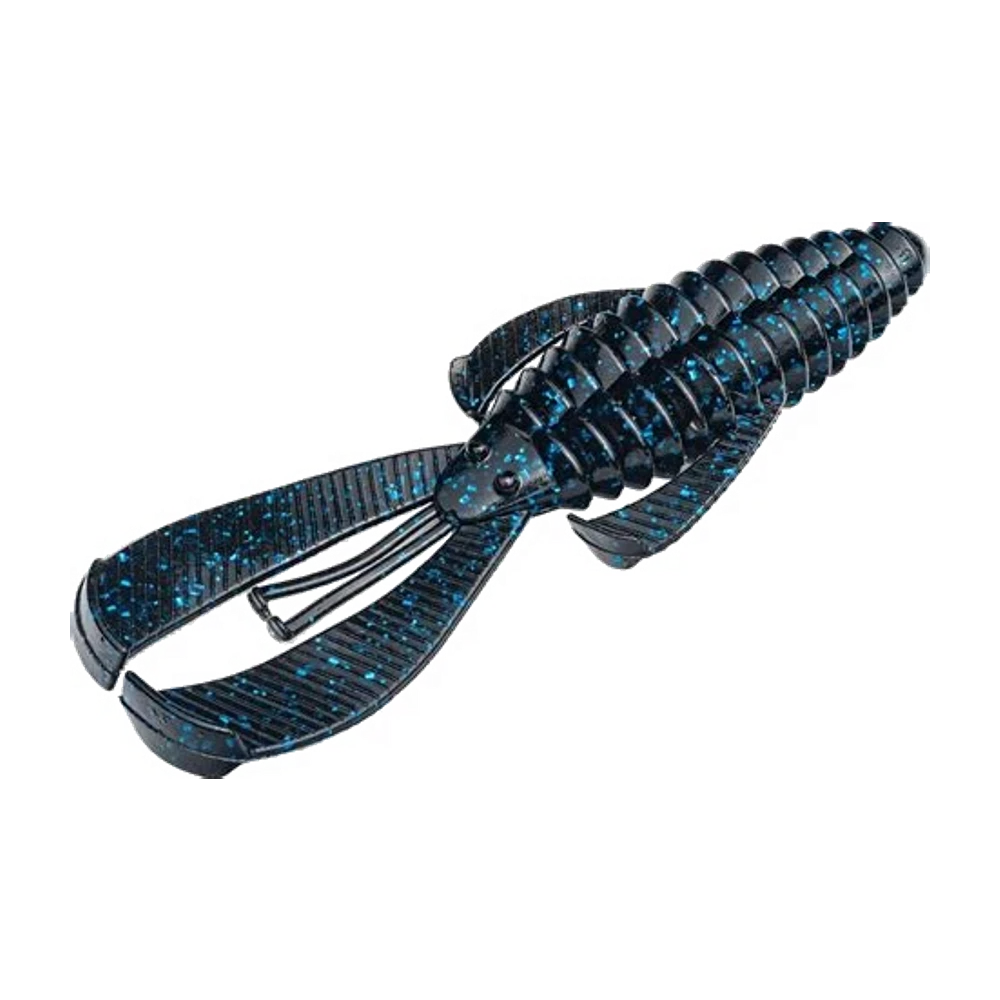
Strike King Rage Bug: the creature where everything happens on the drop
Before tying this one on, it helps to know if the spot actually calls for it. CarnaFish reads the scene from a photo.
In tight drowned wood, most creatures never get the chance to show what they can do. The lure goes through the first fork, snags, you free it, it comes off line, and of the four metres of drop the spot offered you have one left. The problem is almost never the retrieve: it is the geometry of the lure, which is too wide to get through and too slow to express itself.
The Rage Bug takes the problem from the other end. It is a short, compact creature that threads through, and whose appendages fire off within the first few centimetres of the fall. You do not need three seconds of descent for it to work: it works immediately.
The result is a lure for vertical presentations and precision, not for dragging along the bottom. Everything about how you fish it follows from that.
Appendages that beat rather than undulate
The difference between a creature that undulates and one that beats comes down to the thickness and the ribbing of the plastic. The Rage Bug's appendages are wide, flat, and grooved on their inner face. Under the force of the fall they do not simply follow the movement: they fold flat then snap open again, producing a short, fast beat you can feel in the rod tip on a tight line.
Three concrete consequences:
- The signal starts immediately. Over a 60 cm drop under a jetty, a creature with long soft appendages never gets going. This one is beating within the first third.
- The beat creates a low-frequency vibration that carries in coloured water, where a discreet creature relies on silhouette alone.
- The profile stays tucked in when it comes to threading through an obstacle, because the appendages fold back against the body when the lure is pulled upwards.
The body itself is segmented along its length. That is not decorative: those ribs give the bullet weight something to bear against and stop the Texas hook backing out at the first contact with a branch.
The retrieve: the cast, the fall, and one single lift
The pattern is deliberately sparse. That is what makes it work.
- Place the lure vertically over the spot, flipping or pitching, never a lobbed cast. The entry into the water has to be silent.
- Let it drop on a semi-tight line, the rod tip following the fall. Do not lock it up: a restrained line turns the free fall into a pendulum and kills the beat.
- Count the drop. If the lure reaches bottom earlier than expected, you have had a bite.
- One single 20 to 30 cm lift, rod tip from low to high, then release for a second fall.
- Two lifts maximum per spot, then reel in and start again 50 cm further along. A flipping spot is fished by covering plenty of points, not by working one to death.
On the water: over a weed mat, do not strike on first contact. The bass sucks the lure in through the cover and has to drop back down to swallow it. Lower the rod, take up the slack until you feel the weight, and only strike when the line genuinely moves off sideways. Striking on the vibration costs you one fish in two in this style of fishing.
Choosing the weight: the only setting that really matters
The Rage Bug does not change behaviour with retrieve speed — it changes behaviour with the sinker. That is the parameter to work on.
| Texas weight | Situation | Effect on the appendages |
|---|---|---|
| 5 to 7 g | clear margin, sparse weed, cold water | slow fall, wide beat, lethargic fish |
| 10 to 14 g | drowned wood, stumps, jetties | standard compromise, good feel for contact |
| 18 to 21 g | lily or algae mats to punch through | clean penetration, short violent beat |
Two further markers. Always lock the weight hard against the lure with a bead or a line stop: a sliding sinker that runs ahead decouples the fall from the body and kills the trigger. And with heavy weights, move to 0.30 to 0.40 mm braid and a powerful rod — a 21 g drop into dense vegetation cannot be struck on monofilament.
Pick a wide gape hook in 3/0 or 4/0, rigged Texas with the point re-entered just under the skin of the body. If you bury it too deep, the Rage Bug's thick body absorbs the hookset and the point never comes through.
Its home ground, and what to avoid
This is a lure for contact and vertical work.
- Dense drowned wood and stumps: its compactness gets it through forks where a long-legged creature hangs up.
- Lily or filamentous algae mats, punching, with a heavy weight.
- Jetties and rock, pitching under the structure, where the short drop is the only usable phase.
- Post-spawn and summer, when bass glue themselves to cover and refuse to come out and follow a lure.
Conversely, it is poorly suited to searching big stretches of flat bottom. Over a sandy flat or an open drop-off, a rig that glides and drags for a long time covers the ground better; the Rage Bug loses its point there, since its active phase, the fall, lasts only two seconds. It is also too noisy and too fast for a very slow winter fish, a situation where a finesse bait sitting on the bottom does better.
Not sure what to tie on?
Photograph your spot: CarnaFish reads the scene, cross-checks the conditions and gives you the zone, the lure and the retrieve. Free on iOS and Android.
Rage Bug, Crazy Flapper or Brush Hog
These three creatures sit side by side on the shelf, and plenty of anglers treat them as interchangeable. They are not.
The Keitech Crazy Flapper bets on two long soft claws that undulate slowly and a very dense salted material. It is the lure of the long drop and the wary fish, typically in clear water on a jig trailer or a light Texas rig. Its slowness is an asset out in the open and a handicap in tight wood.
The Zoom Brush Hog plays the volume card: more appendages, more water displaced, a silhouette visible from far off in stained water. It is an excellent Carolina drag bait, but that bulk is exactly what makes it hang up when punching.
The Rage Bug occupies the middle ground: compact enough to get through, lively enough to announce itself in the first two seconds. If you want the same beat on a craw profile to run as a jig trailer, look at the Strike King Rage Craw, which shares the ribbed-appendage philosophy. The Texas rig remains the foundation for all these lures, and our beginner's guide to bass fishing places the creature's window within a season. And if you are unsure what weight to fit when you arrive in front of a cluttered margin, CarnaFish analyses a photo of the spot and answers.
Colours
- Clear water, gravel or rock bottom: green pumpkin, brown, with or without flake. You are imitating a crawfish.
- Stained water, low cloud: black and blue, the most readable contrast for a fish hunting on silhouette.
- Under a weed mat: solid black. There is almost no light down there, only the outline counts.
- Summer, warm margins: a touch of orange on the claws, echoing the colour of a moulting crawfish.
Key takeaways
- The ribbed appendages beat within the first few centimetres of the fall: the drop is the retrieve.
- Deliberately compact profile, to thread through dense wood without snagging.
- The weight, 5 to 21 g, is the real setting; lock it against the lure with a bead.
- Over a weed mat, take up the slack and strike on the weight, never on the first vibration.
- Ineffective for searching flat bottom and on very slow winter fish.
FAQ
What weight should I use with the Strike King Rage Bug?
5 to 7 g on a clear margin or in cold water, 10 to 14 g in drowned wood, and 18 to 21 g to punch through a lily mat. The weight must always be locked hard against the lure so that fall and beat stay synchronised.
Do I need a special hook?
A wide gape Texas hook in 3/0 or 4/0 is enough. Set the point just under the skin of the body rather than deep: the plastic is thick and a hook driven too far in will not come through on the strike.
What is the difference with the Rage Craw?
The Rage Craw imitates a crawfish and is used mainly as a jig trailer or Texas-rigged over hard bottom. The Rage Bug is more compact and more versatile for vertical flipping into cover. Both share the same ribbed-appendage principle.
Can I fish it Carolina?
Yes, but it is not its best use. On a Carolina rig the lure drags horizontally and the fall, which is its strong phase, disappears. A bulkier creature makes better use of that rig.
How long should I work the same spot?
Two drops, rarely more. This fishing is about the number of points touched, not persistence: a bass sitting under a structure reacts in the first few seconds or not at all.
Does it work in cold water?
Moderately. The fast beat of the appendages suits a reactive fish. Below 10 °C, a finesse bait sitting on the bottom and worked very slowly generally produces more bites.
The full bass lure guideSeason-by-season strategy: which family of lure, when, and why.Go from theory to fish
CarnaFish reads your spot from a photo and gives you the game plan: zone, lure, retrieve. Free on iOS and Android.