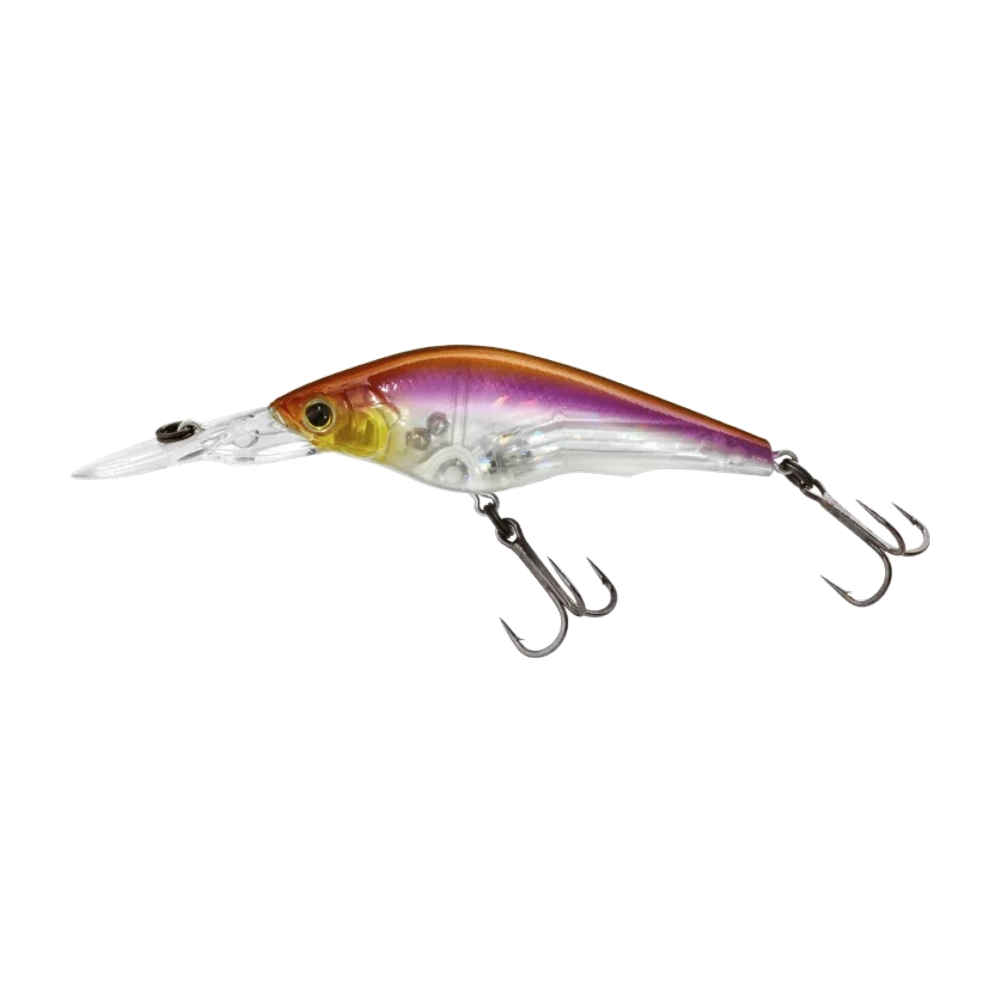
Yo-Zuri Hardcore Shad: the crank that holds its action when you speed up
Rather not fish it blind? Photograph your spot — CarnaFish cross-checks the conditions and points you the right way.
You are searching a gravel flat in 2 to 3 m, you know the zander sit there in late afternoon, and you want to cover 150 m of bank before the light goes. You tie on a balsa crank, you speed up to move faster — and it lies over, kicks out sideways, rises. You slow down, it swims properly again, but you cover three times less ground per hour.
That is a genuine searching problem, not a fussy detail. The Hardcore Shad answers it through its construction: a weighted ABS shell that holds its action across a far wider speed range than a wooden crank. You can speed up to cover ground, then slow down over the hot zone, without changing lure.
Hard shell versus balsa: what it really changes
The debate is old and usually badly framed. Both materials have their ground.
Balsa is lighter for the same volume. It rises quickly, it has lively buoyancy, a slightly erratic action and a very fast "wake-up" after contact with an obstacle. That is a quality when fishing slowly for wary fish.
Weighted ABS is denser and stiffer. That gives three concrete advantages:
- Stability at high speed. The internal ballast holds the lure's attitude as water pressure builds. The lure keeps vibrating straight where balsa folds over.
- Longer casts, often 20 to 30 % more for the same size, thanks to the weight and the internal mass-transfer system.
- Sharper transmission, because the rigid body sends vibration up the line without damping it. You feel the moment the lip touches bottom far better.
In exchange you lose part of balsa's nervous, slightly anarchic action. It is a trade: versatility and productivity against subtlety.
Setting the depth without changing lure
A crank does not "do" a fixed depth. Three variables move it noticeably.
| Variable | Approximate effect |
|---|---|
| 0.20 mm fluorocarbon instead of 0.28 mm | +30 to 40 cm of depth |
| Low rod, tip in the water | around +30 cm |
| Long cast, retrieve over 25 m | +20 to 30 cm over the middle section |
Added together, those three corrections easily gain a metre. That is often what separates a crank brushing the gravel from a crank passing over the top and triggering nothing.
The retrieve: bottom contact is the retrieve
For zander and perch on a flat, you are not after a steady action but accidents.
- Cast long, 30 to 40 m, to give the lure time to reach its depth and hold it over a good part of the run.
- Retrieve at medium speed until you feel the lip touch the substrate. Make a mental note of the number of turns.
- Keep going and let the lure catch the bottom every two or three seconds. Each contact lifts a cloud and knocks the lure off line.
- Pause for one second after every clean knock: the lure rises a few centimetres, and that is very often where the zander takes.
- Accelerate briefly if you feel a follow or after a refusal. The lure switches from a stable action to a more nervous one, and that change triggers.
On the water: for zander, do not look for bottom everywhere. Find the edge of the flat — the line where the gravel tips into the deeper water — and set your crank so it only touches over the last five metres of that edge. A crank that scrapes the whole way saturates the fish and collects debris; a crank that touches only three times per cast, exactly on the drop-off, catches far more.
The rod does half the work
A crank is fished with a particular outfit, and that is the commonest tackle mistake with this lure family.
A fast rod with a stiff tip transmits every vibration, which feels good, but it tears the lure out of the fish's mouth: a zander takes a crank side-on without turning, and a blank that does not bend pulls the hooks. Favour a progressive action that absorbs the head shakes over the first few metres.
On the drag, stay soft. A crank is fished with two trebles that often hold by one point only; a tight drag doubles the number of fish lost at the bank.
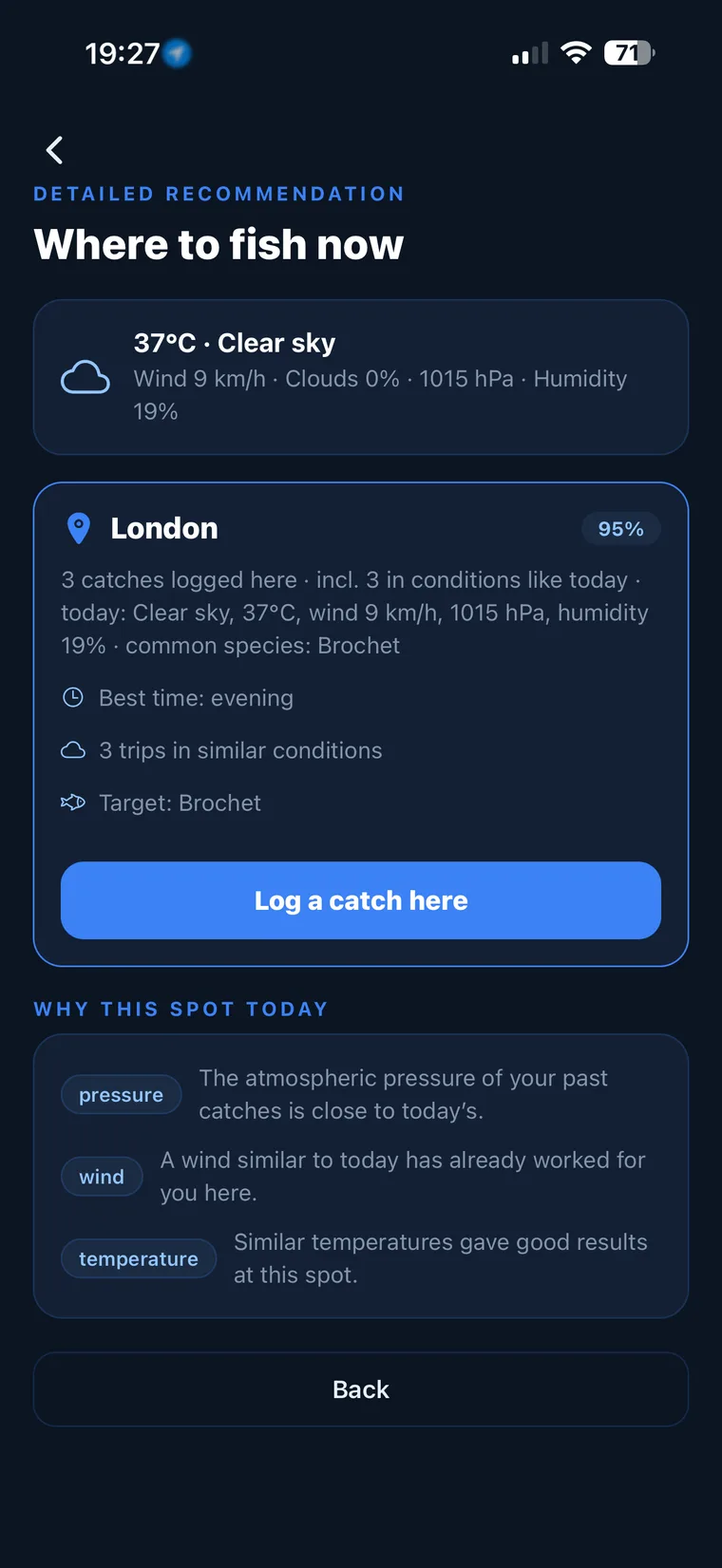
Not sure what to tie on?
Photograph your spot: CarnaFish reads the scene, cross-checks the conditions and gives you the zone, the lure and the retrieve. Free on iOS and Android.
When it shines and when it is useless
Its ground:
- Gravel and hard sand flats between 1.5 and 3 m, in reservoirs as well as big rivers.
- Late summer and autumn, when perch group up and zander move onto the shallows at dusk.
- Slightly stained water, where its high-frequency vibration carries better than a visual signal.
- Searching on foot along a bank, when you need to cover ground quickly without stopping.
Its blind spots:
- Bottoms cluttered with dead wood: a lip working in permanent contact ends up in a branch.
- Very cold water below 8 °C, where the crank's brisk rhythm exceeds what the fish will chase.
- Gin-clear water and educated fish, where its regular, mechanical action looks too clean.
- Deep fishing beyond 3.5 m, outside its range.
Hardcore Shad, Shad Rap or Japanese crank
The Rapala Shad Rap is the balsa benchmark in this format. Its looser action and lively buoyancy give it a clear edge when fishing slowly, in cold water and on apathetic fish: it floats free after a snag on its own and forgives a lot of mistakes. But it casts badly into wind and blows out as soon as you increase speed.
The DUO Realis Crank M65 sits in between: very carefully engineered Japanese design, a controlled action, aimed more at precision on an identified spot. The Hardcore Shad takes on the role of a productivity lure — cast far, move fast, hold the action, take knocks without going out of tune.
The choice is therefore situational: Shad Rap to fish fine and slow, Hardcore Shad to rake water. Our beginner's guide to lure fishing for zander covers how to alternate fast searching with working the hot zone. And if you are unsure what depth to target when you reach your flat, CarnaFish analyses a photo of the spot and answers.
Key takeaways
- Weighted ABS shell: the action holds at speed, where balsa blows out.
- Line diameter and rod angle move the depth by almost a metre.
- The retrieve is the bottom contact, followed by a one-second pause.
- Set the lure so it only touches on the drop-off, not everywhere.
- Wrong tool for dead wood, very cold water and educated fish in gin-clear conditions.
FAQ
What depth does the Yo-Zuri Hardcore Shad run at?
Between 1.5 and 3 m depending on model, line diameter and rod angle. Fine fluorocarbon and a lowered rod tip can gain it close to a metre over a standard setup.
ABS crank or balsa crank for zander?
It depends on the tempo. Searching fast and in wind, ABS holds its action and casts far further. Fishing slowly, in cold water and on apathetic fish, balsa and its lively buoyancy stay superior.
Should the crank touch the bottom?
Yes, but not constantly. Two or three clean contacts per cast, placed on the drop-off, work far better than continuous scraping that saturates the fish and collects debris.
Does it work for perch?
Very well, especially in late summer and autumn when perch group up on the shallows. Go for the small sizes and a steadier retrieve, with brief accelerations to trigger followers.
Can you use it with a clip?
Yes, a light clip is acceptable and makes changes quicker while searching. Avoid heavy ones that alter the lure's attitude and cost it a little depth.
What colour should you pick in stained water?
A dark back with a gold or copper flank. In coloured water it is the vibration that brings the fish in and the contrast of the silhouette that triggers, not how fine the pattern is.
The full zander lure guideSeason-by-season strategy: which family of lure, when, and why.Go from theory to fish
CarnaFish reads your spot from a photo and gives you the game plan: zone, lure, retrieve. Free on iOS and Android.