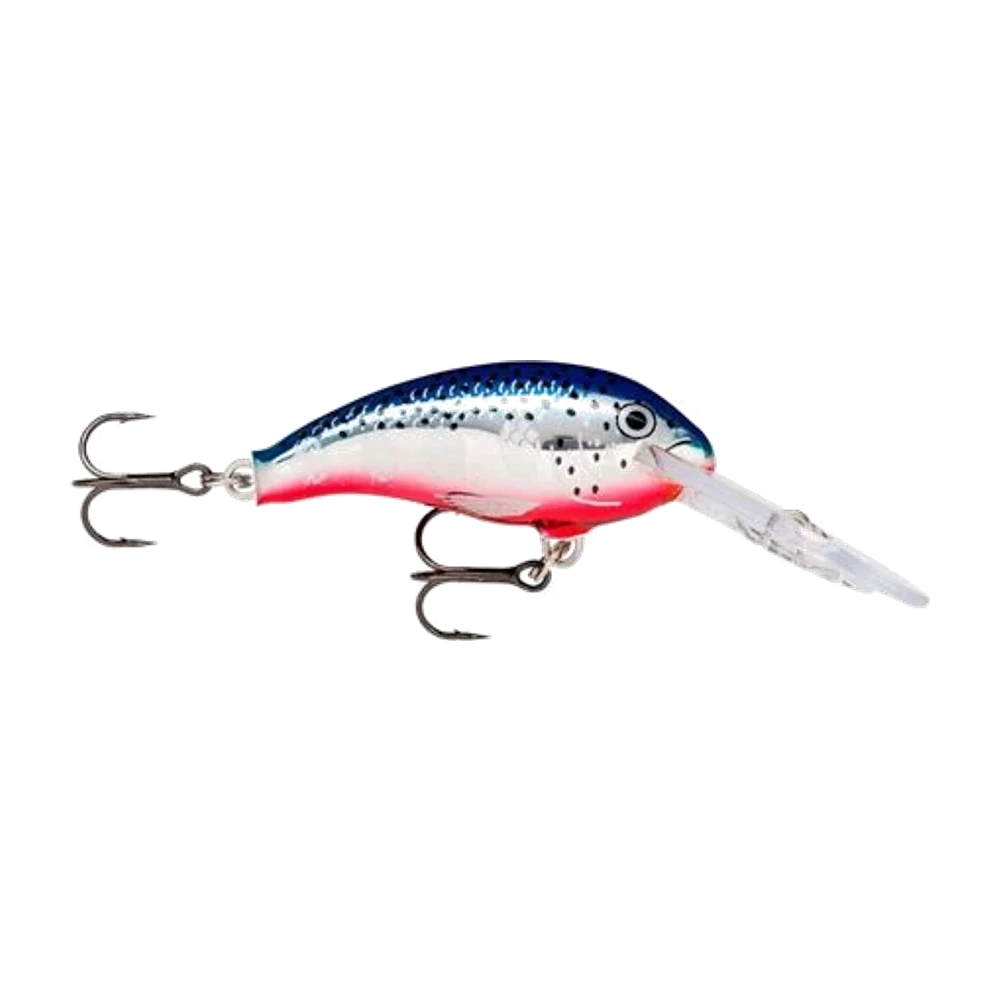
Rapala Shad Dancer: the little crank that fishes by scraping the bottom
The right lure in the wrong spot still catches nothing. CarnaFish spots the zone that works, from a single photo.
The zander is glued to the bottom. You know it, the sounder showed you, your mates told you. And yet you spend the afternoon winding back a crankbait that swims beautifully forty centimetres above its head. A diving lure that never touches anything is not fishing the bottom: it is flying over it.
The Shad Dancer is built to go and find that contact. Small shad body, long steep lip, it gets down fast over a short distance and works by scraping, not by cruising. What triggers with it is not its action: it is the collision.
An oversized lip on a tiny body
The ratio between lip size and body size is what separates this model from a normal crank of the same length. Three practical consequences.
It reaches its depth very fast, within a few turns of the handle, instead of easing down over the whole retrieve. On a short cast in a river that is decisive: you do not lose half your run getting the lure down.
The lip works as a bumper. It hits the rock, the wood or the gravel before the body and before the hooks. The lure noses over, kicks to one side, and carries on. That abrupt deviation — the deflection — is what produces the attack, far more than any regular swimming action.
The volume stays small. That is what makes it acceptable to a zander in cold water or a wary perch, where a big 7 or 8 cm deep crank is already too much. You get the depth of a big lure with the silhouette of a small one.
The vibration itself is tight and fast: nothing like the wide roll of a round-bodied crank. It reads very clearly in the rod, which means you always know whether the lure is working or dragging a strand of weed.
The retrieve: it is not the handle that fishes
- Cast long and let the lure dive as you wind five or six fast turns. You are trying to touch bottom straight away, not to swim in midwater.
- Slow down at the first contact. From there, retrieve slowly enough to feel the bottom once every two or three seconds.
- After every knock, stop for a second. The lure rises twenty to thirty centimetres and levels out. The bite very often comes during that rise.
- Start again smoothly. A violent acceleration after the knock pulls the lure out of the useful layer and costs you bottom contact for ten metres.
- Over the last couple of metres, do not lift the lure out too quickly: perch often follow right to the bank and commit on the vertical rise.
On the water: count contacts, not turns of the handle. On a full cast, aim for three to five touches of the bottom. Fewer than three and you are too high: switch to the longer-lipped model or go finer on your line. More than eight and you are ploughing and collecting every piece of deadwood in the area: speed up slightly or step up a notch in nominal depth.
Setting the depth without changing lure
Plenty of anglers believe retrieve speed sets the depth. On a big-lipped diver that effect is marginal. The real levers are elsewhere.
| Lever | Effect on depth | Order of magnitude |
|---|---|---|
| Going from 0.25 mm fluoro to 0.20 mm | Depth gained | 20 to 40 cm |
| Adding 10 m to the cast | Depth gained | 20 to 30 cm |
| Rod high, tip at 11 o'clock | Depth lost | 30 to 50 cm |
| Rod low, tip in the water | Depth gained | 20 to 30 cm |
| Heavy snap on the ring | Loss of action amplitude | Restricted action |
Remember the ranking: line, distance, rod position. In practice, stay on 0.20 to 0.25 mm fluorocarbon straight through, knotted to the ring or on a small fine snap. Braid improves detection but floats and costs a little depth on long casts; if you insist on it, add a metre of fluorocarbon leader.
Not sure what to tie on?
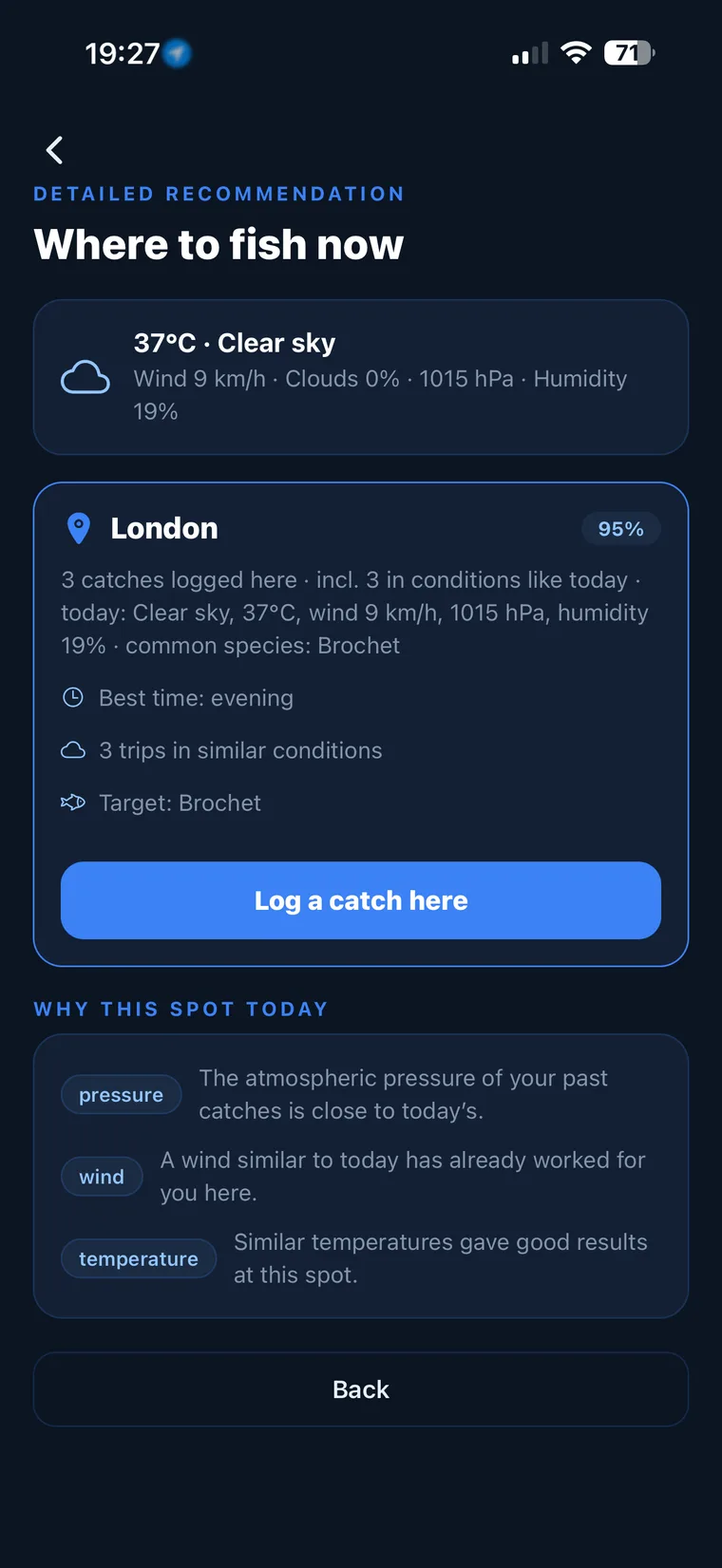
Photograph your spot: CarnaFish reads the scene, cross-checks the conditions and gives you the zone, the lure and the retrieve. Free on iOS and Android.
Where it takes the lead, and where it is the wrong choice
Its ground is shallow hard bottom. River riffles, bank revetments, gravel margins, reservoir flats between 1.5 and 2.5 m, the tails of dams. It also excels in late autumn and spring, when zander move up onto shallow zones and perch group on the lower drop-offs.
It is unsuited in three cases, though. Over soft silt, where contact produces nothing but a cloud and a lot of weed on the trebles. Beyond 3 m, where you need a specifically deep model or a vertical weighted approach. And in dense deadwood: with two trebles and a diving lip, you will offer more lures to the branches than fish to the net. In that case a Texas-rigged soft plastic remains the logical answer.
Shad Dancer or Shad Rap
The Rapala Shad Rap is the direct cousin, in balsa: a livelier action, stronger buoyancy, a faster rise as soon as you stop, but more limited depth and a harder cast in wind. The Shad Dancer trades that lightness for penetration: it gets down faster, holds the bottom better, and casts further. On a calm summer margin the Shad Rap is often the subtler tool; on a riffle or a rocky bank where you need to scrape, the Shad Dancer comes out ahead.
If you want to cover the same depth with a rounder body and a wider vibration, the Rapala DT6 does that job on big flats. And the Berkley Flicker Shad offers a direct alternative with a slightly wider action, useful when fish refuse a vibration that is too tight.
Our beginner's guide to zander fishing with lures explains how to identify hard-bottom zones before you even cast. And if you are unsure what depth to attack on an unknown bank, CarnaFish analyses a photo of the spot and answers.
Key takeaways
- Long lip on a small body: the depth of a big crank with the silhouette of a small lure.
- What triggers is the deflection off an obstacle, not the regular swimming action.
- Stop for a second after every contact: the bite comes on the rise.
- Line and casting distance set the depth far more than speed does.
- Avoid it over soft silt, beyond 3 m and in dense wood.
FAQ
How deep does the Rapala Shad Dancer run?
Between roughly 1.2 and 2.4 m depending on the model, with standard fluorocarbon and a full cast. Finer line or a longer cast gains you twenty to forty centimetres; holding the rod high loses you as much.
Is it a good lure for zander?
Yes, provided you fish hard bottom between 1.5 and 2.5 m. Its small silhouette works well on wary zander, and the repeated contacts of the lip with gravel or rock produce attacks that the swimming action alone does not.
Should you retrieve fast or slow?
Slow, keeping bottom contact every two or three seconds. On this kind of diver, speed has little influence on the depth reached: it mainly changes the intensity of the vibration and the frequency of the knocks.
Does the Shad Dancer rise when you stop?
Yes, it floats and comes back up around twenty centimetres when you stop retrieving. That is exactly what to exploit after hitting an obstacle: hold a one-second stop and let it lift before starting again.
What is the difference with the Shad Rap?
The Shad Rap, in balsa, has a livelier action and more pronounced buoyancy but runs shallower and casts less well. The Shad Dancer favours penetration and keeping contact with the bottom, especially on a long cast or in wind.
What colour should you choose in stained water?
A dark back with chartreuse or orange on the belly gives a readable silhouette without shining pointlessly. In clear water go back to natural perch or roach patterns, which work better on fish that see the lure up close.
The full zander lure guideSeason-by-season strategy: which family of lure, when, and why.Go from theory to fish
CarnaFish reads your spot from a photo and gives you the game plan: zone, lure, retrieve. Free on iOS and Android.