Googan Scout Jerkbait 3.5 in: the small jerkbait for tiny baitfish
One lure, endless conditions. CarnaFish reads your spot from a photo so you are not just guessing.
There is a moment in the season when everyone ties on an 11 cm jerkbait and nobody catches. The fish are there, visibly feeding, but they are working three-centimetre fry, and an 11 cm outline has nothing to do with what they are eating. That is exactly the slot the Scout Jerkbait 3.5 fills: a complete jerkbait, with its cadence and its pauses, brought down to a size that finally matches the food of the moment.
Going smaller without losing the cast
The usual problem with small jerkbaits is weight. Cut the length by a third and you cut the mass by far more, because volume falls with the cube. The result is a lure that no longer casts, especially into the wind, and you end up fishing three metres in front of your boots.
Googan sidesteps that in an interesting way: the table lists 3.5 in, that is 8.9 cm, for 3/8 oz, which is about 10.6 g. That is distinctly heavy for the size — plenty of 9 cm jerkbaits sit closer to 7 g. That extra density has to be paid for somewhere, probably in rate of fall, but in exchange it buys you casting distance and wind resistance a 7 g bait of the same length will never have.
What the table says, and what it does not
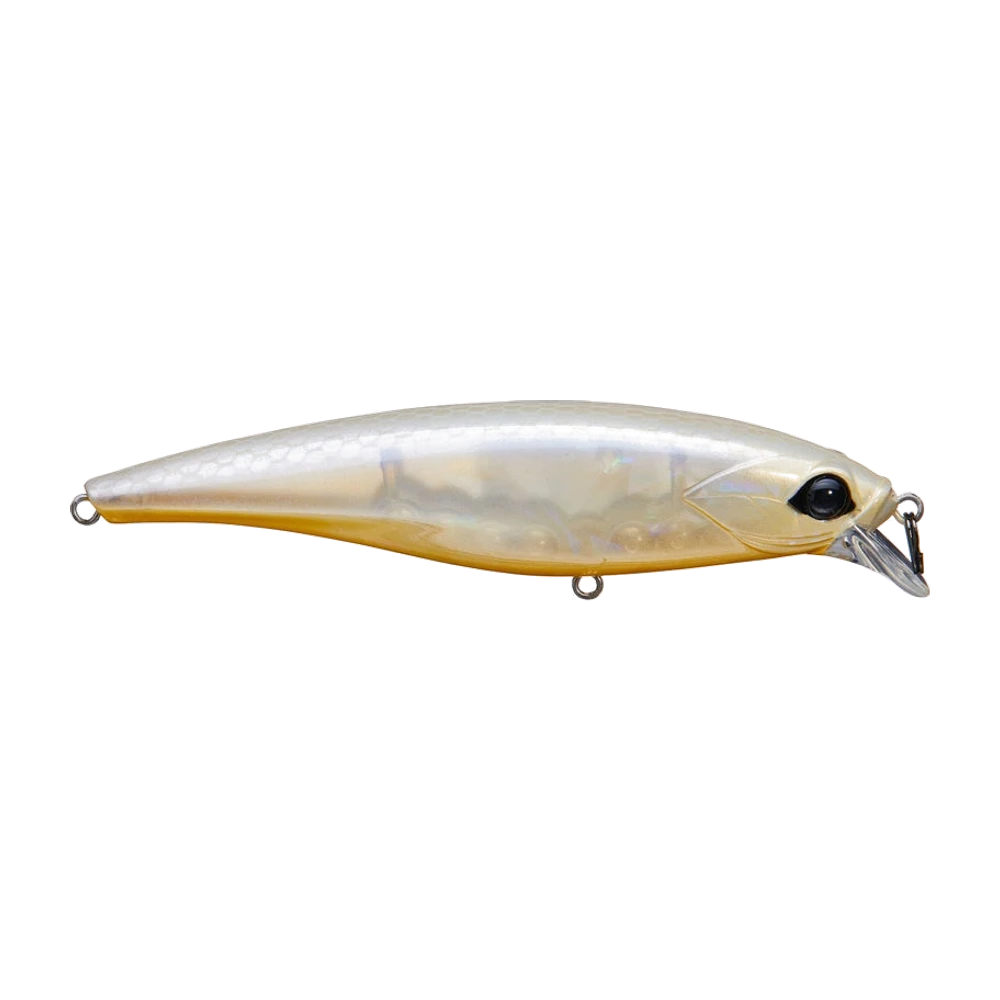
Googan's table has three columns: length, weight, depth. 3.5 in, 3/8 oz, 3 to 5 ft — that is 0.9 to 1.5 m of running depth. That is shallow for a jerkbait, and it fits the short lip visible in the photo: this lure works high in the column, not on deep breaks.
What matters just as much is that there is no buoyancy column. Googan therefore states neither floating, nor suspending, nor sinking. Do not fall back on the habits of the family: most modern jerkbaits suspend, but it is not written here, and the high density noted above argues for caution. The reflex is simple: on the first cast, drop the lure two metres from the bank, leave it alone for five seconds and watch. One look tells you what the table does not, and your whole handling of the pause depends on it.
The balls, and the chamber that holds them
Googan claims a balanced internal rattle system housed in a chamber set in the belly. The maker gives it two jobs: improving casting distance and calling fish from afar.
The second is obvious, a rattle can be heard. The first deserves a qualification. A belly chamber, meaning a fixed one set low, is not a mass-transfer system in which a weight slides back towards the tail on the cast. It mainly improves the stability of the projectile by lowering the centre of gravity, which keeps the lure from tumbling in flight. The gain is real, but it comes from balance, not from a sliding mechanism.
A detail the photo shows well: the body is translucent enough to make out the balls through the flank. It looks good, and more usefully it gives you a visual check that no ball is jammed after a hard knock against a rock.
How to work it
The basic cadence
Rod at 45 degrees pointing down, line slightly slack. Two crisp twitches from the wrist, not the arm, then a pause. The twitches must be short: on 8.9 cm, a big sweep pulls the lure off its path instead of making it dart. Take up the slack on the reel during the next twitch, never during the pause.
Change the pattern, not the force
When the two-twitch, one-pause cadence produces nothing, do not hit harder: change the pattern. Three quick twitches followed by a long pause, or a single twitch followed by a very long pause. On pressured water it is the break in regularity that triggers, not the amplitude.
On a small jerkbait, the length of the pause matters more than the strength of the twitch. Count under your breath. Two seconds when the water is at 18 °C, five to eight seconds when it drops below 10 °C. It will feel like wasted time, and that is exactly when the fish makes up its mind.
The classic mistake
Striking on a slack-line bite. On a jerkbait worked with slack in the line, the bite often shows up as the tension simply disappearing — the lure no longer comes back into place on the next twitch. Many anglers then rip upwards and tear the lure out. The right move is to regain contact on the reel first, then sweep sideways once you feel the weight. With fine trebles and a small body, that is the difference between landing the fish and dropping it halfway in.
Where and when to use it
The Scout 3.5 is made for clear water and small forage. Its two most obvious contexts are late autumn, when the year's fry drop down and predators work them in open water, and tough midsummer days on a busy lake, when nothing answers big profiles any more.
With a 0.9 to 1.5 m running depth, you fish it over flats, above drowned weed, along a dam wall or on a rocky edge. On a five-metre break it is pointless: the fish will not rise three metres for a 9 cm lure.
Googan aims it at bass. In Europe this size class also falls squarely into perch territory, and perch eat exactly this kind of fry late in the season — treat that as a European extension of use, as the maker does not claim it. If the water holds pike, add a suitable leader: a small jerkbait worked high in the column gets bitten off very regularly.
Not sure what to tie on?
Photograph your spot: CarnaFish reads the scene, cross-checks the conditions and gives you the zone, the lure and the retrieve. Free on iOS and Android.
Rigging and hooks
Googan lists black nickel trebles and stresses how sharp they are. The example in the photo is shown bare: you can see the three hook hangers, two on the belly and one at the tail, with no trebles fitted and only a small snap on the nose ring. That is a presentation image, not the delivered state, and you should not read the real hook fit-out from it.
For tackle, a light spinning or casting rod rated 5 to 15 g with a tip that takes the twitches without damping them. Thin fluorocarbon straight through, 0.20 to 0.25 mm, or braid with an 80 cm fluorocarbon leader: on a lure you animate constantly, the stretch of nylon eats part of the stroke. Finish with a loop knot or a small snap to leave the lip free.
Colours by water
- Clear water: the translucent pearl bone of the photo, with an amber belly. Translucency stays credible under hard light, where an opaque flank throws too harsh a reflection.
- Over small shad: a natural silver back, matching the dominant colour of the moment.
- Lightly stained water: a chartreuse flank, which restores detection distance without losing the slim outline that is the whole point of the model.
Against other jerkbaits
The Scout 3.5 is not there to replace a standard jerkbait, it covers the case where that one is too big. A Megabass Vision 110 remains the benchmark in the 11 cm class, at a price and a finish of a different order; a Rapala Husky Jerk covers the middle range with a more buoyant behaviour. Within the same brand, the Googan Darts offers the soft-plastic version of the same idea, for situations calling for another step down in subtlety. And when fish want a continuous swimming action rather than darts, a Rapala Shad Rap does the job better.
The right lure never replaces reading the spot, and that is exactly what CarnaFish makes easier: a photo of the spot, and the AI suggests the zone, the depth and the type of presentation that fit the day's conditions. For the basics on tackle and water, our guide to getting started in bass fishing remains a good way in.
What to remember
- 8.9 cm for 10.6 g: a deliberately dense small jerkbait that casts far where downsized models usually stall.
- Listed depth of 0.9 to 1.5 m: this is a lure for flats and edges, not for deep breaks.
- Googan publishes no buoyancy rating: test the at-rest behaviour on your first cast, because your whole pause management depends on it.
- The belly rattle chamber calls fish and stabilises the lure in flight, but it is not a mass-transfer system.
FAQ
What are the dimensions of the Scout Jerkbait 3.5?
Googan's table lists 3.5 in and 3/8 oz, that is 8.9 cm for about 10.6 g, with a running depth of 3 to 5 ft, which is 0.9 to 1.5 m.
Is this jerkbait floating, suspending or sinking?
Googan does not say: the table has no buoyancy column. Do not assume anything from the family, check it yourself by dropping the lure two metres from the bank on the first cast and leaving it still for five seconds.
Why 10.6 g for only 8.9 cm?
That is above the average density for this size class, and it is what lets such a short lure cast a long way, including into the wind. The likely trade-off is a faster fall on the pause, which you need to build into your cadence.
How long should the pause be?
It depends on water temperature far more than on the fish. Count two seconds in warm water, five to eight seconds below 10 °C. It is the single setting that changes the number of bites most on a jerkbait.
How deep does it run?
Between 0.9 and 1.5 m according to the maker. This is a lure for flats, edges and the tops of weed beds; on a deep break it will show the fish nothing.
Does it come with hooks fitted?
Googan lists black nickel trebles. The photo on this page shows a bare example with its three hook hangers visible and no trebles fitted: that is a presentation image, so do not use it to judge the hooks supplied.
The full bass lure guideSeason-by-season strategy: which family of lure, when, and why.Go from theory to fish
CarnaFish reads your spot from a photo and gives you the game plan: zone, lure, retrieve. Free on iOS and Android.