Strike King KVD 200 Jerkbait: the all-round size that reaches two metres
Rather not fish it blind? Photograph your spot — CarnaFish cross-checks the conditions and points you the right way.
The mid-size jerkbait is the hardest one to pick: too small and it never reaches fish sitting under the warm layer, too big and it turns into a pike bait nothing else wants. The KVD 200 sits right on that ridge, a shade over eleven centimetres with a running range that reaches two metres. It is the size you keep in the box all year, provided you accept the constraint that comes with it: you have to pause, and pause long.
What the maker publishes
The spec table gives four values for this model: a length of four and a half inches, or 11.4 cm, a weight of three eighths of an ounce, or about 10.5 g, a running range of four to seven feet, or 1.20-2.10 m, and a suspending class.
Read the metric figures carefully: they are conversions of round imperial values. Four and a half inches is not exactly 11.4 cm, and three eighths of an ounce works out at 10.63 g — rounding to 10.5 g is a convenience, not a weighing. Think in orders of magnitude, especially if you are comparing this bait with a European model whose specs are metric to begin with.
The published range is wide, 1.20 to 2.10 m, and that is normal: the real depth of a jerkbait depends on line diameter, cast length and how fast you start the retrieve. Thin fluorocarbon and a long cast put you at the bottom of the range; thick braid and a short cast keep you at the top.
Weight transfer, visible through the body
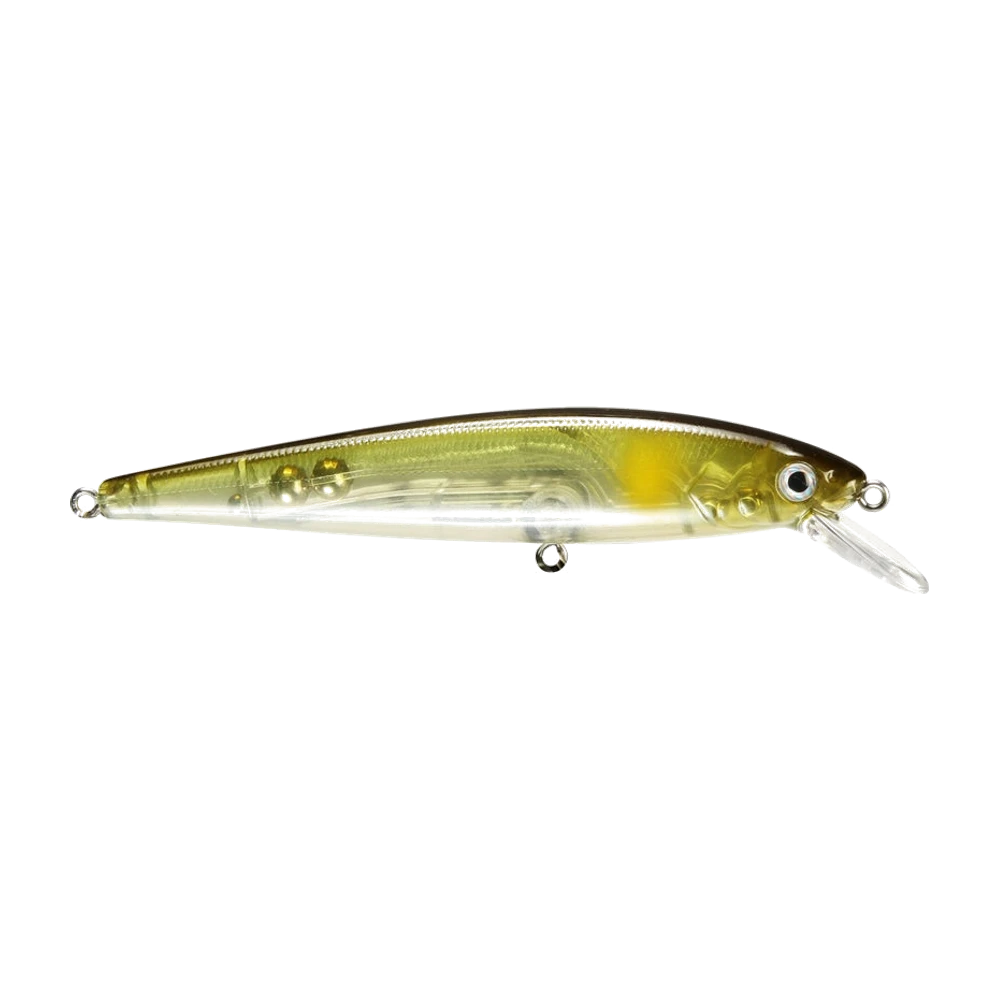
Strike King leads with a weight transfer system said to add a great deal of casting distance. That is the brand's main selling point on this model, and it is worth what selling points are worth. What is interesting is that the translucent finish in the photo lets you see the mechanism: two gold balls sit in the rear third of the body, housed in an internal channel that runs forward. That is an observation on a product photo, not a specification, but it explains the principle without anyone having to take it on trust.
On the cast the balls move back and shift the centre of gravity towards the tail: the bait flies point-first instead of tumbling. As soon as you start the retrieve they roll forward again and the bait recovers its running attitude. The practical consequence is worth knowing: cast and start twitching before taking two or three turns of the handle, and the balls are still back there, so the bait swims badly. That is not a fault, it is the operating instruction.
After every cast, give three firm turns of the handle before the first twitch. It resets the balls and brings the bait down to depth. Anglers who complain that weight-transfer jerkbaits swim poorly have almost always skipped that step.
Working it: two strokes, one pause, and patience
The basic cycle
The maker recommends working this bait on slack line, leaving give between each rod stroke. That is the key to the sideways dart: a tight line turns the stroke into a pull and the bait simply advances instead of breaking out.
Two or three sharp strokes downwards, then a pause. In warm water, one to two seconds. In cold water, five to fifteen seconds without moving. The take comes almost always at a standstill, and it rarely registers as a clear hit: usually you pick up the line and it is heavy. Set sideways rather than upwards, so you do not tear the hook out of a mouth that has only pinched the bait.
The mistake that costs the most fish
Cutting the pauses short. It is counter-intuitive, but the colder the water the more the stillness works. A fish at eight degrees does not chase: it either commits or it does not, and it needs time. Counting under your breath during the pause is a silly trick that works — without it, the five seconds you think you are holding turn out to be two.
Second trap: trying to search water with this bait. The KVD 200 is not a search tool. To cover a large area quickly, a crankbait or a lipless like the Strike King Red Eyed Shad is far more efficient per metre travelled. The jerkbait comes afterwards, on the zones that gave you a sign.
Where this size takes over
Between 1.20 and 2.10 m you are exactly on the band of shoreline drop-offs, bridge pilings, deep weed edges and late-winter flats. It is also where zander often sit in clear water in spring, and an eleven-centimetre jerkbait hanging motionless at their level is a deadly presentation on that fish, far more so than a steady retrieve.
For bass, this size shines mainly from late autumn to the end of winter, when fish are grouped up and reluctant to chase. In summer the smaller, shallower Strike King KVD 100 Jerkbait often becomes the better call again.
On tackle: a baitcasting setup, medium light to medium power, fast action, 1.98 to 2.13 m. Ten and a half grams casts very comfortably on baitcasting gear, which makes this model far easier to throw than its little brother. Straight 0.25-0.30 mm fluorocarbon, or braid with a fluorocarbon leader if you want better detection on pause bites.
What the photo shows, and what the description says
The written description explicitly states two trebles fitted as standard. In the image for this model, the bait is shown bare: the nose tie, the belly hanger and the tail hanger are all three visible and empty, with no hook at all. That is an image observation, not a specification — catalogue photos often show the body alone to display the finish. Check the hooks on arrival anyway, and above all their weight if you plan to swap them: on a suspender, one heavier treble is enough to turn hanging into a slow sink.
Not sure what to tie on?
Photograph your spot: CarnaFish reads the scene, cross-checks the conditions and gives you the zone, the lure and the retrieve. Free on iOS and Android.
Colours by water
- Clear water: the translucent olive-gold finish from the photo, discreet and close to a baitfish seen against the light, with a silver lateral line that catches just enough flash.
- Stained water: a solid white dominant or a firetiger pattern, which keeps a readable outline once visibility drops below a metre.
- Low light, dark water: a plain dark silhouette. Late in the day what registers is the profile cut against the surface light.
Alongside the rest of the range
The KVD 200 sits in the middle of the series: longer and deeper than the 100, more compact and more manageable than the Strike King KVD Jerkbait 300. If you are only going to own one, it is this one, simply because its depth band covers the majority of bank and boat situations.
The right lure never replaces reading the spot, and that is what CarnaFish is for: from a single photo of the swim, it suggests the zone, the depth and the presentation that fit the day. To build your method around the fish rather than the lure, our guide to getting started with zander on lures covers the spots and the activity windows.
Key takeaways
- Published specs: 11.4 cm / 4.5 in, about 10.5 g / 3/8 oz, 1.20-2.10 m / 4-7 ft, suspending — conversions of round imperial units, so orders of magnitude.
- Three turns of the handle after each cast to bring the transfer balls forward, otherwise the bait swims badly.
- Slack-line animation, two or three twitches then a long pause: the take comes at a standstill.
- In the product photo the bait is shown with no trebles, while the description states two fitted as standard.
FAQ
How long should you pause with the KVD 200?
One to two seconds in warm water, five to fifteen seconds in cold water. The further the water drops below ten degrees, the more decisive the long pause becomes: the fish no longer chases, it makes up its mind in front of a motionless bait.
Why does my jerkbait run crooked after the cast?
Most likely because the weight transfer balls are still in the rear position. Give three firm turns of the handle before the first twitch and they roll forward, restoring the bait's running attitude.
Is this jerkbait any good for zander?
Yes, and it is one of its best uses in Europe as soon as the water is clear. Its 1.20-2.10 m band matches the shoreline drop-offs and flats where zander sit in spring, and the stillness on the pause triggers them better than a steady retrieve.
Do you need a wire leader?
Only if the swim holds pike. On a pure bass, perch or zander spot in clear water, 0.25-0.30 mm fluorocarbon stays more discreet and is plenty for a bait this size.
How is it different from the KVD 100?
The 100 is 8.9 cm for 0.60-1.20 m, the 200 is 11.4 cm for 1.20-2.10 m. The 100 is a finesse bait for clear, shallow water, the 200 an all-round size that reaches fish one storey down.
Can you cast it on spinning gear?
Yes, easily — ten and a half grams loads a spinning rod fine. Baitcasting stays preferable for the precision of the rod stroke and for picking slack back up quickly after each twitch, but it is not compulsory.
The full bass lure guideSeason-by-season strategy: which family of lure, when, and why.Go from theory to fish
CarnaFish reads your spot from a photo and gives you the game plan: zone, lure, retrieve. Free on iOS and Android.