Strike King Bitsy Jerkbait: the 6.4 cm micro jerkbait for finesse
Before tying this one on, it helps to know if the spot actually calls for it. CarnaFish reads the scene from a photo.
March, clear cold water, and fish refusing anything longer than four inches. You can see the follows at the side of the boat: they come in behind the jerkbait, escort it for two metres and turn away without opening their mouth. American anglers have a name for that behaviour, it is the downsizing signal. Strike King built the Bitsy Jerkbait for exactly this: a micro-format jerkbait, said to be drawn with the same method as the KVD jerkbaits, but aimed at extreme finesse applications.
Two and a half inches for three and a half grams
The maker's size table gives 2.5 in, so 6.4 cm, for one eighth of an ounce, about 3.5 g. That is very small even for a finesse jerkbait: most so-called compact models sit around eight or nine centimetres. At this size you are no longer imitating a baitfish, you are imitating a fry of the year.
Those three and a half grams change everything around the bait. A 5 to 15 g rod with a soft tip, thin braid, and above all no heavy leader: past 8 lb fluorocarbon, the stiffness of the line chokes the sideways darts and the bait simply tracks straight.
Buoyancy: the description contradicts itself, and it needs saying
Here is the point where you deserve honesty. Strike King's description contains two incompatible statements. In the body text, the bait is presented as having a slow-sinking action. In the size table, the column giving the buoyancy class reads suspending.
Both cannot be true at once. A suspending bait holds its depth when you stop working it; a slow sinker goes down, gently but surely. In practice the two behaviours touch each other: plenty of baits sold as suspending sink slowly in cool fresh water, and a change of hooks is enough to tip a bait from one state into the other.
Our advice: treat it as a near-neutral bait and check its real behaviour on the first cast, close in, counting ten seconds of pause to see whether it drops. Then set the length of your pauses accordingly. That is a thirty second check, and it beats a contradictory specification.
Depth: a column left blank
Same table, different problem. The header announces four columns, length, weight, depth and class, but the Bitsy Jerkbait row carries only three values. The running depth is simply not filled in.
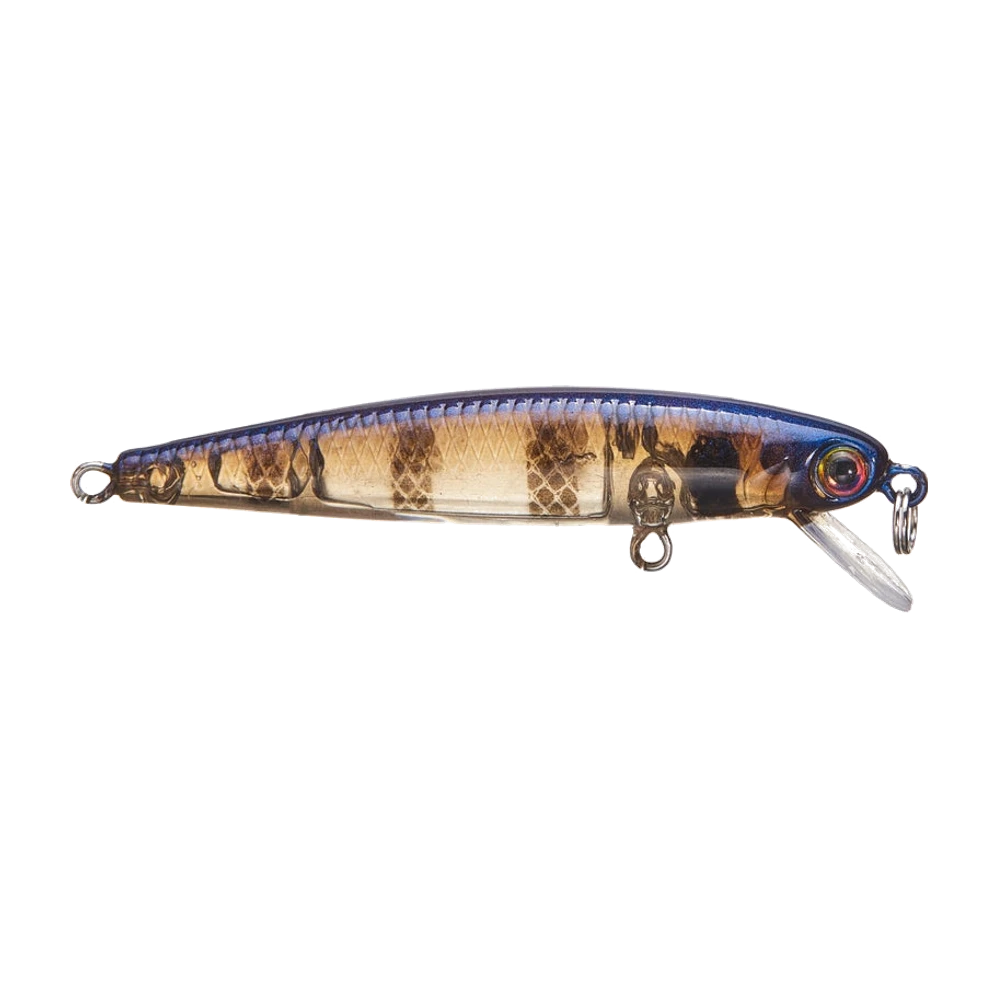
We will not replace it with an invented number. What the photo shows is a short, narrow, angled lip, which generally corresponds to a subsurface swimming depth, but that is an observation on a product photo, not a specification. If exact depth matters to you, it is normally printed on the packaging, and that is where to read it.
With a bait this light, running depth depends as much on your rod angle as on the lip. Rod high, it stays in the top thirty centimetres; rod low and pointed at the bait, it gains half a metre easily. On a micro jerkbait that is a setting in its own right.
Working a three and a half gram jerkbait
The rhythm
Two short sharp wrist jerks, then a pause. That is the base, and on a micro jerkbait the pauses matter more than the jerks. In cold water leave three to five seconds, sometimes more. Each jerk should kick the bait sideways in one crisp snap: if you feel a soft resistance, your stroke is too long.
Keep a small loop of slack between jerks. That slack is what lets the bait pivot on itself instead of being dragged toward you. With this little mass, the slightest permanent tension is enough to cancel the dart.
The classic mistake
Fishing too fast because you feel nothing. Three and a half grams transmits very little to the hand, and the reflex is to speed up to get a sensation back. You need to do the opposite: slow down, lengthen the pauses, and watch the line rather than the rod. On a micro jerkbait, the bite is often seen before it is felt, as a small sideways twitch of the braid and nothing more.
Not sure what to tie on?
Photograph your spot: CarnaFish reads the scene, cross-checks the conditions and gives you the zone, the lure and the retrieve. Free on iOS and Android.
Size 10 trebles and what that implies
Strike King states size 10 trebles in light wire, chosen for fast penetration. That is consistent with the format: a bigger treble would unbalance the bait and weigh down a buoyancy that is already uncertain, as we have seen.
The trade-off is very real. A light-wire size 10 treble opens up on a fish that pulls hard against a tight drag. Fish a light drag, never apply brutal pressure, and use a net rather than swinging fish aboard. Be careful too wherever pike are present: with a six centimetre bait, a pike take never ends well, for the line or for the hooks.
The sample in the photo is in fact bare: a split ring at the nose, two empty belly hangers, no trebles in place. That is an observation on a product photo, not a specification, since the description does state factory-fitted trebles.
Colors by light and water
- Clear cold water: the translucent amber flank mottled in brown of the pictured sample, a discreet rendering that passes light through the way a real fry does.
- Bright light: a metallic blue back, which returns enough flash to be found at distance without shouting.
- Stained water: a dark solid silhouette, because at six centimetres the detail disappears before the shape does as soon as visibility drops.
Where it makes sense, and where it does not
The Bitsy Jerkbait is a bait for one precise situation: clear water, wary fish, tiny forage. It does not replace a Strike King KVD Jerkbait 300 for covering water, and it will never cast as far. It does belong in the same backpack as the Strike King Bitsy Dawg: two answers to the same diagnosis, one on top, one in the middle. In the Japanese register, the Megabass X-70 BFS Jerkbait occupies a neighbouring slot with a higher level of finish.
In Europe this size also interests river trout and margin perch, and the maker itself names trout among the target species. To know when downsizing really is the right answer on a given spot, CarnaFish saves you time: a photo of the bank, and the AI suggests the zone, the depth and the lure type that fit the conditions. Our guide to river trout fishing extends this page nicely into small hard-bait territory.
What to remember
- 6.4 cm for about 3.5 g: a micro format that demands a light outfit and a fine leader.
- The description contradicts itself on buoyancy, slow sinking in the text and suspending in the table: check the real behaviour on the first cast.
- The running depth is not filled in on the size table, and we are not inventing it.
- Light-wire size 10 trebles: effective and fragile at once, so fish a light drag and use a net.
FAQ
Is the Bitsy Jerkbait suspending or sinking?
The manufacturer's description says both: the text speaks of a slow-sinking action, the size table lists it as suspending. The two statements are incompatible, so treat it as a near-neutral bait and check its real behaviour close in on your first cast.
How deep does it run?
Strike King does not say: the depth column of its table was left blank. The lip visible in the photo is short, which points to a subsurface runner, but that is an observation on a photo, not a specification. Read the packaging if that criterion matters to you.
What tackle suits a 3.5 g jerkbait?
A light rod rated 5 to 15 g with a soft tip, thin braid and a 6 to 8 lb fluorocarbon leader. Heavier line stiffens the connection and stops the bait darting sideways.
Should I change the stock trebles?
Not for bigger ones: a heavier treble would alter the balance of a 3.5 g bait. If you do replace them, stay at size 10 in light wire and offset their fragility with a light drag setting.
Is it any good for trout?
Yes, Strike King explicitly names trout among the target species, and the size matches what a river trout feeds on. In Europe it also interests margin perch in summer and early autumn.
Why does my Bitsy Jerkbait track straight?
Two usual causes: a leader that is too heavy, or a line held tight between jerks. Drop to 6 or 8 lb and leave a small loop of slack before each wrist snap, and the dart comes straight back.
The full bass lure guideSeason-by-season strategy: which family of lure, when, and why.Go from theory to fish
CarnaFish reads your spot from a photo and gives you the game plan: zone, lure, retrieve. Free on iOS and Android.