Googan Scuddle Bug: the pre-rigged craw that flees backwards
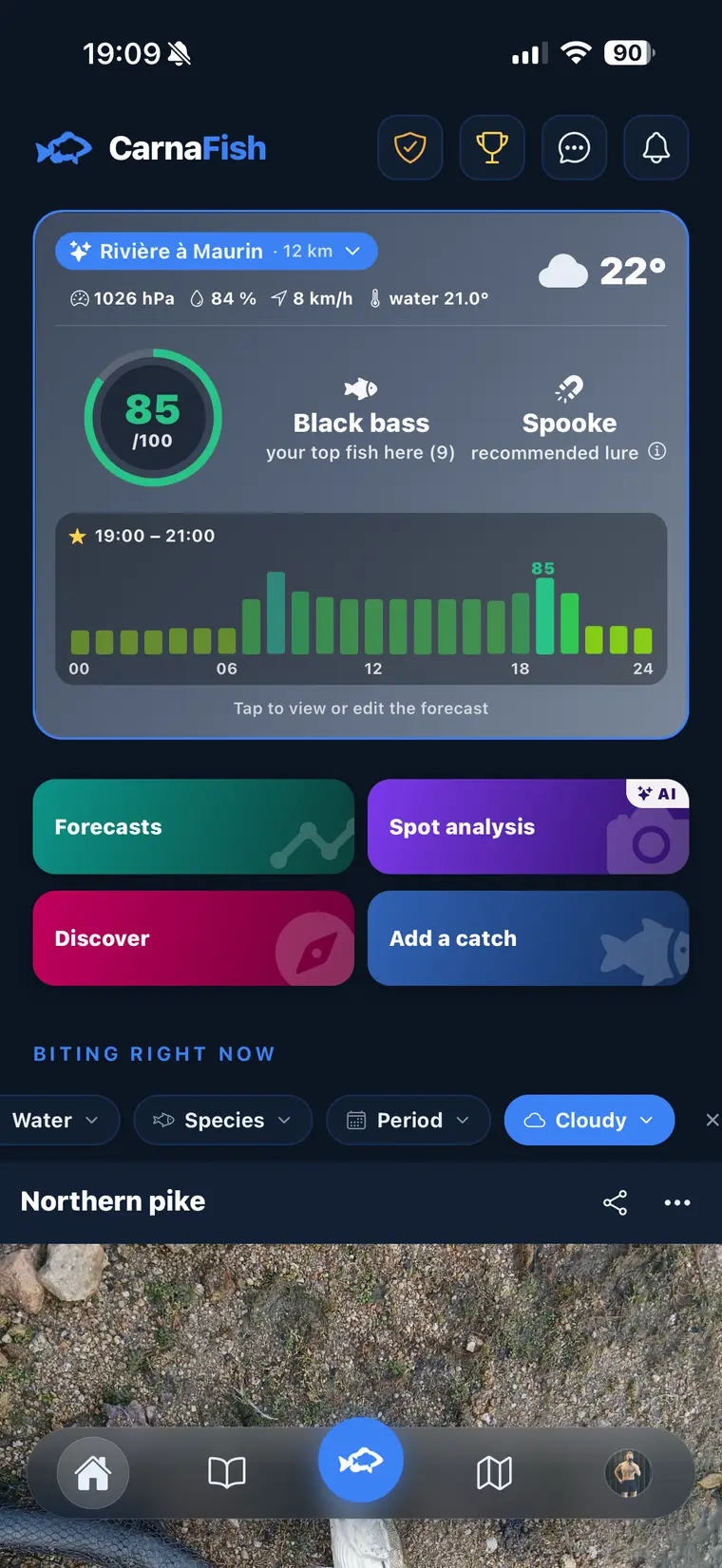
Not sure this lure fits YOUR spot today? CarnaFish tells you in 10 seconds, from a photo.
Late summer, the water is low and warm, bass are pinned to the rip-rap and nothing will come up for a topwater. You slow down, you go deeper, and you eventually notice that the only prey still moving on those rocks is crawfish. The Googan Scuddle Bug is built for exactly that moment: a lure that doesn't swim, doesn't shimmy, and simply bolts backwards like a crawfish that just saw a shadow go past.
A flight, not a swim
Googan built this whole bait around one single movement: the startled crawfish folding its body and jetting backwards with a flick of its abdomen. A shad or a creature bait tells the story of prey moving forward; the Scuddle Bug tells the story of prey retreating, and a bass has never seen a crawfish back off for no reason. The signal isn't "food is going by", it's "food is getting away", and that doesn't trigger the same response.
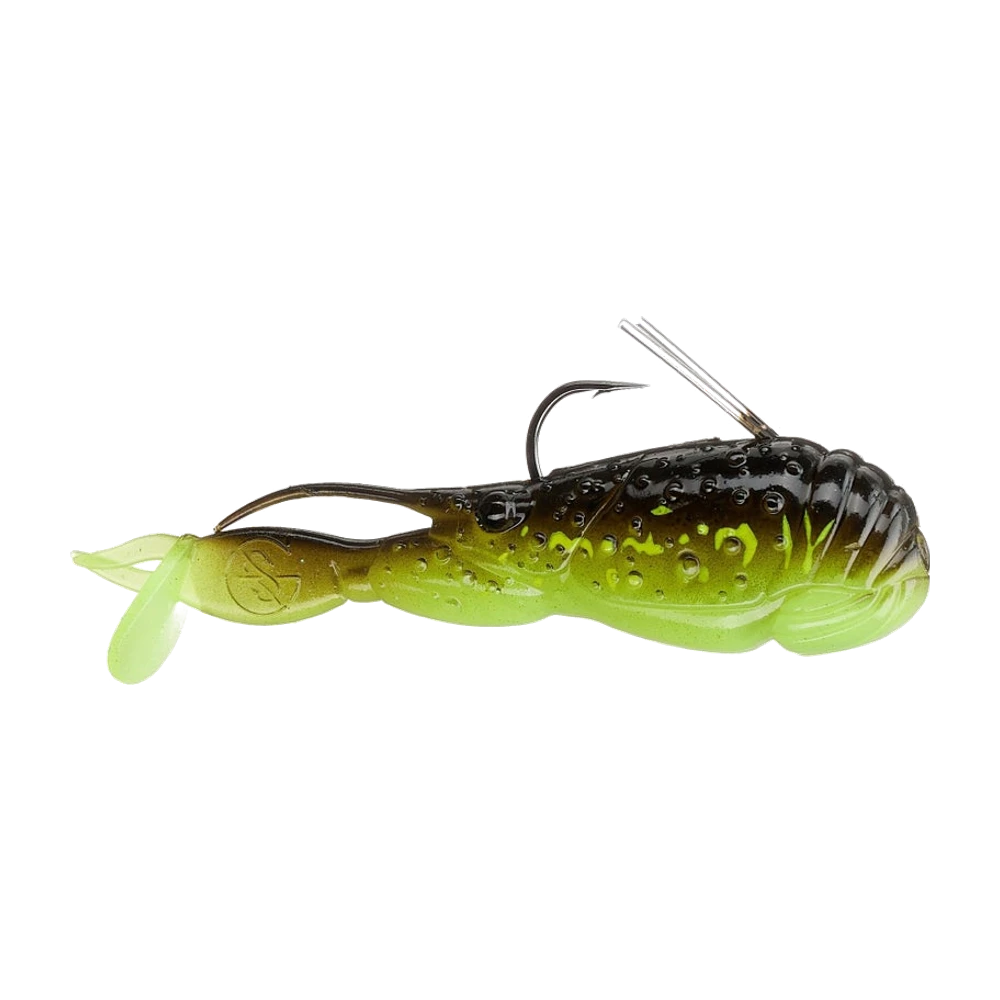
The body is ribbed end to end and the mould pushes detail down to fine anatomical features, which is exactly what the brand claims. On the photographed sample you can make out the carapace segments, the side legs, two very thin antennae and a tail fan split into two lobes. Appendages that fine move on their own at the slightest turbulence, including when the bait is sitting still on the bottom.
The maker's spec table lists the 4 inch model as Sinking. That's no surprise given the internal weight, but it is worth knowing before you buy: the Scuddle Bug will never hang suspended in the water column and no floating version appears in the stated line-up. It works on the bottom, and that's all it does.
A heavy bait, and you have to take that seriously
This is where you get caught out if you skip the numbers. The copy talks about a compact package, which suggests a small, discreet bait; the table gives two weights for a lure just 10.2 cm / 4 in long: 3/8 oz of internal weight, or 10.6 g, and a stated total of 9/10 oz, around 25.5 g. The two statements pull in opposite directions, and the table is what counts. This bait is compact in volume, not in mass.
One caveat on that second figure. The fraction 9/10 oz barely exists in tackle manufacturers' weight grids, which work in 3/4, 7/8 or 1 oz. Treat those 25.5 g as an order of magnitude rather than a gram-accurate weighing. The practical conclusion doesn't change: this is a lure in the twenty-gram-plus bracket.
In practice that calls for a medium-heavy to heavy rod and braid. It also means a fast, near-vertical drop, so you can reach a fish holding under a dock or at the foot of a break without waiting ten seconds for the bait to arrive. And it means permanent bottom contact: you feel every rock and every change of substrate, which is fishing information in its own right.
The weight isn't a design flaw, it's the engine of the action. It's what folds the body on the hop and what brings the bait back down flat, abdomen first. A lighter version would produce a vaguer movement, and therefore a less convincing one.
Working it: one sharp pull, then nothing
The natural temptation with a heavy bait is to reel it steadily so you can feel something. That's exactly what you must not do here. The Scuddle Bug produces nothing worthwhile on a straight retrieve: it just drags, and you lose its only asset.
The rhythm that works
Cast, let it drop to contact, and wait two seconds doing nothing. Then give one short, sharp pull of twenty to thirty centimetres, no more. The bait jumps backwards, the antennae and tail fan whip, and it settles back down flat in two or three seconds. Wait again, then repeat. The usual ratio is one second of action for four or five seconds of stillness - and the bite comes during the stillness, because that's when the bass makes up its mind.
Keep a slight tension in the line on the drop: a craw bite usually registers as nothing more than weight, or line drifting off sideways, never as a sharp knock in the rod.
The classic mistake
Setting the hook too early. A bass inhales a crawfish then turns it in its mouth to swallow it head first, and that turn takes a second or two. Strike on contact and you pull the bait out before the hook is in position. Let it go, tighten gently until you feel the fish's weight, then sweep sideways rather than lifting vertically.
Where and when to use it
Anywhere crawfish live, which means hard bottom: rip-rap, rock slides, gravel flats, dam concrete, dock pilings. Pure mud is pointless here - crawfish don't live in it and the bait buries itself.
Season matters as much as cover. Spring, when bass are feeding hard to put weight on, is the obvious window. Late summer on low water is a second, less obvious one: fish bury themselves in hard cover and refuse anything crossing mid-water, but will still take a prey item on the deck. In winter it stays effective provided you double your pause times.
Not sure what to tie on?
Photograph your spot: CarnaFish reads the scene, cross-checks the conditions and gives you the zone, the lure and the retrieve. Free on iOS and Android.
Factory rigging: what it saves you, what it takes away
The Scuddle Bug arrives ready to fish. It carries a 3/0 BKK hook, a built-in weed guard - the two fine strands visible in the photo, protecting the point - and a line-through system that runs the line through the body. You tie on and you fish, with no jighead to choose and no Texas hook to seat straight.
That line-through rigging has a real benefit: during the fight, the soft body doesn't absorb every head shake, because the connection runs through the line rather than through the plastic alone. Conventional soft craws tend to tear after two or three fish; here a body lasts noticeably longer.
The trade-off is that you lose adjustment. With a bare Strike King Rage Craw or Savage Gear Ned Craw you pick your weight to the gram depending on depth and wind. Here the weight is fixed: if 25 g is too much for a five-foot pond, there's no way to lighten it. That's what makes the Scuddle Bug a situational bait rather than a universal one.
Colour by water clarity
The manufacturer doesn't publish a detailed colour chart, but the useful tone families on a craw are always the same and the logic doesn't change from brand to brand.
- Clear water: green pumpkin, brown and subdued olive tones, matching the real colour of a crawfish outside its moult.
- Lightly stained water: the scheme photographed here, dark olive back speckled with black over a chartreuse belly, which keeps a natural base while adding a marker visible from underneath.
- Dirty water or low light: black and blue, a clean silhouette that reads when colour no longer does.
Picking the right lure never replaces reading the spot, and that's exactly what CarnaFish makes easier: a photo of the spot, and the app suggests the zone, the depth and the type of presentation suited to the day's conditions - enough to tell whether the bottom in front of you really justifies a craw. To build your tackle and spot-reading fundamentals, our beginner's guide to bass fishing is a good starting point.
Key takeaways
- The Scuddle Bug imitates a crawfish fleeing backwards, not prey swimming past: work it with short hops followed by long pauses.
- The table states 10.6 g / 3/8 oz of internal weight and around 25.5 g / 9/10 oz total for 10.2 cm / 4 in: a heavy bait despite its compact volume, for a medium-heavy rod at minimum.
- It comes factory-rigged on a 3/0 BKK hook with a built-in weed guard and line-through body, which simplifies everything but rules out any weight adjustment.
- The maker lists it as sinking, and it is a bottom bait on hard cover only.
FAQ
Do I need to add a jighead to the Scuddle Bug?
No, and that's the whole point of the product. The weight is internal, the 3/0 BKK hook is already in place and the weed guard is built in. You tie your line direct and fish.
What rod and reel suit this bait?
A medium-heavy to heavy casting rod with braid, given the stated weight of roughly 25 g. A finesse or ned rig rod is far too light to cast this lure properly and will tire quickly.
Why won't my Scuddle Bug lift off the bottom on the hop?
Most likely because the pull is too soft or too long. It takes a short, crisp twenty-to-thirty-centimetre move from the wrist to make the body fold. A wide sweep only drags the bait along the bottom.
Is it good for anything other than bass?
The maker presents it as a bass bait and its bottom-crawling craw profile backs that up. Nothing stops another bottom-feeding predator taking an interest, but that isn't the intended use and there's no data to claim it.
How many fish does one body survive?
Noticeably more than a Texas-rigged soft craw, thanks to the line running through the body and absorbing the pull instead of the plastic. Still check the antennae and tail fan after each fish.
How does it differ from a creature bait like the Trench Hawg?
The Googan Trench Hawg is a big bare 6 inch creature bait you rig yourself, which flutters and displaces water on the drop. The Scuddle Bug is shorter, pre-rigged, factory weighted, and relies on one precise backwards escape move rather than on bulk and vibration.
The full bass lure guideSeason-by-season strategy: which family of lure, when, and why.Go from theory to fish
CarnaFish reads your spot from a photo and gives you the game plan: zone, lure, retrieve. Free on iOS and Android.