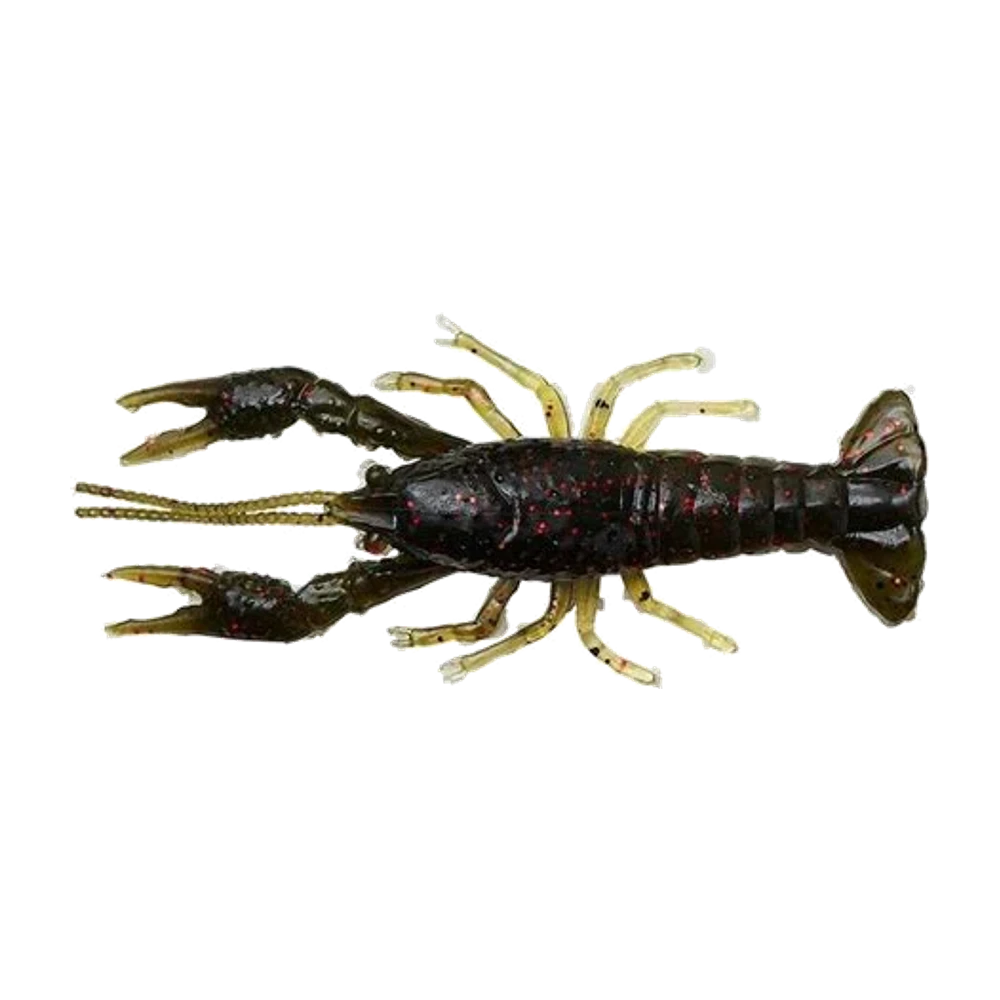
Savage Gear Ned Craw: the crawfish on guard on a Ned head
Before tying this one on, it helps to know if the spot actually calls for it. CarnaFish reads the scene from a photo.
A crawfish that senses a predator coming does not bolt straight away. It turns, braces on the bottom, and raises its claws. That is a defensive posture, and it is also a signal predators read perfectly well: this animal is on the defensive, so it is cornered.
Most craw lures only reproduce the escape — the appendages beating on the fall or on the pull. The moment you stop working them, they flatten out on the bottom and stop telling any story at all.
The Ned Craw is built for the other half of the scenario. On a Ned head, the body floats and lifts the claws upwards for the whole of the pause. You can leave it thirty seconds without touching it: it stays on guard, and the claws keep moving on the slightest stir of water.
The floating body is what makes the posture
If you have never rigged a Ned rig, start with our guide to the Ned rig: the principle of the weighted head with a single hook and the stubby body is covered there. What interests us here is what a craw profile changes about that rig.
Body buoyancy does everything. The plastic of the Ned Craw is formulated to float, and the weighted Ned head is the only ballast. The result is a lure that settles on its nose, body raised, back end in the air. On a straight worm profile, that gives a stick pointing at the surface. On a craw profile, it gives exactly the defensive posture — claws up, body braced.
The claws are thin and flat. They are not there to create vibration on the pull, unlike a jig craw with big flappers. They are there to pick up the slightest movement of water during the pause. A bottom current of a few centimetres per second is enough to set them oscillating.
The volume stays small. This is a finesse approach, not a power approach. The Ned Craw is not meant to displace much water or call from a distance: it is made to be dropped in front of a fish you already know is there.
The retrieve: the shortest possible move
The whole exercise consists of moving the lure thirty centimetres at a time, no more, then leaving it alone.
- Cast and let it sink on a free line until it touches bottom. Count the seconds to gauge the depth.
- Take up the slack gently without moving the lure, rod at ten o'clock.
- Wait ten to thirty seconds doing nothing. This is the guard phase: the lure is standing up, the claws are working.
- Pull it twenty to forty centimetres by lowering the rod slowly, with no jerk. The lure slides along the bottom, lies down, and stands back up as it stops.
- Take up the slack and start again. On a precise spot you can run ten cycles over three metres of ground.
- Set the hook with a sideways pull, with no violent vertical snap: the single hook penetrates on its own.
On the water: on a craw Ned rig, the fish almost always takes during the stillness, and the bite shows as line moving off to one side, not as a knock. Watch your line rather than your rod. If you wait to feel a tug, you will miss half your bites in cold water.
Choosing the head
This is the only real adjustment on the rig, and it governs everything.
| Depth / current | Ned head | Line |
|---|---|---|
| 1 to 2 m, calm water | 1.8 to 2.5 g | 0.16-0.18 mm fluoro |
| 2 to 4 m | 2.5 to 3.5 g | 0.18-0.20 mm fluoro |
| 4 to 8 m or light current | 3.5 to 5 g | Fine braid + 0.20 mm fluoro leader |
| River with marked current | 5 g and up | Braid + 0.22 mm leader |
One simple principle guides the choice: take the lightest head that still lets you feel the bottom. Too heavy and the lure sinks into the silt and loses its posture; too light and you no longer know where it is and move it without realising.
Where it excels, and where it misses the point
The Ned Craw is a lure for hard bottom and for difficult days.
- Gravel, rock and shell bottom, where crawfish actually live and where the lure sits on top instead of sinking in.
- Drop-offs and the tops of flats in late summer and autumn, on bass that have moved down.
- Blank days, after a crankbait or a spinnerbait has been refused: it is a fallback lure that saves sessions.
- Big solitary perch on hard reservoir bottom, where a craw profile goes down better than a shad.
It is, on the other hand, thoroughly unsuited to deep muddy bottom: the lure sinks in, the claws disappear into the silt, and the guard posture no longer exists. It is also unusable in dense timber despite the single hook, because the Ned head stays exposed. Finally, it is not a searching lure: with thirty-second cycles, you cover a few dozen square metres an hour. If you are still looking for the fish, this is not the moment to tie it on.
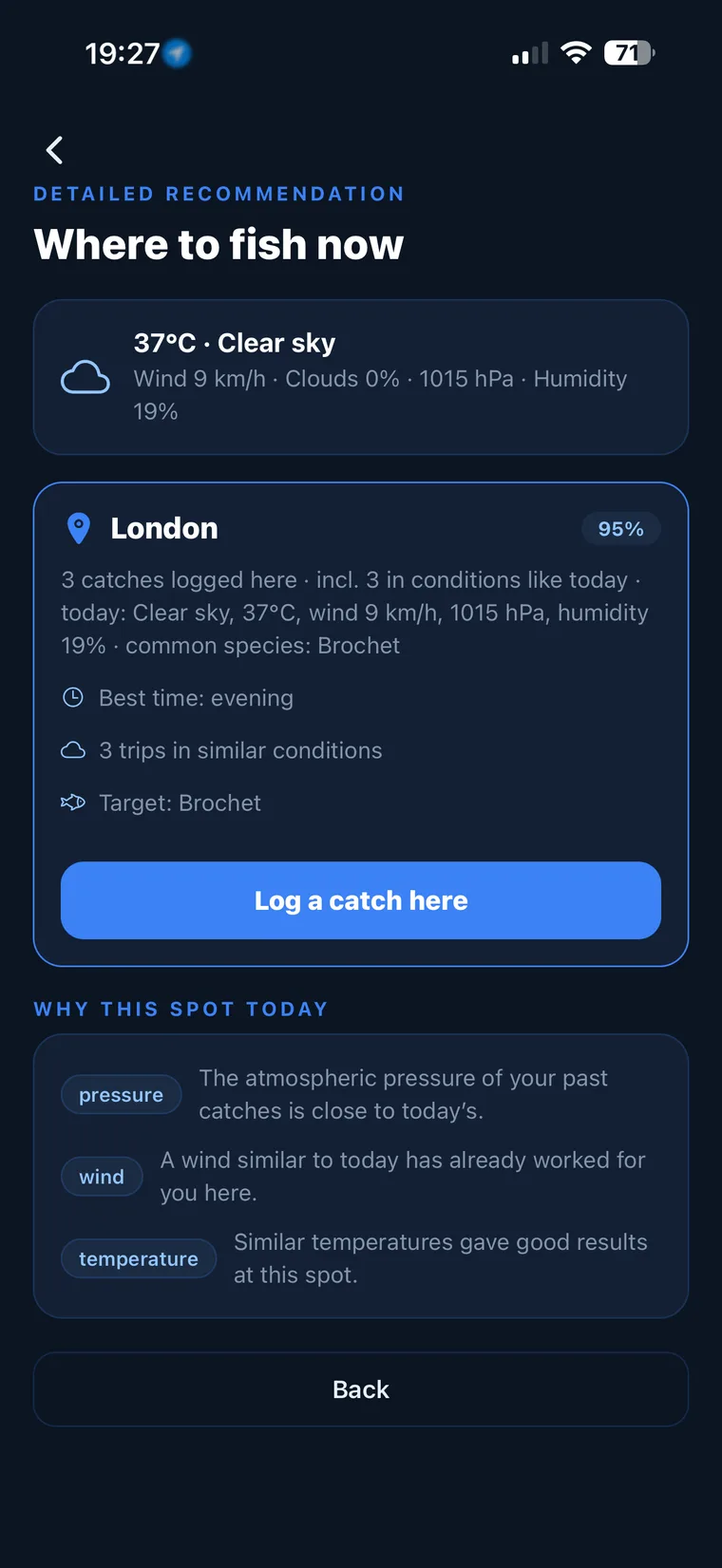
Not sure what to tie on?
Photograph your spot: CarnaFish reads the scene, cross-checks the conditions and gives you the zone, the lure and the retrieve. Free on iOS and Android.
Ned Craw or TRD CrawZ
These two lures share the same rig and the same slot, and the comparison is worth getting right. The Z-Man TRD CrawZ is moulded in a very tough, particularly buoyant elastomer, with shorter, thicker claws. It holds its position extremely well, takes a lot of fish without tearing, and its thick body gives a compact silhouette.
The Ned Craw plays a slightly different tune: longer, finer claws, so more reactive to the least stir of water, and a more detailed overall profile. The trade-off is the usual one — more movement, less durability. On very clear water and wary fish, that extra finesse makes the difference. On a high-volume day when you are catching perch one after another, the TRD holds up better.
If you want a far more demonstrative craw profile on an entirely different rig, the Keitech Crazy Flapper fishes Texas-rigged or as a jig trailer, with appendages that beat actively on the fall: that is the power approach, where the Ned Craw is the finesse one.
Our beginner's guide to bass fishing places the Ned rig among the other finesse rigs. And if you are unsure what the bottom is made of before choosing between these two logics, CarnaFish analyses a photo of the spot and answers.
Rigging details that matter
Thread the body perfectly straight onto the hook shank. A twisted lure spins on the pull and lies down instead of standing up: the whole posture is lost.
A drop of glue on the collar of the head stops the body sliding back on every bite. Over a session of several hours, that saves you twenty re-rigs.
Point the claws upwards when you rig it, not to the side. It sounds obvious put like that, and it is the commonest mistake with this lure.
Key takeaways
- The body floats and the Ned head weights the front: the lure stands up, claws raised, at rest.
- The guard posture during the stillness is the real argument, not the action on the pull.
- Moves of twenty to forty centimetres, then ten to thirty seconds of doing nothing.
- Take the lightest head that still lets you feel the bottom.
- Ineffective over deep mud, in timber, and for covering water fast.
FAQ
Does the Ned Craw only go on a Ned head?
That is its reference rig, because it exploits the buoyancy of the body to raise the claws. It also works as a trailer on a small jig or a compact chatterbait, but you then lose the upright posture that makes it what it is.
What head weight should I choose?
1.8 to 2.5 g down to two metres, 2.5 to 3.5 g down to four metres, and 3.5 to 5 g beyond that or in current. The rule is to take the lightest one that still lets you feel the bottom.
How do I detect the bite on this rig?
By watching the line rather than the rod. The fish takes during the stillness and the bite usually shows as line moving off sideways, with no perceptible tug, especially in cold water.
Does the Ned Craw work for perch?
Yes, particularly on big solitary perch sitting on hard bottom. In the 5 cm size with a 2 to 3 g head, it is an excellent fallback when shads and blades are being refused.
Should I glue the body to the head?
It is strongly recommended. A drop of superglue on the collar stops the body sliding back on every bite and saves you re-rigging it every ten minutes.
What is the difference with a classic jig craw?
A jig craw relies on volume and on appendages beating actively during the fall and the pull. The Ned Craw relies on a motionless posture and fine claws that react to the slightest current: it is a finesse approach, for wary fish.
The full bass lure guideSeason-by-season strategy: which family of lure, when, and why.Go from theory to fish
CarnaFish reads your spot from a photo and gives you the game plan: zone, lure, retrieve. Free on iOS and Android.