Googan Trench Hawg: the 6 inch creature bait built for big bass
Not sure this lure fits YOUR spot today? CarnaFish tells you in 10 seconds, from a photo.
A fallen tree in two metres of water, branches everywhere, and something that moved in the shade when you eased the boat in. You know there's a fish in there, and you also know a small bait will either be ignored or eaten by the first twelve-inch bass that sees it. That's exactly the situation Googan drew the Trench Hawg for: a creature bait big enough to put off the small fish and loud enough to get noticed in cover where visibility is measured in centimetres.
Six inches of deliberate bulk
Googan presents the Trench Hawg as the bigger brother of the Bandito Bug Craw, and the family resemblance is obvious at a glance. Same stocky creature-bait logic, on another scale: six inches, or 15.2 cm. At that size you're no longer dealing with a numbers bait but with a selective one, the lure you reach for when you want a particular fish rather than a lot of fish.
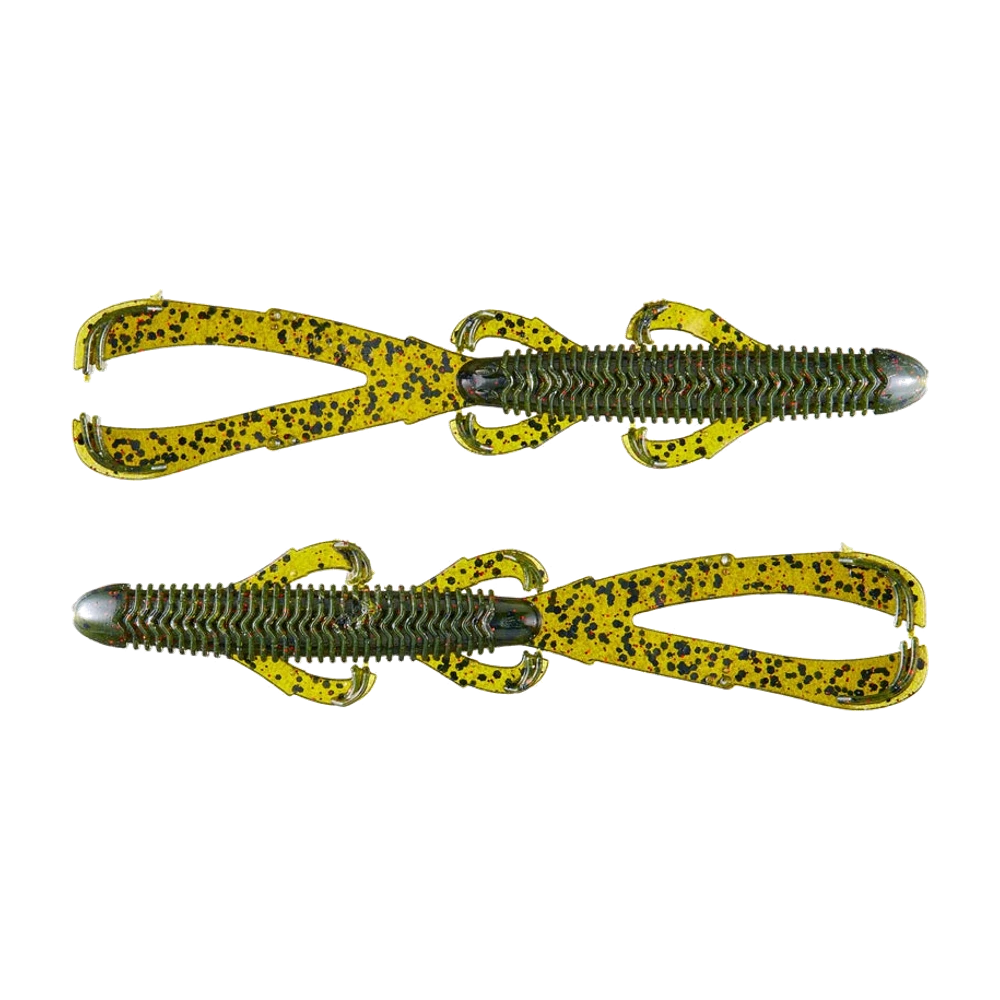
Three features do the work in the water. First a fully ribbed body from end to end: every rib grabs water and creates micro-turbulence that slows the drop and sends signal out sideways. Then extra-long claws, flat and tipped with a curl - in the product photo they easily account for half the overall length. And finally multiple side legs, short and spread along the body.
The maker's stated result is an exaggerated action and heavy vibration. That's the kind of marketing line you'd normally take with a pinch of salt, but the geometry here makes it credible: appendages that wide and that long cannot drop without flapping. The Trench Hawg is not a subtle bait, and subtlety isn't what you're asking of it.
What the manufacturer doesn't tell you: the weight
This point matters, because it changes how you buy. Googan publishes no spec table for the Trench Hawg: no per-bait weight, no sinking or floating class, no count per pack. The only official figure is the six inch length.
So don't believe anyone who tells you this bait sinks slowly or hangs mid-water: the manufacturer simply doesn't state it. In practice that's not a problem, because a creature bait this size is always fished weighted. It's the sinker you pick, not the bait, that sets the drop rate and the working depth. But it does mean trying two or three weights to find the right one rather than relying on a spec sheet.
Bait volume and sinker weight are two independent settings, and that's a valuable freedom. A Trench Hawg on 7 g / 1/4 oz glides down and lets the claws work for a good five seconds; the same bait on 21 g / 3/4 oz drops like a stone and only works on the way back up. Both catch fish, but not on the same days.
Three ways to fish it
Flipping and pitching on a weighted Texas rig
This is the main use, and the maker says so itself. A 4/0 or 5/0 wide gap hook, a 10 to 21 g bullet weight pegged against the bait, and you drop it vertically into every hole in the cover. The bait falls, the claws flap, and you watch your line: nine bites in ten come on the drop, not after. If it reaches bottom untouched, two small hops on the spot, then out and on to the next hole.
As a jig trailer
The other use the brand recommends. Behind a flipping jig, the Trench Hawg adds bulk to the silhouette and its claws give the jig a drop signature it doesn't have on its own. Watch the proportions: behind a jig that already carries a full silicone skirt, a 15 cm trailer makes a huge package. Plenty of anglers trim a centimetre or two off the front of the body to bring it back to scale, which takes nothing away from the claws.
Unweighted Texas along the bank
Rarer, but effective on shallow, cluttered edges. With no sinker the drop becomes very slow and the appendages have all the time they need. Keep it for calm days: as soon as the wind gets up you lose contact and stop feeling anything.
The classic mistake
Setting the hook on first contact. With a bait this long, a bass often grabs the back end, a claw, and needs two or three seconds to work up to the body where the hook sits. An instant strike earns you a torn-off claw and nothing else. Let the fish load up, tighten, then set hard - it takes real power to drive a hook through fifteen centimetres of plastic.
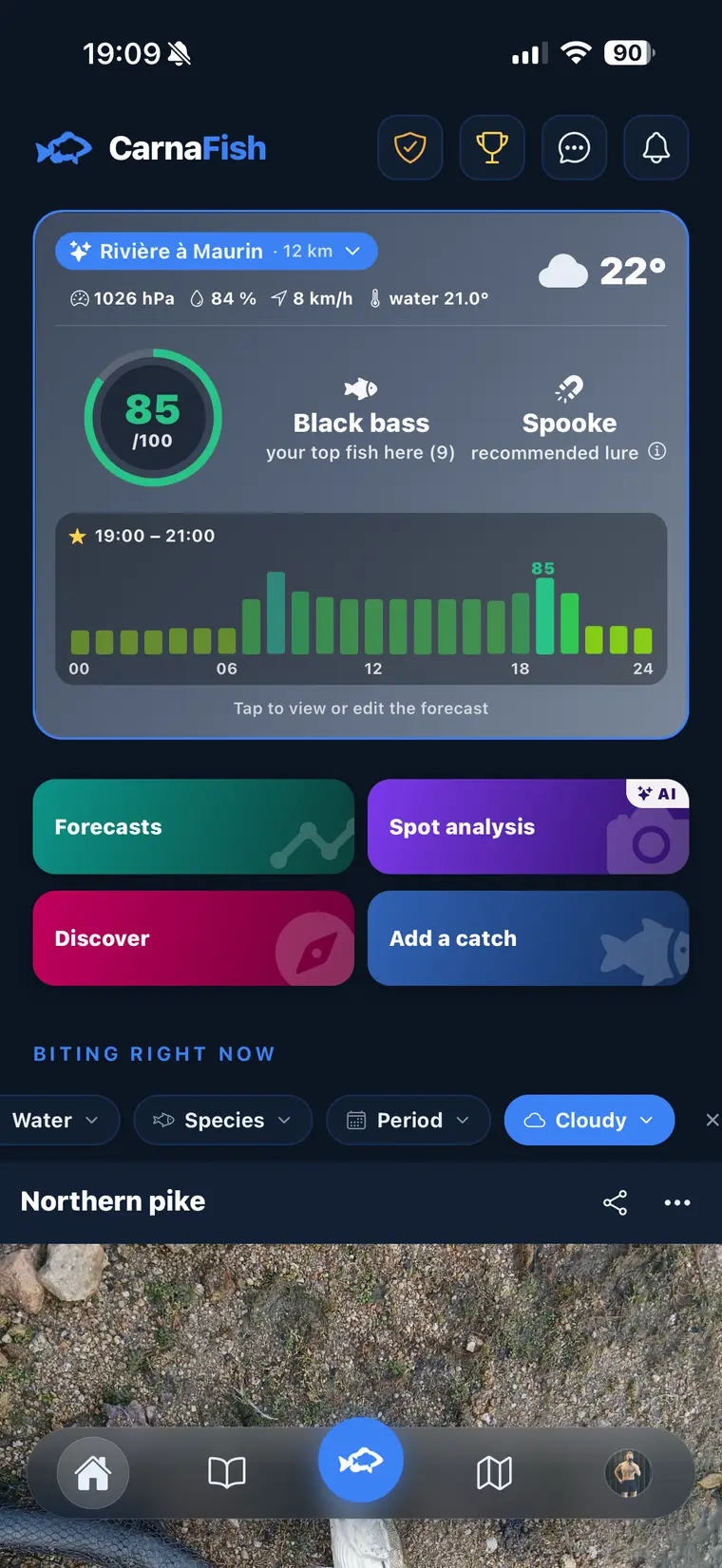
Not sure what to tie on?
Photograph your spot: CarnaFish reads the scene, cross-checks the conditions and gives you the zone, the lure and the retrieve. Free on iOS and Android.
Where and when to use it
Heavy cover is its ground: flooded timber, stumps, thick weed, lily pad edges, under docks. Anywhere you can't throw a treble-hooked lure without writing off your afternoon. The bulk has a mechanical advantage here on top of the visual one: a thick bait hangs up on branches instead of slipping between them, which gives you time to shake it free cleanly.
Seasonally the obvious window is late spring and summer, when fish are settled in cover and crawfish and larger bottom forage are active. In cold water a 15 cm creature bait becomes hard to sell, and a slimmer profile works better.
One last claim from the manufacturer: the bait is loaded with an in-house attractant called Slaunch Sauce, said to make fish hold on longer after the bite. That's a brand claim, impossible to verify on the water without a serious side-by-side - read it as such, not as a specification.
Colour by water clarity
Googan doesn't publish a detailed colour chart, but the useful tone families on a creature bait are stable from brand to brand.
- Clear water: green pumpkin and muted browns, the crawfish and small-perch tones that don't overplay anything.
- Lightly stained water: the colour photographed here, yellow-green with black and orange flake, which keeps a natural base while staying visible at a metre.
- Dirty water or fishing in shade: black and blue, the silhouette that works when colour has no role left.
The right lure never replaces reading the spot, and that's exactly what CarnaFish makes easier: a photo of the spot, and the app suggests the zone, the depth and the type of presentation suited to the day's conditions - enough to tell whether the cover in front of you really deserves a bait this size. To cover the basics, our beginner's guide to bass fishing walks through tackle and the spots worth targeting.
Key takeaways
- 15.2 cm / 6 in of ribbed creature bait with oversized claws: a selective bait, not a numbers bait.
- The manufacturer publishes neither a weight nor a sinking or floating class: the sinker you add drives everything.
- Flipping on a weighted Texas rig and jig trailer duty are the two uses the brand recommends; the drop is the key moment.
- Delay the hookset and set hard, or you bring back a torn claw.
FAQ
What sinker weight should I use with the Trench Hawg?
Between 10 and 21 g / 3/8 to 3/4 oz for flipping heavy cover, less if you want a slow drop in shallow water. The maker gives no weight for the bait itself, so the whole adjustment happens at the sinker, by trial.
Does the Trench Hawg sink or float?
There's no way to state it: no manufacturer spec table lists a sinking or floating class for this model. It's fished weighted anyway, and the sinker is what dictates its behaviour.
What hook size suits a 6 inch bait?
A 4/0 or 5/0 wide gap Texas hook. Anything smaller doesn't leave enough gap to drive through the thickness of the body on the hookset, and you drop fish.
Is it a beginner's bait?
Not really. It calls for a powerful rod, a firm hookset and a good read of the cover. A shorter Bandito Bug Craw is easier to make work and far more forgiving of rhythm mistakes.
Can it be trimmed?
Yes, and plenty of anglers do when rigging it as a jig trailer. You cut a centimetre or two off the front of the body: the claws and side legs, which do all the work, stay untouched.
How does it differ from the Scuddle Bug from the same brand?
The Googan Scuddle Bug is shorter, factory rigged, weighted from the start and built around a backwards escape move. The Trench Hawg is sold bare, twice as long, and relies on bulk and the vibration of its appendages on the drop.
The full bass lure guideSeason-by-season strategy: which family of lure, when, and why.Go from theory to fish
CarnaFish reads your spot from a photo and gives you the game plan: zone, lure, retrieve. Free on iOS and Android.