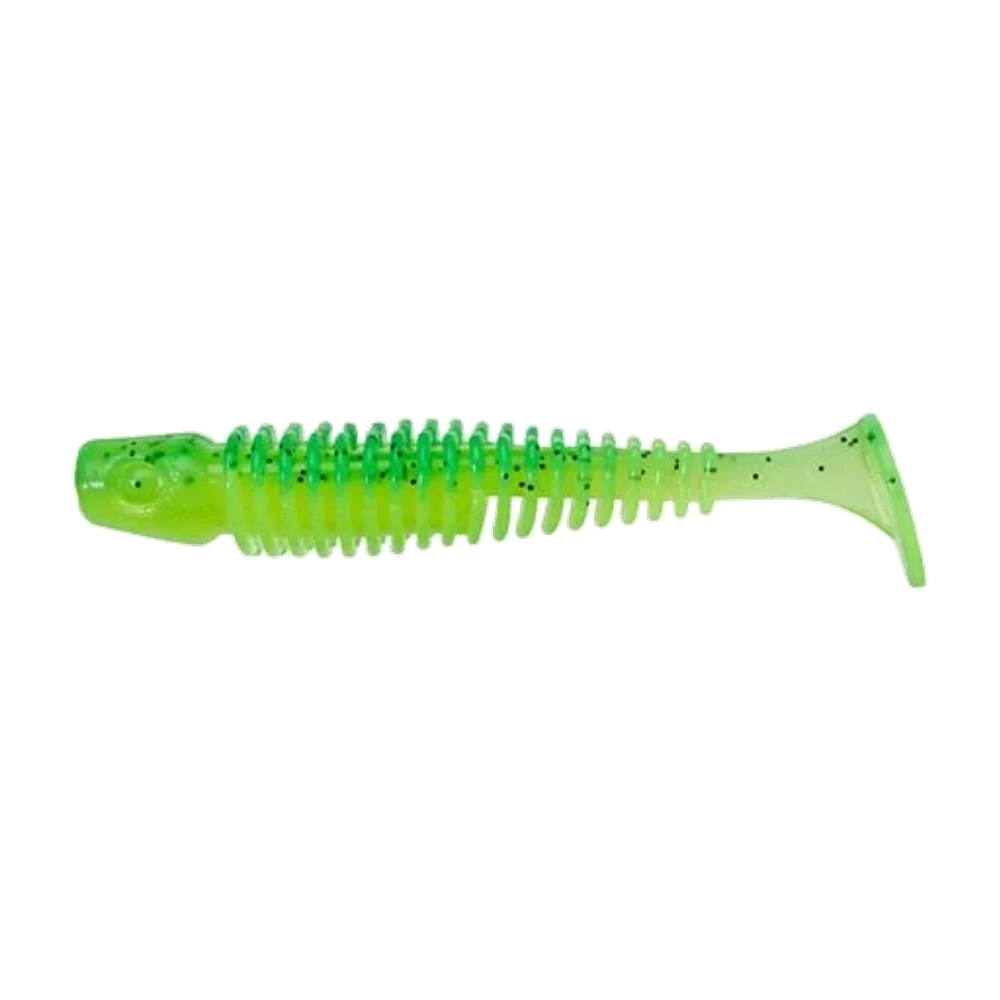
Gunki Tipsy: the lipless you fish downwards, for zander
Not sure this lure fits YOUR spot today? CarnaFish tells you in 10 seconds, from a photo.
Late-autumn zander glue themselves to the bottom and stop following. You run your soft plastic just over the rocks — nothing. You speed up — nothing. The problem is not always the lure: it is that your retrieve stays horizontal while the fish is looking upwards from a metre below.
A lipless is often sold as a fast searching lure, cranked straight back at mid-depth. That is one way to fish it, but it is not the way that catches zander. The Tipsy works on the vertical axis: you let it sink, you snap it off the bottom, you let it drop back. Its very tight vibration kicks in within the first few centimetres of pull, which lets you work the bottom with a tiny amplitude.
This is a contact and bottom lure, not a lure for searching on the move.
A tight vibration that starts immediately
Not all lipless baits vibrate the same way. The difference comes down to mass distribution and body section.
A tall, thick body produces a wide roll, a low-frequency vibration that carries far. That is excellent for calling a pike or a bass in stained water over a large area. The Tipsy plays a different register: compact profile, tighter section, a short fast beat. In practice:
- The vibration starts within 20 to 30 cm of pull, whereas a bulkier lipless often needs a firmer kick-off.
- The signal it puts out is high in frequency and low in amplitude, exactly what a zander's lateral line reads well at short range without it becoming aggressive.
- The descent is nose-down, with a lateral wobble instead of a straight drop. Most bites arrive during that phase.
Zander do not attack because they heard something from far away. They attack because an object passed through their immediate field making the right noise. The Tipsy is cut for that cubic metre.
The retrieve: the descent is the key moment
- Let it sink on a controlled line until it touches bottom, line slightly tight. You should feel the sharp knock of arrival; if you cannot feel that, the bite on the drop will escape you too.
- Lift the lure 30 to 50 cm with a crisp upward flick of the rod tip. You feel the vibration start immediately.
- Follow the descent by lowering the rod at the same speed as the lure, without slack and without excess tension. The lure should fall back wobbling, not swing back on a pendulum under the rod.
- Wait one to three seconds sitting on the bottom. Do not move anything. Zander often come and inspect a motionless object before taking it.
- Repeat, moving a metre or two along with each cycle, or drifting slowly if you are fishing from a boat.
When searching from the bank, swap the vertical for a saw-tooth retrieve: two or three fast turns of the handle to lift the lure, a complete stop, a followed descent to contact, then start again. You cover ground while keeping the falling phase that does the work.
On the water: never let the line go completely slack during the descent. A lipless that drops on slack line spins on itself and tangles the front treble in the line, and you feel nothing. Keep just enough tension to see the bow move — a zander bite on the drop is read with your eyes on the line long before it is felt in your hand.
Weights and depths
| Size | Working depth | Situation |
|---|---|---|
| ~5.5 cm / 11 g | 2 to 4 m | margins, plateaus, shallow river |
| ~7 cm / 17 g | 4 to 8 m | holes, current, crosswind |
Two adjustments that change everything:
The attachment point. Most lipless baits offer several rings along the back. Moving the attachment point rearwards raises the lure's head and increases the amplitude of the wobbling descent. Moving it forwards gives a flatter, faster action, useful on a straight retrieve. For zander, the rear ring almost always gives more bites.
The hooks. The stock trebles catch everything on the bottom. On cluttered ground, replace the rear treble with a single rigged point-up and remove or shrink the front treble. You lose a few marginal bites and save three lures a session.
On the line side: fine braid in 0.12 to 0.14 mm to read the fall, and about a metre of 0.30 mm fluorocarbon leader. Straight nylon cushions the descent too much and makes you miss the subtle bites.
Not sure what to tie on?
Photograph your spot: CarnaFish reads the scene, cross-checks the conditions and gives you the zone, the lure and the retrieve. Free on iOS and Android.
Where it takes the lead, and where it has no place
The Tipsy comes into its own when zander are deep, grouped and unwilling to chase.
- Holes and drop-offs in winter, where the fish sit between 4 and 8 m.
- Stained water after a flood: the vibration replaces sight, and you stay in permanent contact with the bottom.
- Dams and stone embankments, where the descent down the slope carries the lure past several lies in a single sequence.
- Night fishing near lights, where the tight frequency is less alarming than a big lipless.
Conversely, forget it over dense weed beds: it loads up with vegetation on every descent and its vibration stops dead. It is also poorly suited to active fish in mid-water, open feeding or zander high in the column: there, a lightly weighted soft plastic or a minnow covers better. Finally, in a fast-flowing river, the light version gets lifted off and you lose contact with the bottom.
Tipsy, Fat Vibes or TN 70
The Savage Gear Fat Vibes is the useful counter-example: tall body, big volume, wide vibration. It carries far in stained water and targets pike and bass on a straight retrieve. The Tipsy, more compact, trades that range for the ability to work just above the bottom with very small movements.
The Jackall TN 70 sits between the two, with a reputation built on tight vibration on a straight retrieve and lift-and-fall for bass. The practical difference is orientation: the TN 70 is usually fished high on active fish, the Tipsy is fished deep and slow on zander that have stopped moving.
Our beginner's guide to lure fishing for zander puts the lipless back in context alongside soft plastics, which remain the backbone of this fishing. And if you are torn between attacking a spot vertically or on a saw-tooth retrieve, CarnaFish analyses a photo of the spot and answers.
Key takeaways
- The Tipsy is fished downwards: crisp lift, followed descent, pause on the bottom.
- Its vibration starts within 20 to 30 cm of pull, which allows very small movements.
- The bite comes on the drop: keep the line just tight and watch the bow with your eyes.
- Rear attachment ring for more wobble on the fall, rear treble swapped for a single on cluttered ground.
- Unsuited to dense weed and to high, active fish.
FAQ
Is a lipless really a zander lure?
Yes, provided you work it vertically rather than on a straight retrieve. Zander react to a compact object that vibrates briefly and drops back near the bottom; fished in lifts and controlled descents, a compact lipless fits that register perfectly.
What time of year does it work best?
From late autumn to the end of winter, when zander group up low on precise spots. In the height of summer, a soft plastic or a longer lure in mid-water generally covers active fish better.
Should I keep the stock trebles?
On clean bottoms, yes. On rock or wood-strewn ground, replace the rear treble with a single hook rigged point-up and remove the front treble: you cut snags dramatically without losing many fish.
How do I detect a bite on the drop?
Watch the line rather than waiting for a feeling. A bite on the fall shows up as line that stops too early, moves off sideways, or suddenly goes slack. Strike as soon as the descent does not behave as expected.
Which size should I start with?
The middle size, around 7 cm and 17 g, is the best starting point: it sinks fast, holds in a little current and stays within the sizes zander take all year. Save the small version for shallow, clear water.
How does it differ from a jig or a spoon fished vertically?
A lipless adds continuous vibration throughout the pull, which neither a jig nor a spoon produces. In coloured water that is decisive; in very clear water on wary fish, the quieter jig can take the lead again.
The full zander lure guideSeason-by-season strategy: which family of lure, when, and why.Go from theory to fish
CarnaFish reads your spot from a photo and gives you the game plan: zone, lure, retrieve. Free on iOS and Android.