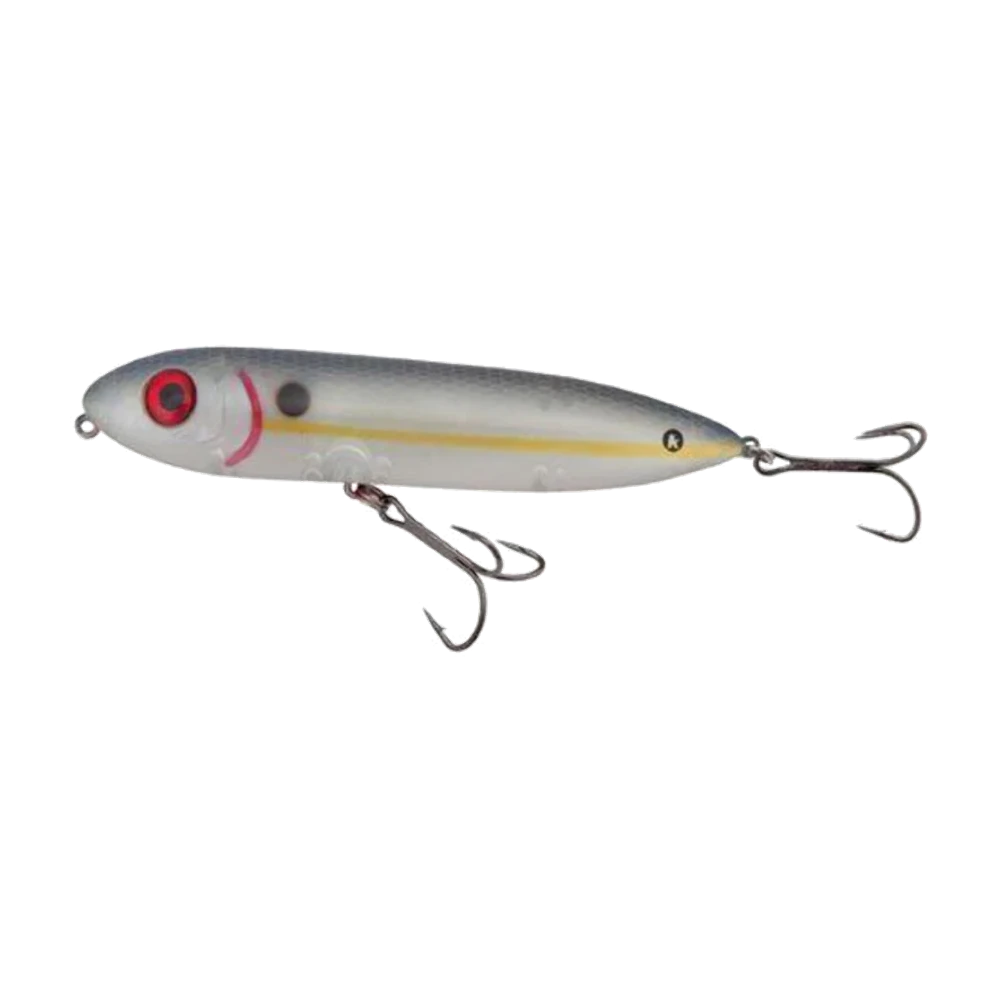
Heddon One Knocker Spook: one ball bearing, and everything changes
The right lure in the wrong spot still catches nothing. CarnaFish spots the zone that works, from a single photo.
On a heavily fished water in the middle of August, bass eventually associate one particular noise with danger. It is not the silhouette that educates them first — it is the sound. The high, continuous rattle of a multi-bearing walking bait is a signal the fish in a public pond hear several times a week.
The One Knocker Spook attacks that problem from the only angle left available: change the sound register without changing the lure or the technique. The body is the Spook family body, the retrieve is the classic walk the dog, but the inside has been emptied of its rattle and replaced with a single heavy ball bearing.
The result is not a quieter lure. It is a lure speaking another language: a dull, spaced-out, low knock instead of a high, permanent chatter.
One sound, two physical properties
The difference is not just a matter of taste. A single heavy ball and a set of small ones do not behave the same way in water.
- A lower frequency carries further. Low sounds attenuate more slowly in water than high ones. A single knock is audible to a fish considerably further away than a fine rattle, even if it seems less intense to a human ear.
- A spaced-out signal is easier to locate. Continuous noise drowns the source. A clean pulse, separated by silence, gives the fish a point to aim at. That is a real advantage at night, in stained water or under cover.
- The moving mass alters the balance. The ball travels front to back on every change of direction. It goes with the movement of the body and gives the zigzag a slightly wider amplitude, with a rather cleaner hang at the end of each glide.
That last point is the real hidden bonus: this is not just a deeper-sounding Spook, it is a Spook that glides a little differently.
The retrieve: walk the dog, cadenced on the knock
The gesture does not change from the rest of the family. It is the reference point that changes.
- Cast long, rod low, tip almost skimming the water.
- Recover just enough slack to be in contact, keeping a slight bow. No slack, no zigzag.
- Link short regular wrist snaps, roughly one every half second, turning the handle a quarter turn between each.
- Listen and set your rhythm by the knock. One knock per snap means the lure is tipping cleanly from side to side. If the knock becomes irregular or disappears, your cadence is too fast or your line too tight.
- Do not stop. Walk the dog lives on its regularity. Pauses come at the end of a sequence, not in the middle.
- Set the hook on weight. Keep the gesture going after the explosion and strike when the rod loads up.
| Situation | Cadence | Amplitude | Line |
|---|---|---|---|
| Dawn, flat water | Slow, 1 snap/s | Wide | 0.30 mm fluoro |
| Full day, rippled water | Sustained, 2 snaps/s | Medium | 0.35 mm fluoro |
| Night, stained water | Slow and very steady | Wide | Braid + leader |
| Crosswind | Fast, rod low | Reduced | 0.20 mm braid |
On the water: the knock of the ball is not a gimmick, it is your feedback. As long as you hear one clean pulse per snap, the lure is zigzagging properly even if you cannot see it. That is what makes this model particularly valuable at night: you steer a topwater retrieve by ear, without ever needing to see your lure.
When the low register takes the lead
This lure is not better in all circumstances — it is better in identifiable ones.
Its slots:
- Heavily pressured waters where the fish have heard every rattle of the season.
- Night fishing, where the sound reference serves the angler as much as the fish.
- Stained water and late evenings, where the range of a low sound compensates for poor visibility.
- Large calm expanses, where the spaced-out pulse calls from further off than a continuous chatter.
- Fish that follow without attacking a classic walking bait: changing the sound signature is often more effective than changing colour.
Where it adds nothing, or actually loses:
- On very clear, flat water with wary fish, where it is the noise itself that is the problem, whatever its register. There, a smaller, silent topwater gets through better.
- On active surface feeding, where the high rattle of a classic model excites fish that are already hunting more effectively.
- On narrow, cluttered spots, where an 11 cm lure that needs running room to zigzag has no space to express itself.
- In heavy chop, where surface noise drowns the pulse.

Not sure what to tie on?
Photograph your spot: CarnaFish reads the scene, cross-checks the conditions and gives you the zone, the lure and the retrieve. Free on iOS and Android.
One Knocker or Super Spook
This is the comparison that matters, because the two lures share the same shell.
The Heddon Super Spook carries several ball bearings and produces a continuous chatter. On active fish, on choppy water, or when you are searching a long bank fast, that permanent signal brings fish from a distance and remains the best default choice.
The One Knocker takes over when that signal stops working: educated fish, calm water, a session in the second half of the day once everyone else has been through. It is a second-pass lure, not a first-cast lure.
The Heddon Zara Spook remains the finest of the three on the quality of its zigzag and the best suited to medium-sized fish. And if you want to be able to alternate walking and popping on the same lure, the Heddon Chug'n Spook covers that need.
Our beginner's guide to bass fishing details the time slots where topwater beats everything else. And if you are unsure whether to keep working a bank that has already been fished or to change register, CarnaFish analyses a photo of the spot and answers.
Key takeaways
- A single heavy ball replaces the rattle: a deep spaced-out knock instead of a high chatter.
- Low frequencies carry further in water and give the fish a point to home in on.
- The moving mass slightly widens the zigzag and sharpens the hang at the end of each glide.
- The knock is your feedback: one knock per snap means a clean zigzag, even at night.
- A second-pass lure for educated fish, not a first cast on active ones.
FAQ
What is the concrete difference from a Super Spook?
The Super Spook carries several ball bearings and produces a continuous high-pitched chatter; the One Knocker has just one, heavy, which gives a deep, spaced-out knock. The body and the retrieve are identical: it is the sound signature that changes.
Does a low sound really carry further?
Yes, low frequencies attenuate more slowly in water than high ones. At comparable perceived intensity, a single knock is detectable by a fish further away than a fine rattle, especially in calm water.
How do I know my walk the dog is right?
Listen to the ball. A clean pulse on every snap means the lure is tipping properly from one side to the other. An irregular or absent knock indicates a cadence that is too fast or a line that is too tight.
Is it a good lure for night fishing?
That is one of its best slots. The sound reference lets you steer the retrieve without seeing the lure, and the deep spaced-out signal helps the fish locate its target in the dark.
Fluorocarbon or braid?
Fluorocarbon in 0.30 to 0.35 mm straight through is the simplest and cushions lost fish well. Braid with a metre of leader gives more control in wind or at long range, at the cost of slightly more fish coming off.
When should I leave it in the box?
On very clear, flat water with wary fish, where any noise becomes a deterrent, and on active surface feeding where the high chatter of a classic model excites fish more. It is also too bulky for narrow spots.
The full bass lure guideSeason-by-season strategy: which family of lure, when, and why.Go from theory to fish
CarnaFish reads your spot from a photo and gives you the game plan: zone, lure, retrieve. Free on iOS and Android.