Heddon Chug'n Spook: a popper that can also walk
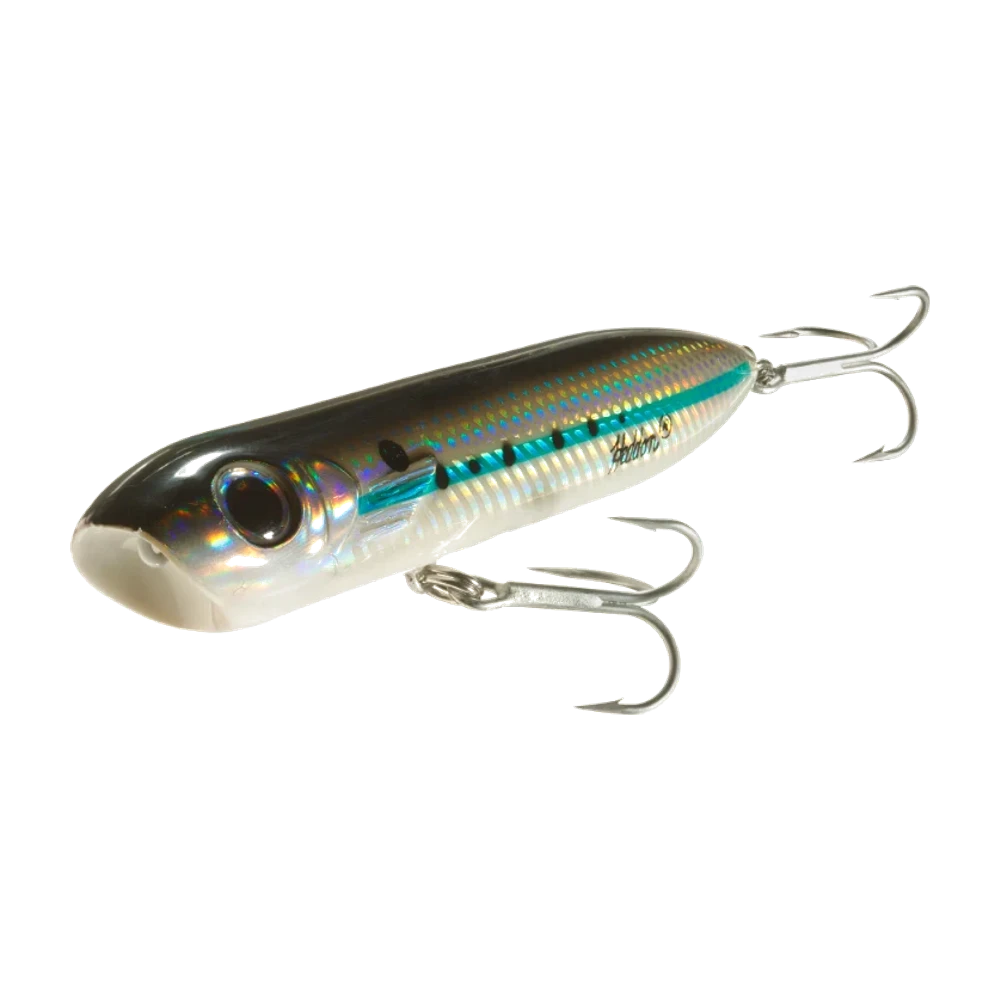
This lure shines under specific conditions. CarnaFish tells you in 10 seconds if today is one of them.
Along a long bank or over a saltwater flat there are two ways to fish the surface, and normally they exclude each other. Either you search with walk the dog: the lure moves, sweeps twenty metres, finds the active fish. Or you work a popper: noise, spray, pauses, over a known lie. Two lures, two rods, or a change every time.
The Chug'n Spook removes that choice. It takes the long, heavy body of the Spook family — so the casting distance and the ability to zigzag — and grafts on a cupped mouth capable of throwing a real spray. Depending on how you hold the rod and how you cadence, the same lure does one or the other.
This is not a soft compromise: it pops properly, and it walks properly. But it does require knowing which gesture produces what.
Two behaviours in one body
The difference comes down to three parameters you control entirely.
- Rod tip position. Rod high, at 45° or more, and the pull is vertical: the mouth grabs water and throws it forward. Rod low, almost skimming the surface, and the pull is horizontal: the lure slides sideways and zigzags.
- Cadence. Isolated, spaced-out snaps produce clean pops. A steady cadence, one snap every half second with continuous slack recovery, kicks in walk the dog.
- Line tension. Walk the dog only exists with a permanent bit of slack. A constantly tight line locks the lure on its axis and makes it pop, even with the rod low.
The second family trait: the internal rattles. They produce a continuous clatter that accompanies both the zigzag and the pops. It is an extra sound signal, useful in stained water and in a rough sea, less relevant on clear water and educated fish.
Third point, purely practical but decisive: the weight and profile allow very long casts, including into the wind. On a flat where the fish are forty metres out, that is often the criterion that settles everything else.
The retrieve: pick your mode and stick with it
Popper mode, to work a lie.
- Cast beyond the target, rod high.
- Take up the slack, tip at 45°.
- One short sharp snap, wrist only. Clean spray.
- Pause of one to three seconds depending on activity.
- Repeat, keeping the lure in the productive zone.
Walking mode, to search.
- Cast long, rod low, tip almost in the water.
- Recover a little slack, keep a slight bow in the line.
- Link small regular wrist snaps, one every half second, turning the handle a quarter turn between each.
- Do not stop. Regularity creates the zigzag; the slightest hesitation breaks it.
Mixed mode, the most productive. Ten metres of walking to cover ground and call fish, then two or three sharp pops as you arrive at the lie, then a pause, then back to walking. That break is what triggers most often: the fish has followed a lure that was fleeing, and the sudden pop makes up its mind.
On the water: a fish that has followed a topwater without attacking almost never commits on a pause. It commits on a change of register. If you see a wake behind the lure, whatever you do, do not stop — switch instantly from walking to popping, or the other way around. That change of sound signature and trajectory, in the same spot, converts where stopping makes them peel away.
Settings by venue
| Venue | Version | Line | Dominant mode |
|---|---|---|---|
| Pond, calm margin | Jr (9 cm) | 0.30 mm fluoro | Pop, slow cadence |
| Big lake, wind | 11.4 cm | Braid + leader | Walk, broken by pops |
| Saltwater flat | 11.4 cm | 0.15 mm braid + 0.45 mm fluoro | Sustained walking |
| River, stained water | 11.4 cm | 0.35 mm fluoro | Firm popping, rattles put to work |
In saltwater, replace the stock split rings with stainless models as a matter of course if you fish often: a topwater lure takes violent shocks under lateral load, and it is the ring that lets go before the body.
On the hooks, stay with an equivalent wire diameter. Too heavy and they make the tail sit low and stop the body sliding sideways — you lose the walking mode and all you have left is an average popper.
Not sure what to tie on?
Photograph your spot: CarnaFish reads the scene, cross-checks the conditions and gives you the zone, the lure and the retrieve. Free on iOS and Android.
Its strengths and its blind spots
It dominates:
- Long lake and reservoir banks in summer, where you need to cover ground fast before working a spot.
- Saltwater flats and rocky points, where casting distance is the limiting factor.
- Slightly stained or choppy water, where the internal clatter and the spray carry far.
- Sessions where you only want one topwater lure on the rod.
It falls short:
- On tiny, cluttered spots, where its size and casting ability are no use at all. A small prop bait or a compact popper will be far better suited.
- On very clear, flat water with educated fish, where the volume and the noise become deterrents.
- On small fish: it is a lure that selects upwards, which is an advantage or a drawback depending on what you are after.
Chug'n Spook or Super Spook
The Heddon Super Spook is a pure walking bait: rounded nose, maximum glide, a wide regular zigzag. It covers more ground, faster and more cleanly. If your programme for the day is "search the surface", that is the one.
The Chug'n Spook sacrifices part of that fluidity — the cupped mouth slightly brakes the glide — to gain the ability to pop properly. The Super Spook Jr stays ahead of it on wary fish, and the Zara Spook keeps the edge on the quality of the zigzag.
On the other hand, as soon as you want to alternate between the two registers without changing lure, or the fish want a clean break mid-retrieve, the Chug'n Spook has no equivalent in the range. For a narrow spot where you need to work on the spot, switch to a Heddon Torpedo instead.
Our guide to lure fishing for sea bass details the windows where topwater beats everything else along the coast. And if you are torn between searching and working a spot when you reach the bank, CarnaFish analyses a photo of the spot and answers.
Key takeaways
- Walking bait body, popper mouth: both retrieves are available on the same lure.
- Rod high with isolated snaps to pop, rod low with a steady cadence to walk.
- Walk the dog needs a permanent slight bow in the line; a tight line kills the zigzag.
- Change register, not rhythm, when a fish follows without attacking.
- Too bulky for narrow spots and clear water with educated fish.
FAQ
Can you really walk the dog with a popper?
With this one, yes, because it takes the long body of the Spook family. You have to drop the rod down to the water, keep a slight bow and cadence steadily. The glide stays slightly less fluid than on a pure walking bait.
Which version should I choose, the 11.4 cm or the Jr?
The 11.4 cm for the sea, for wind and for open water, where casting distance counts. The Jr on ponds, on calm margins or against wary fish, where the full size sometimes causes refusals.
Is the internal rattle an advantage?
In stained water, a rough sea or low light, yes: it is a sound signal that carries when sight is not enough. On clear, calm water with heavily fished fish, it can work against you.
What rig for saltwater?
A 0.15 mm braid main line, a metre to a metre and a half of 0.45 mm fluorocarbon, and stainless split rings replacing the stock ones if you fish salt regularly.
Should I change the trebles?
Stay with equivalent wire diameters. Heavier hooks make the tail of the lure sit low and kill the lateral glide: you lose the walking mode and you are left with an ordinary popper.
When should I prefer a classic Super Spook?
As soon as your only aim is to search a long bank fast and cleanly. The Super Spook glides better and covers more ground; the Chug'n Spook earns its place when you want to be able to pop without changing lure.
The full bass lure guideSeason-by-season strategy: which family of lure, when, and why.Go from theory to fish
CarnaFish reads your spot from a photo and gives you the game plan: zone, lure, retrieve. Free on iOS and Android.