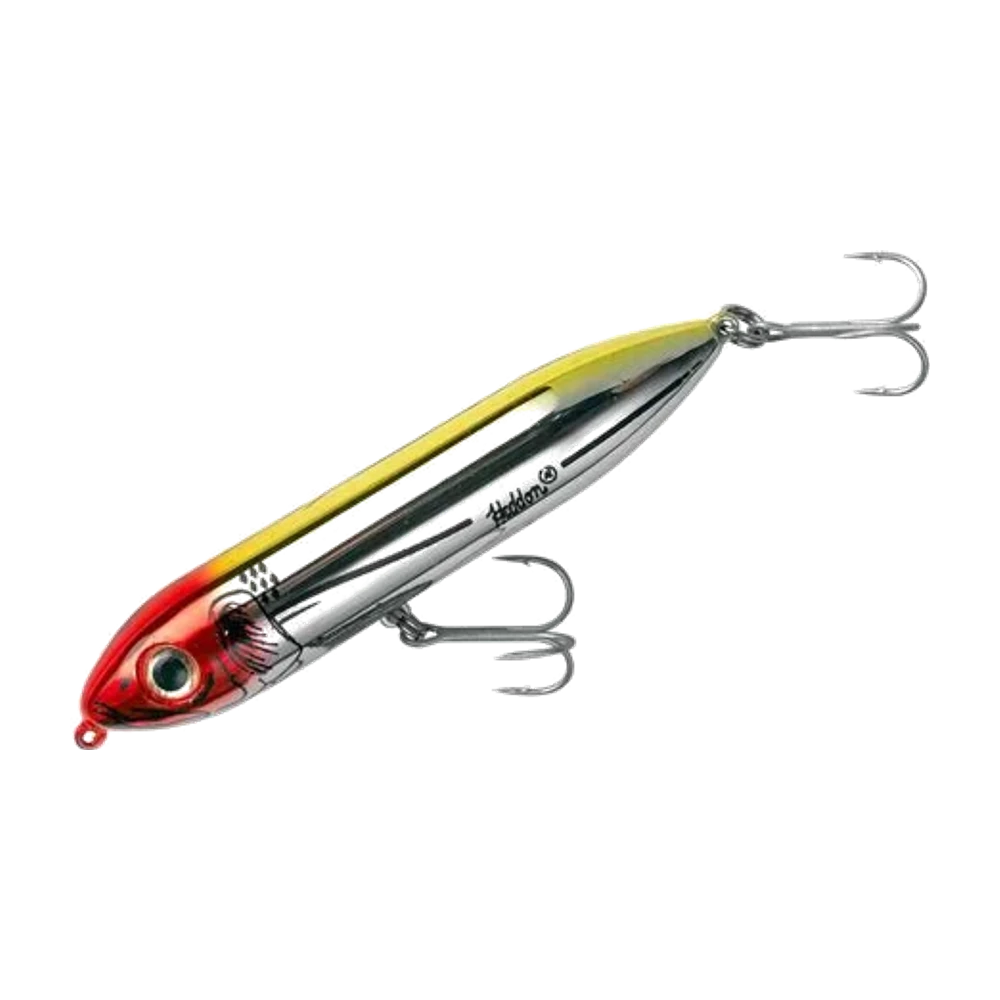
Heddon Super Spook Jr: the size that converts when the big one only provokes
Not sure this lure fits YOUR spot today? CarnaFish tells you in 10 seconds, from a photo.
You are fishing the Super Spook, fish are coming up, splashing, and leaving without taking anything. It happens all morning. The lure is doing its calling job — it attracts — but something is jamming at the moment of decision.
That is exactly the situation the Jr is built to unblock. It is not a "small Super Spook": it is the conversion tool to the big model's calling tool.
What the drop in size changes
Going from 12.7 to 8.9 cm changes three things at once.
The profile becomes credible to more fish. A 35 cm bass hesitates in front of a 13 cm prey item. At 9 cm, the attack no longer requires any particular commitment. You mechanically widen the population of fish likely to follow through.
The zigzag tightens up. Less mass and less length give a reduced lateral amplitude. The lure stays longer above a precise point, which counts on a tight spot — under a branch, against a jetty, in a gap in the weed.
The rattles change register. The sound is higher pitched and carries less far. That is a loss in calling power, but an advantage on close fish that a deep clatter would put on alert.
The cadence, faster than on the big model
The gesture is the same — rod tip down, short wrist snaps, one turn of the handle between each — but the rhythm differs.
- Rod tip pointed at the water, 30 cm off the surface.
- Sharp, closely spaced wrist snaps, more frequent than on the 12.7 cm.
- One turn of the handle between each snap to recover the slack.
- No pauses in standard use.
On the water: the Jr needs a more sustained cadence to keep its zigzag going. With a light lure, too slow a rhythm lets the line come tight between two snaps and the lure sets off in a straight line again. If you lose the zigzag, speed up rather than pulling harder.
On a fish that follows without committing, the correction is the opposite: a dead one-second stop, then an immediate restart. That break converts a good share of followers.
Where it beats the big model
- Small waters and ponds, where 22 g of lure is out of proportion.
- Clear, calm water, where the bulk of the big model makes fish suspicious.
- Precise, sheltered spots, thanks to the tighter zigzag that stays on the zone.
- Medium-sized bass, its natural target.
Conversely, it loses clearly as soon as you need to cast far, fish in wind, or call across a big expanse — that is where the 22 g and the deep rattles of the standard model remain irreplaceable.
Not sure what to tie on?
Photograph your spot: CarnaFish reads the scene, cross-checks the conditions and gives you the zone, the lure and the retrieve. Free on iOS and Android.
The sequence that works
The most productive approach is to use both models in the same session, each in its own role.
Start with the Super Spook to cover the area and provoke reactions. Note where fish come up. Then switch to the Jr on those precise points, fishing more slowly and more finely.
That sequence exploits the genuine complementarity of the two sizes: one locates, the other closes.
Rigging
Fluorocarbon in 0.25 to 0.30 mm straight through suits. Finer than on the big model: the Jr is lighter and a heavy line chokes a zigzag that is already tight.
The stock trebles are decent. If you replace them, stay with an equivalent weight — a heavier treble makes the lure's nose sit low and breaks the level attitude that walk the dog requires.
Against a compact popper, the difference comes down to the signal: the popper produces a one-off spray and works on the spot, the Jr traces a continuous movement. On a fish that follows, continuous movement generally converts better. Our beginner's guide to bass fishing details the topwater windows, and if you are torn between calling and converting on a spot, CarnaFish analyses a photo and answers.
Key takeaways
- This is not a small Super Spook: it is the big model's conversion tool.
- Tight zigzag: the lure stays longer above a precise spot.
- Faster cadence than on the 12.7 cm — if you lose the zigzag, speed up.
- A dead one-second stop to convert a follower.
- Wrong for distance, wind and big open water.
FAQ
What is the difference between the Super Spook and the Super Spook Jr?
The Super Spook is 12.7 cm for 22 g: it casts far and calls from far away, it is the searching tool. The Jr is 8.9 cm for 14 g, with a tighter zigzag and a less intimidating profile: it converts the fish that the big model only makes react.
Why won't my Jr zigzag?
Most often because the cadence is too slow. With a light lure, an insufficient rhythm lets the line come tight between two snaps and the lure sets off straight. Speed the cadence up rather than pulling harder.
How do I convert a fish that follows without attacking?
Mark a dead one-second stop in the middle of the retrieve, then restart immediately. That abrupt break in rhythm makes up the minds of a good share of undecided followers.
What line should I use?
Fluorocarbon of 0.25 to 0.30 mm straight through. Stay finer than on the big model: the Jr is light and a heavy line chokes its zigzag, which is already tighter by design.
Should I use both models?
That is the most productive approach. Start with the Super Spook to cover the area and spot where fish come up, then go back over those precise points with the Jr to close.
Is it suitable for sea bass?
Yes, in the margins and on small spots in calm water. As soon as you need to cast far from a beach or fish in wind, the standard model takes the lead again thanks to its mass.
The full bass lure guideSeason-by-season strategy: which family of lure, when, and why.Go from theory to fish
CarnaFish reads your spot from a photo and gives you the game plan: zone, lure, retrieve. Free on iOS and Android.