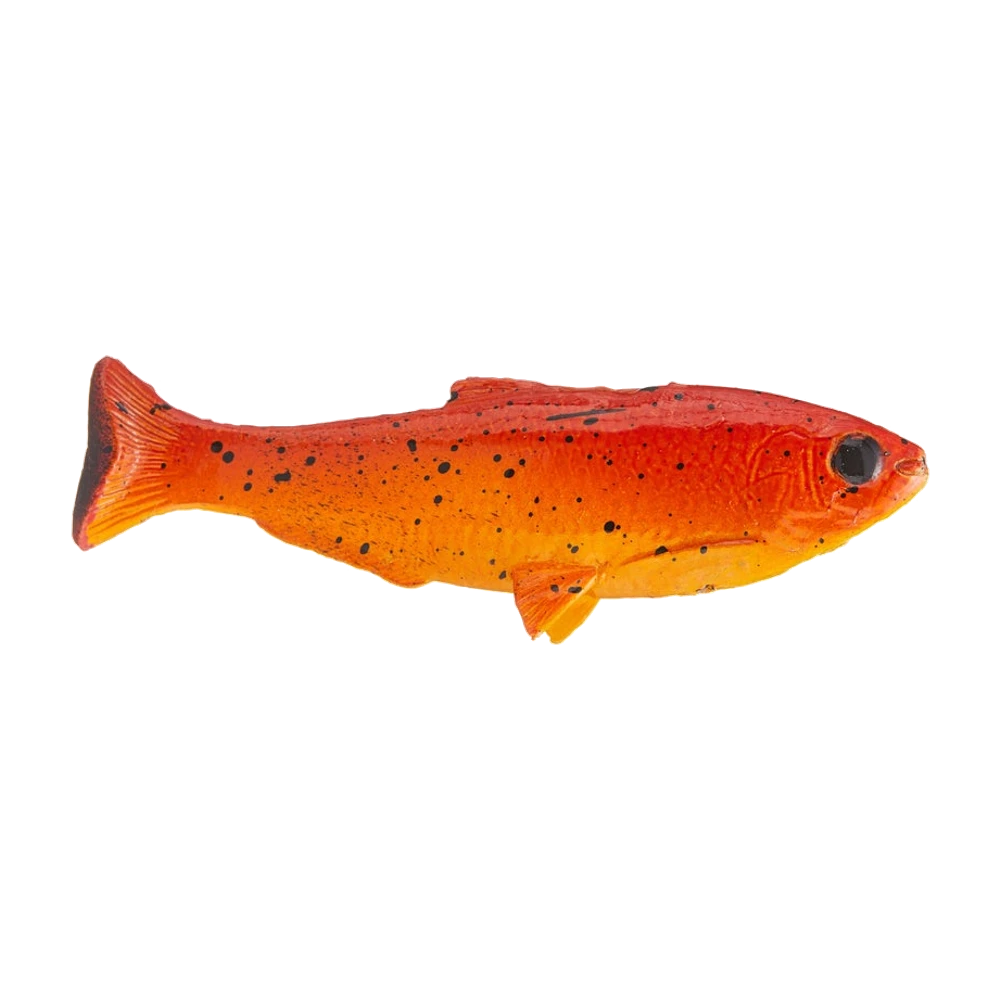
Huddleston Weedless Shad: 4.25 in with a 3/0 hook buried in the body
Rather not fish it blind? Photograph your spot — CarnaFish cross-checks the conditions and points you the right way.
There's a precise moment when a swimbait session dies: the third cast in a row that comes back with a clump of grass on the treble. You know fish are under that mat, you know the bait is right, but you're spending more time cleaning than fishing. The Huddleston Weedless Shad is built squarely against that problem — nothing protrudes anywhere, and even the line eye is shaped to pick nothing up.
A 3/0 hook that disappears into the body
The heart of the bait is a single Mustad 3/0 black nickel hook, described by the brand as super sharp and completely hidden in the body. Not a point tucked under the skin of the plastic the way a Texas rig works: the hook is built into the moulding, and in the photo on this page absolutely nothing shows.
That choice raises the question everyone fears with a weedless setup: if the point is locked away, how does it ever find a jaw? The answer lies in the plastic formulation. Huddleston states a soft compound that is both durable and designed to collapse easily on strikes, freeing the point the moment the fish closes its mouth. That is the bait's central trade-off: a firmer plastic would come through grass better but hook worse, a softer one would hook well and shred on the second fish.
The horizontal line eye, the detail people underrate
The second weedless feature is less visible and at least as useful: the line eye is horizontal. On most swimbaits the eye or split ring sits vertically, forming a small open hook that catches floating grass blades and strands of algae. An eye lying along the axis of the body gives far less purchase: debris slides along the nose instead of piling up in front of the bait.
That is exactly what the brand highlights, and it's what makes the difference on water full of decaying vegetation fragments — a very common situation in late summer, when weed beds start breaking up and the water loads with floating debris.
What the spec table says, and what it doesn't
The maker's table is short and unambiguous: two columns, length then weight, and a single row. It reads 4-1/4 in and 5/8 oz, so 10.8 cm for 17.7 g. That's it: no size range, no weight variants.
What isn't there deserves equal attention. There is no buoyancy column in that table, and the description never says whether the bait sinks, floats or suspends. So don't trust a shelf label: run the test at the water with the bait rigged, counting seconds of descent over a known depth. You'd do that anyway to calibrate the retrieve, and it saves you building a session on a false assumption.
What can be said is that 17.7 g over 10.8 cm is a high density for a soft bait of this length: it casts well, including into wind, and needs no added weight.
Fishing it: slowly, and nothing else
Huddleston claims a patented swimming action, and the good news is that it asks for no rod work at all. The bait does its job on a slow, steady straight retrieve — that's the speed it's designed around, and exceeding it breaks the illusion without gaining anything.
Three presentations cover most of it. The slow roll over the mat: count two or three seconds after the splashdown, then retrieve slowly enough to feel the bait brushing the tops of the weed. The count-down on a drop-off: let it sink along an edge until it touches, then come back on a straight retrieve. And the cover crossing, where you deliberately run through timber and low branches, accepting a few contacts: that's where the buried hook pays its price back.
Make it a rule: on a hard contact, stop reeling for half a second. A soft swimbait that has just ticked a branch and then pauses briefly draws more bites than the same bait wound at constant speed. And since the hook is buried, you can afford to hunt for contact instead of avoiding it.
The classic mistake: the reflex hookset
With a buried hook, a sharp instant strike is the best way to miss the fish. The point has to travel through the plastic first, and that takes a fraction of a second during which the fish must keep the bait in its mouth. The right sequence: let the line come tight, feel the weight, then sweep sideways, long and firm, rather than snapping upward.
Tackle follows the same logic. A rod that's too stiff rips the bait away before the point emerges; one that bends into the top third follows the fish's turn and lets the plastic collapse as intended. Fluorocarbon, with its slight stretch, helps more here than bare braid.
Not sure what to tie on?
Photograph your spot: CarnaFish reads the scene, cross-checks the conditions and gives you the zone, the lure and the retrieve. Free on iOS and Android.
Colors by water
- Stained or loaded water: a bright speckled orange like the one in the photo, which stays visible once light stops getting through. It's also a good card in spring on aggressive fish.
- Clear water: a natural shad livery, silver-grey with a darker back, consistent with the baitfish profile the brand claims.
- Low light or deep water: a dark, plain tone, for a clean silhouette rather than detail nobody can see.
Note one point Huddleston flags itself: the baits are hand-painted, and colors may vary slightly from one piece to another compared with catalogue images. That isn't a defect, it's the trade-off of the process — but if you order two identical pieces to compare, don't be surprised to find them a little different.
Where it sits in the range
Within Huddleston's line-up, the Weedless Shad fills the sensible-size, heavy-cover slot. The Huddleston 68 Hollow Body answers the same ground with a hollow build, and the Huddleston 8 in Trout plays in an entirely different category, that of the very large bait and heavy tackle. At 10.8 cm for 17.7 g, the Weedless Shad stays castable on an ordinary casting setup, which is no small thing in this family.
Against a swimbait with an exposed top hook like the Megabass Magdraft, the trade is clear: the Magdraft hooks up more easily in open water, the Weedless Shad goes where the Magdraft stops. It isn't a better bait, it's a bait for a different place — and carrying both means you don't have to decide before you reach the water.
Knowing whether the spot in front of you genuinely calls for a weedless rig is exactly what CarnaFish makes easier: a photo of the spot, and the AI suggests the zone and the presentation that fit the day's conditions. For the groundwork on gear and bass holding spots, our beginner's guide to bass fishing pairs well with this sheet.
Key takeaways
- 10.8 cm for 17.7 g (4-1/4 in, 5/8 oz) in a single version: no size or weight choice to make.
- A Mustad 3/0 black nickel hook fully buried, with plastic formulated to collapse on the strike and free the point.
- The horizontal line eye cuts floating-grass pickup as much as the hidden hook does.
- The maker states no buoyancy class: test the sink rate at the water before building a session on it.
FAQ
Is the hook really invisible?
Yes. The brand describes a Mustad 3/0 black nickel completely hidden in the body, and the photo on this page shows no exposed point. That's what lets it go through vegetation and timber without fouling on every cast.
Does it hook up properly with the point enclosed?
That's exactly what the plastic formulation is for: Huddleston states a soft compound that collapses easily on strikes to free the point. In return, the hookset has to be a firm sweep, never a sharp instant snap, or you pull the bait away before the point emerges.
Does the Weedless Shad sink?
The maker doesn't say: the spec table has no buoyancy column and the description stays silent on it. Run the test yourself over a known depth, timing the descent — you need that for an accurate count-down anyway.
What exactly are the size and weight?
One version only: 4-1/4 in and 5/8 oz in the table, so 10.8 cm for 17.7 g. There's no length range and no weight variant in what the brand publishes.
Do I need a special rod?
Not special, but not just any rod. A medium-heavy that bends into the top third follows the fish's turn and lets the plastic collapse; a very stiff blank works against the rig. A fluorocarbon leader, with its slight stretch, pulls in the same direction.
Why aren't my two baits exactly the same color?
Because they're hand-painted, which Huddleston states explicitly: colors may vary slightly from one piece to another and from the catalogue photos. It's inherent to the process and has no effect on the swim.
The full bass lure guideSeason-by-season strategy: which family of lure, when, and why.Go from theory to fish
CarnaFish reads your spot from a photo and gives you the game plan: zone, lure, retrieve. Free on iOS and Android.