Nomad Design Live Ops Cobra Shad: the soft shad you weight yourself
Before tying this one on, it helps to know if the spot actually calls for it. CarnaFish reads the scene from a photo.
Most soft shads give you exactly one adjustment: the weight of the jighead. Nomad Design's Cobra Shad offers something else — a floating body, two tungsten balls in the pack and a tube for inserting them wherever you want in the bait. Depending on where you put them, the same lure drops flat, tail-first or head-first. That is an unusual degree of freedom, and you need to know what to do with it for it to be worth anything.
The ADJUSTA-BALL system, in practice
The bait ships with a rigging tube and two tungsten balls. The tube cuts a clean cavity in the plastic without tearing it; the balls slide in. Three positions give three completely different behaviours.
Ball centred: the bait sinks flat and horizontal, holding the attitude of a small fish gliding. This is the setting for a long fall in front of a fish you can see on screen that will not come up for it.
Ball towards the tail: the tail leads, the nose stays high. The bait adopts the posture of a fish backing up, which is unusual and therefore unsettling, and above all it stays far longer in the target layer because the fall is across the body.
Ball towards the head: a fast, direct nose-down descent. The setting for punching through a layer of baitfish quickly, or for reaching bottom in current without drifting away.
The tungsten has a second effect the manufacturer claims: it makes the bait markedly more visible on sonar. On modern presentations where you track your bait on screen and watch the fish decide whether or not to come up, that is not cosmetic — it is what tells you whether you are passing at the right height.
Always start with a single ball, centred. Two at once makes a bait that falls too fast for most bass situations. The second one is for wind, current or genuine depth.
The belly wing and the hair-thin tail
Two shape elements do the rest of the work. The first is that wide fanned wing under the belly, made of a series of fine ribs. The manufacturer uses it to produce an upward jumping movement: on the pull, the wing bites the water and the bait rears instead of simply moving forward. That behaviour is rare on a soft shad, and it is exactly what triggers a reflex strike from a fish that is following without committing.
The second is the stem, extremely thin, carrying a small forked tail. That thinness has a direct consequence: almost no energy is needed to make it move. The manufacturer makes a point of it — the action fires even at reduced retrieve speed and with minimal rod input. In practice, the bait keeps vibrating through the pause, where most shads go dead the moment you stop.
The plastic is a TPE elastomer Nomad calls Titan-Rx, described as ultra stretchy and highly durable. The bare body floats: that buoyancy is the whole basis of the adjustable weighting, since without a ball the bait rises instead of sinking.
The rigs the mould was built for
The markers exist for a reason
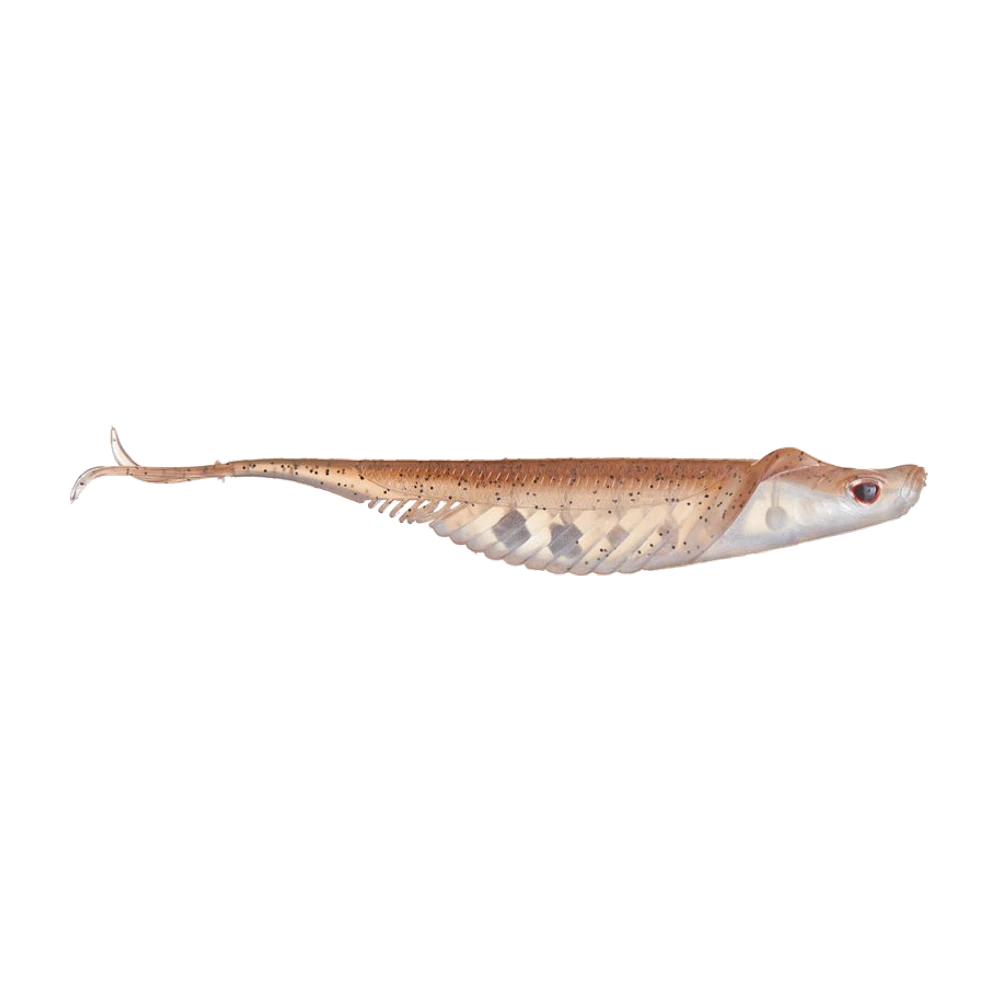
The body carries an alignment slot along the back, a rigging channel at the nose and grey marker dots on the belly — clearly visible in the photo on this page. They are not decoration: the slot guides the hook shank so the bait stays straight, the nose channel stops the plastic bunching at the entry point, and the belly dots show where to bring the point out for a given hook size. A soft shad rigged crooked swims crooked, and these markers remove half of the rigging mistakes.
Weedless Texas and jighead
The manufacturer states the bait suits bottom, mid-water or weedless presentations. Texas-rigged on a wide gap hook with the point tucked in, it slides through a laydown without snagging and the tungsten ball supplies all the weight. On a plain jighead you lose the attitude adjustment but gain casting distance and feel — keep that for situations where you need to cover water rather than work on a located fish.
The classic mistake
Treating the Cobra Shad like a paddle tail. A paddle tail shad needs a steady retrieve to exist: you cast, you wind, the tail kicks. This one works the other way, in sequences — a pull to trigger the jump, then a pause during which the fine tail carries on working by itself. Wind it in like a paddle tail and you delete the jump and lose everything it was drawn for.
What the manufacturer does not say
The description gives no length, no body weight and no mass for the supplied balls. No spec table. On a bait whose whole point rests on tuning its density, that is an awkward gap: you cannot work out your fall rate in advance, you will have to measure it yourself at the water's edge. Check the length stated on the exact item before ordering, especially if you are trying to match a specific forage size.
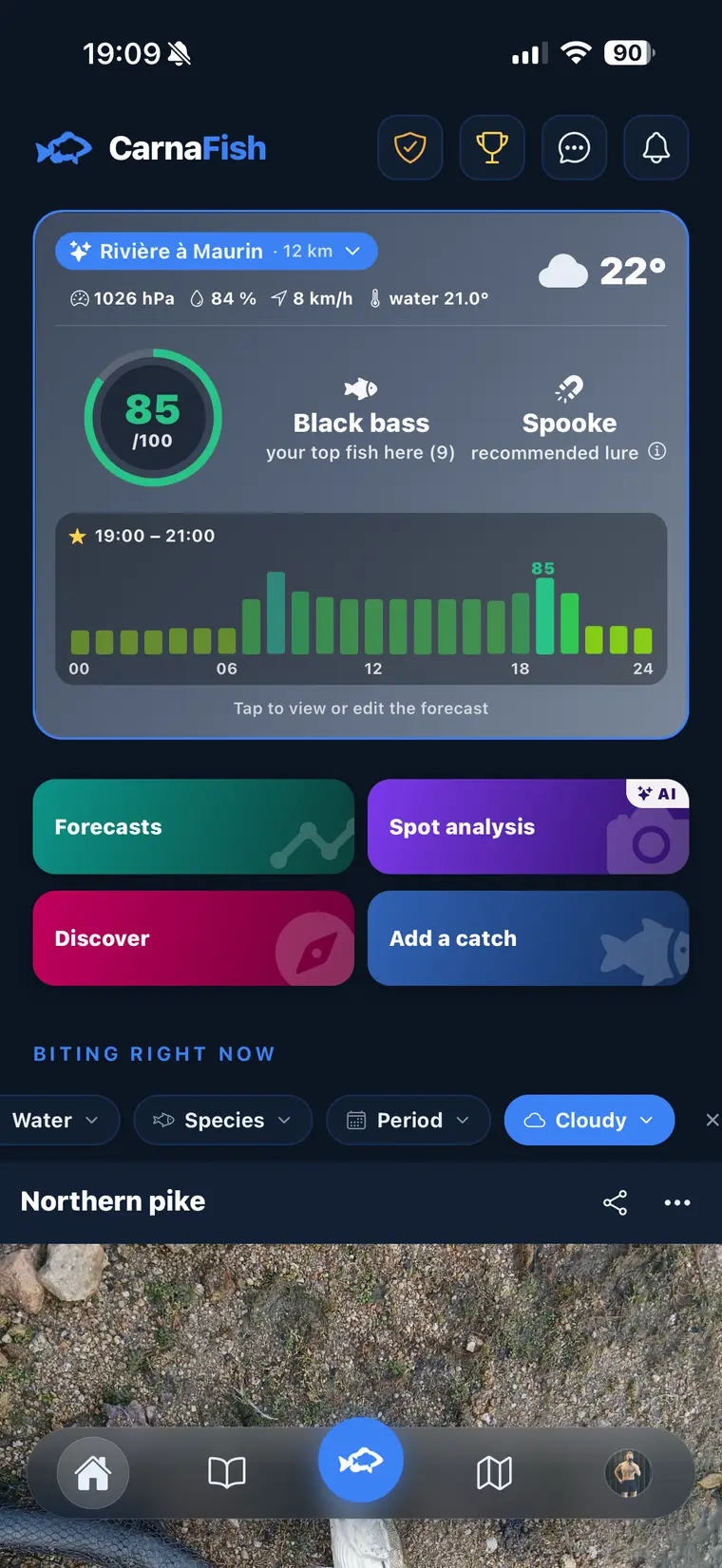
Not sure what to tie on?
Photograph your spot: CarnaFish reads the scene, cross-checks the conditions and gives you the zone, the lure and the retrieve. Free on iOS and Android.
Colors by water clarity
- Clear water : a speckled natural with a brown back and pearl belly, like the model in the photo. The Reactor UV finishes combine baitfish patterns with UV additives, which adds depth without breaking the realism.
- Stained water : a distinctly darker back, to keep a readable silhouette from below when light struggles to get through.
- Low light or real depth : a glow-loaded pattern. That is where the photoluminescent additives the brand advertises genuinely earn their place, not in bright sun.
A precision bait for a fish you have already found
The Cobra Shad is built for targeted fishing: you see a fish, you set your fall, you pass at the right height. It is far less relevant when you do not yet know where they are. Reading the spot before choosing the setting is exactly what CarnaFish makes easier: one photo of the spot and the AI suggests the zone, the depth and the type of presentation that suit the conditions. To understand how spots and behaviour shift through the year, our season-by-season predator fishing guide complements this page well.
Key takeaways
- A floating body plus two tungsten balls in the pack: you decide whether the bait drops flat, tail-first or head-first.
- The fanned belly wing makes the bait jump upward on the pull — work it in sequences, never on a straight retrieve.
- The hair-thin tail keeps working through the pause, which is rare on a soft shad.
- No dimensions published in this description: length, body weight and ball mass all need checking on the item you buy.
FAQ
What exactly does the ADJUSTA-BALL system do?
It moves the bait's centre of gravity. A centred ball gives a flat fall, a ball towards the tail gives a backing-up descent, a ball towards the head gives a fast nose-down drop. The supplied tube is there to cut the cavity without tearing the plastic.
Does the Cobra Shad float?
The manufacturer advertises a high-floating action for its Titan-Rx elastomer. That is precisely what makes adjustable weighting useful: with no ball, the bait rises. How long it takes to sink with one ball depends on the size, which the manufacturer does not state.
Should I use one ball or two?
Start with a single one, centred. Two give a fast fall that is only worth having in strong wind, in current, or to reach a deep layer without wasting time.
How long is the bait?
It does not appear in the manufacturer's description, and we would rather flag that than put a number on the page. Check the length stated on the bag or the retailer's listing before ordering.
How do I rig it straight?
Follow the moulded markers: the nose channel for the hook entry, the back slot to align the shank, and the grey belly dots to choose where the point comes out. A soft bait rigged crooked spins and loses all credibility within a few metres.
Can it be fished on a straight retrieve?
Technically yes, but you miss the point. The belly wing exists to produce an upward jump on each pull, and that does not happen on a continuous retrieve. Work it in pull-pause sequences; the pause is when the fine tail takes over.
The full bass lure guideSeason-by-season strategy: which family of lure, when, and why.Go from theory to fish
CarnaFish reads your spot from a photo and gives you the game plan: zone, lure, retrieve. Free on iOS and Android.