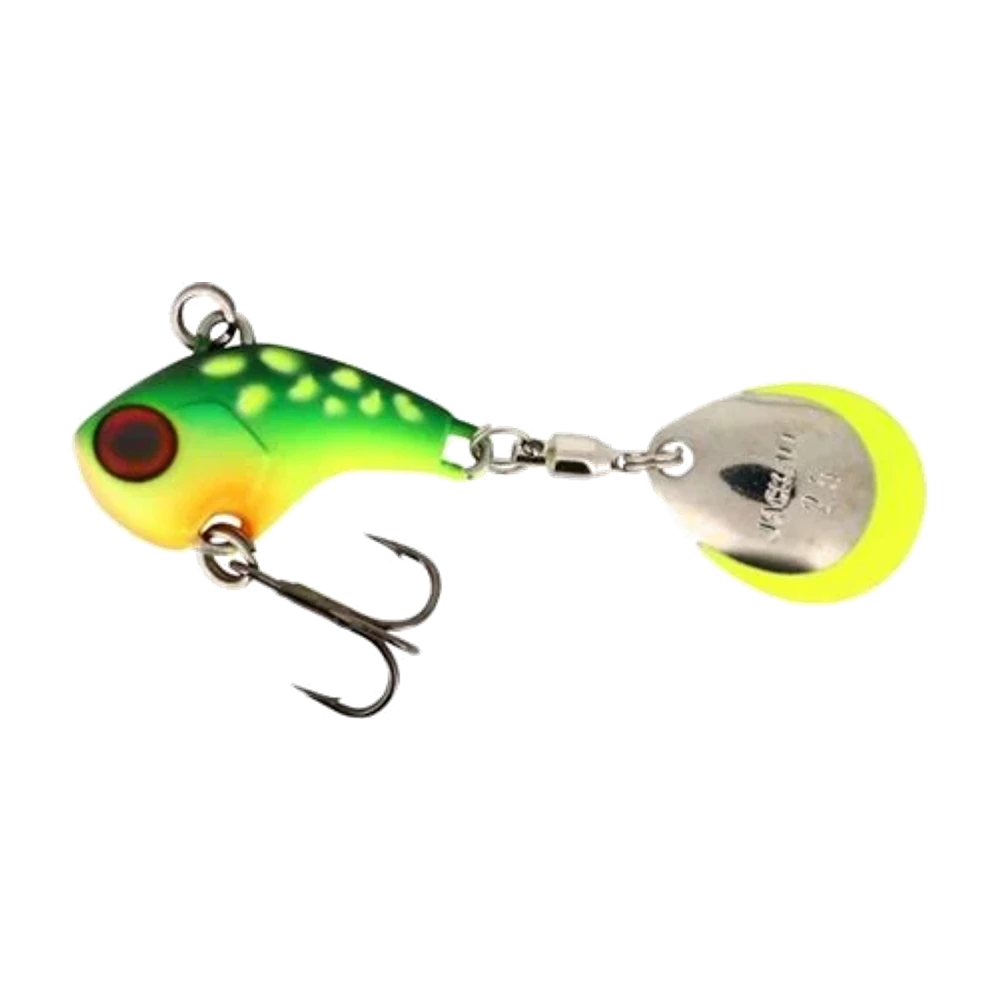
Illex Deracoup: the blade that spins all the way down
Not sure this lure fits YOUR spot today? CarnaFish tells you in 10 seconds, from a photo.
A shoal of perch under four metres of water, right in the middle of a gravel pit, with no margin or structure to work off. The sounder shows them in mid-water, rising, dropping, moving. By the time you have cast a soft plastic, let it sink, worked it and wound it back in, the shoal has moved somewhere else.
The problem is not convincing the fish, it is reaching it fast enough and staying in its layer long enough. You need a lure that is heavy for its volume, that falls straight, and that stays attractive during the descent — because that is where it spends half its time.
The Deracoup does exactly that. A small compact metal body, a spinning blade mounted at the rear on a swivel: the blade starts turning the moment the lure moves, including in free fall. That is the defining feature of the whole tail spinner family, and it is what makes them so effective for fast vertical searching.
What the blade adds on the drop
You have to compare with the neighbouring family to understand. A blade bait or a lipless only produces a signal when you pull on it: on the drop they glide or spin down, silent, emitting nothing in particular.
A tail spinner reverses that relationship:
- The blade spins in free fall, driven by the water moving along the body. The lure descends while emitting continuously.
- The signal is a short, repeated flash, not a deep vibration. It carries less far, but it is highly visible at short and medium range, which suits a fish you have already located.
- The body stays compact and dense. It goes down straight, without gliding, which lets you know roughly your depth by counting.
- The vibration is discreet. On wary or already-fished perch, that is an advantage against a lipless that saturates the zone.
The immediate practical consequence: with this lure, the descent is no longer dead time to be cut short, it is the main fishing phase.
The retrieve: the yo-yo, and almost nothing else
There are not thirty-six ways to work a tail spinner. There are two, and one is far superior to the other.
- Cast and let it drop on a controlled line, without letting go completely. Count the seconds: roughly one second per metre is a reasonable marker for the mid-range weights.
- Stop the descent at the depth you want, or let it touch bottom if you are looking for the lower layer.
- Lift firmly by sixty centimetres to a metre, with a wide rod movement, not a flick of the wrist.
- Follow it back down, rod following, line semi-tight. The blade spins throughout that phase.
- Hold a one-second pause at the bottom of the travel, then start again.
- Take up the slack on the handle between two lifts so you do not end up with twenty metres of loose line.
The second possible retrieve is the fast straight retrieve, useful for sweeping a horizontal layer on actively feeding perch. It catches fewer fish but covers more ground, and it is sometimes the only way to keep up with a fast-moving shoal.
On the water: never let your lure fall on a slack line. A tail spinner taken on the drop cannot be felt — you simply see your line stop sinking or give a small twitch. Always keep a little tension with your index finger on the line during the descent, otherwise you can spend a whole day getting bites without knowing it.
Choosing the weight by water layer
The choice is made on the depth to reach and on how fast you want to be there.
| Situation | Weight | Behaviour wanted |
|---|---|---|
| Perch at the surface or at 2 m | 7 to 9 g | Slow drop, more time in the layer |
| Shoal in mid-water, 3 to 6 m | 10 to 14 g | Clean descent, wide yo-yo |
| Bottom at 6 to 10 m, or wind | 14 to 21 g | Fast contact, long cast |
| Zander sitting on a drop-off | 14 to 21 g | Systematic bottom contact, short lifts |
Two rigging points. Avoid the snap: it lengthens the front of the lure and encourages the blade to tangle around the main line on the drop. A direct knot to 0.20 to 0.26 mm fluorocarbon limits that problem. And if the blade still tangles repeatedly, it is almost always because you are punching the end of your cast — a rounder casting stroke settles the question.
Not sure what to tie on?
Photograph your spot: CarnaFish reads the scene, cross-checks the conditions and gives you the zone, the lure and the retrieve. Free on iOS and Android.
Its windows, and the moments where it does not fit
It gives its best in clearly identified situations:
- On gravel pits and clear lakes, on perch shoals spotted on the sounder or by surface feeding.
- In late autumn, when perch group up deep and the activity window is short.
- On drop-offs and bare plateaux, where the absence of structure allows a clean yo-yo without snagging.
- On zander during the day, with shorter lifts in contact with the bottom, when you want to cover ground fast before slowing down with soft plastics.
And it is poor in three specific cases. In flooded timber and weed beds, the rear blade catches on everything — that one is disqualifying. In very coloured water, its brief visual signal is lost, and a deeper vibration will be better perceived. Finally, on a completely apathetic fish in cold water, the yo-yo stays too dynamic: the tail spinner is a reaction lure, not a slow-persuasion lure.
Deracoup or lipless: short flash against continuous vibration
The natural comparison is with blade baits and lipless lures, often used on the same spots.
A Rapala Rippin' Rap generates a strong, continuous vibration the moment you pull, with a low-frequency signal that carries far in coloured water. That is the tool for calling scattered fish or fishing murky water. But it produces nothing during the drop, and it saturates a zone quickly if you keep at it.
The Deracoup works the other way round: little vibration, plenty of flash, and a signal maintained throughout the descent. It assumes the fish is already located and close by. On perch that have already refused two lipless lures during the day, it is often the one that walks away with the prize.
The logical order over a session: lipless to locate and call, tail spinner to work the zone once it is identified, soft plastic to finish on the fish that remain. Our guide to lure fishing for perch details that sequence. And if you are unsure which weight to tie on when you arrive at an unfamiliar gravel pit, CarnaFish analyses a photo of the spot and answers.
Key takeaways
- The blade spins in free fall: the descent is a fishing phase, not dead time.
- Yo-yo retrieve, wide lifts of 60 cm to 1 m, followed back down on a semi-tight line.
- Always keep a little tension on the drop, otherwise you will not feel the bites.
- Weight is chosen on the water layer targeted: 7 to 9 g near the surface, 14 to 21 g beyond 6 m.
- Unusable in weed and flooded timber: the rear blade catches every time.
FAQ
How do I work a tail spinner like the Deracoup?
On the yo-yo: a wide lift of 60 cm to 1 m, then following it back down on a semi-tight line. The blade spins throughout the fall, and that is when the majority of bites come.
What weight should I choose for perch?
7 to 9 g to fish the first two metres, 10 to 14 g for a shoal in mid-water at 3 to 6 m, and 14 to 21 g as soon as you need to go deeper or cast into a headwind.
Why does the blade tangle around the line?
Most often because the cast is punched at the end of the stroke: the lure sets off spinning and the blade wraps around the main line. A rounder cast and a direct knot rather than a snap remove the problem in most cases.
What is the difference with a blade bait or a lipless?
The lipless produces a strong vibration only when you pull, and nothing on the drop. The tail spinner emits a flash constantly, including on the descent, with a noticeably more discreet vibration.
Can it be fished on a straight retrieve?
Yes, on a fast retrieve to sweep a water layer and follow a moving shoal. It is less productive than the yo-yo but sometimes the only way to stay in touch with perch that are moving fast.
Does it work on zander?
Yes, with an adapted retrieve: shorter lifts and systematic bottom contact. It is a good fast searching tool during the day, before slowing down with soft plastics over the zones where you have found fish.
The full perch lure guideSeason-by-season strategy: which family of lure, when, and why.Go from theory to fish
CarnaFish reads your spot from a photo and gives you the game plan: zone, lure, retrieve. Free on iOS and Android.