Lunkerhunt Big Eye Tail Spin Jig: the blade that thumps on the vertical
Not sure this lure fits YOUR spot today? CarnaFish tells you in 10 seconds, from a photo.
Fish pinned mid-water over ten metres of bottom, clearly marked on the sonar, utterly indifferent to anything you drop on them: that is the most frustrating situation in boat fishing. The fish is there, it will not move, and no conventional swimming action makes up its mind. That is exactly the tail spinner's ground, and Lunkerhunt's Big Eye is a deliberately tiny version of one.
A 5 cm bait that sends a 10 cm signal
The tail spinner principle fits in a sentence: a compact weighted body up front, a spinning blade hung off the back, and nothing else. The body supplies the mass, hence casting distance and drop rate; the blade supplies vibration and flash. The peculiarity is that the blade turns in both directions of travel — on the lift and on the fall — where a spinnerbait only works while moving forward.
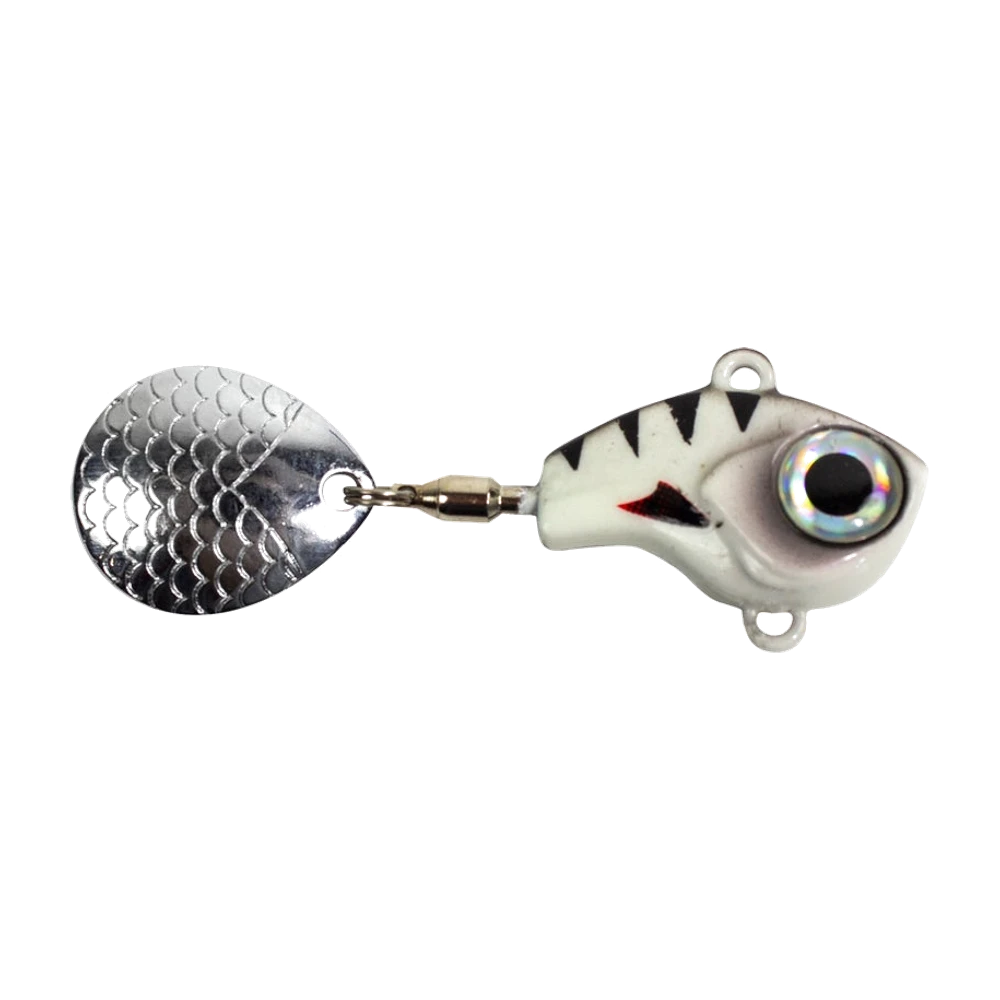
Lunkerhunt puts three things forward for this model. First a mini profile, aimed at difficult, already-pressured fish that refuse bulky baits. Then oversized holographic eyes, clearly visible in the photo: a visual focal point that helps a fish locate a bait this small even in dirty water. Finally a blade that, according to the maker, thumps at the back and delivers flash on the rise and on the fall during vertical jigging.
That last point is worth reading carefully, because it implies something no column in the table states: the maker publishes no floating or sinking rating, yet describes vertical fishing with a drop and a lift. For a painted weighted body there is no practical doubt — it goes down — but it is worth knowing that the information comes from the prose and not from a spec line.
Three versions, and a table detail that matters
The maker's table gives a length and a weight for each version:
- 2 in / 5.1 cm for 1/4 oz / 7.1 g. The perch and wary-fish version, the one that drops slowest and hangs longest in the layer.
- 2.2 in / 5.6 cm for 3/8 oz / 10.6 g. The broadest compromise: heavy enough to hold a vertical in moderate wind, light enough to stay readable.
- 2.3 in / 5.8 cm for 1/2 oz / 14.2 g. The deep-water and current version, and the one that casts furthest from the bank.
The length gap between the smallest and the largest is seven millimetres, while the weight doubles. In other words, these three are not chosen on silhouette, which is virtually identical, but on drop rate and the depth you need to reach. If you hesitate, pick the weight that suits your water layer and forget the length: it is the only variable that genuinely changes anything.
What the ball bearing swivel actually changes
The maker specifies that the blade runs on a ball bearing swivel, and that is not a catalogue line. On a cheap tail spinner the blade hangs off a plain barrel swivel: after a few drops the axis loads up, the blade takes longer to start, and above all the line twists. With a ball bearing, the blade starts within the first centimetres of the fall and twist stays manageable.
It is an easy thing to measure: drop the bait two metres on a slack line and watch your line above the surface. If it is rotating on itself, the swivel is dead or the rig is wrong.
Rigging and hooks
The Big Eye ships with a short shank treble, hung under the belly. In the photo the bait is shown with no hook fitted at all: you can see both rings, the top one for the line and the belly one for the treble, and both are empty. Do not use that image to judge what comes in the pack.
For the connection, a small snap on the top ring is enough and speeds up weight changes, which matters on a style of fishing where you adjust often. Avoid a knot cinched straight on: the blade transmits constant micro-torsion and a knot always suffers in the end. Add a rolling swivel twenty centimetres up the line if you fish the same spot for a long time.
The classic mistake
Working it like a soft plastic on the vertical, with metre-long sweeps. The blade then stalls at the top of the stroke and falls back without turning. The right move is a lift of thirty to forty centimetres, then following the bait down while keeping just enough contact to feel the blade pulse. It is during that guided fall that the bites come.
The reference that changes everything: you must feel the blade in your hand, continuously, like a small motor. If that feeling disappears for half a second, it is never an accident — either the blade has stuck, or a fish has just taken it. When in doubt, set the hook.
Where and when to use it
The Big Eye is not a horizontal searching bait. Its ground is the located fish: a school suspended on the sonar, a sharp break where perch hold, a drop-off where zander rise late in the day. From a boat you drop it vertically; from the bank you cast it and yo-yo it back down the slope, letting the blade work on every fall.
It is also a very good cold-water bait. When the temperature falls and fish refuse to chase, a compact lure that throws vibration without travelling is often the only thing that still triggers. In that register it plays in the same category as a 6th Sense Slice Blade Bait, with a different signature: the blade bait vibrates through its whole body, the tail spinner concentrates its signal at the rear.
Not sure what to tie on?
Photograph your spot: CarnaFish reads the scene, cross-checks the conditions and gives you the zone, the lure and the retrieve. Free on iOS and Android.
Colours by water clarity
- Clear water: a natural silver finish that lets the blade do the flashing without overloading the silhouette.
- Lightly stained water: the white with black bars and the big holographic eye from the photo. The contrast stays readable at three or four metres of visibility, and the oversized eye gives the aiming point.
- Dirty water or flood: chartreuse. At 5 cm long, a discreet bait becomes invisible as soon as visibility drops below a metre.
Its place in a vertical box
Between a Damiki Axe Blade Tail Spinner and a Savage Gear Fat Tail Spin, the Big Eye stands out mainly for its size: 5 cm is genuinely small for this family, and that is precisely the argument on fish that have already refused everything else. The trade-off is that it lacks mass to get down fast in deep water, even at 14.2 g.
Finding the layer the fish are holding in before you drop anything is half the work, and that is exactly what CarnaFish is for: one photo of the spot and the AI suggests the zone, the depth and the type of presentation that match the day's conditions. To place the tail spinner among the other deep-water families, our beginner's guide to zander fishing with lures covers the alternatives.
Key takeaways
- A tail blade on a ball bearing swivel: it spins on the fall as well as on the lift, which no spinnerbait does.
- Three versions at 5.1, 5.6 and 5.8 cm for 7.1, 10.6 and 14.2 g: seven millimetres of length difference for a doubled weight, so choose on weight.
- A short shank treble is supplied under the belly, and it is absent from the product photo.
- A bait for located fish and for cold water, not for fast horizontal searching.
FAQ
Which Big Eye Tail Spin Jig weight should I choose?
The 3/8 oz / 10.6 g covers most vertical situations down to about ten metres. Drop to 1/4 oz / 7.1 g for a slower fall on wary fish, and step up to 1/2 oz / 14.2 g for current or real depth.
Are the three sizes genuinely different?
In silhouette, barely: 5.1, 5.6 and 5.8 cm, seven millimetres between the extremes. In behaviour, yes, since the weight doubles between the lightest and the heaviest. So what changes is drop rate, not volume.
Does the lure come with a hook?
Yes, the maker states a sharpened short shank treble. The product photo shows it with no hook fitted and both rings bare: do not judge the contents of the pack from that image.
How do I work it vertically?
Short lifts of thirty to forty centimetres, followed by a guided fall with light contact kept throughout. You should feel the blade pulsing continuously; too wide an amplitude stalls the blade at the top of the stroke.
Which species does this bait suit in Europe?
The maker's copy targets bass and difficult suspended fish. In Europe the 5 cm size works very well on perch fished vertically and on zander along drop-offs, especially in cold water.
Do I need an extra swivel on the line?
The blade already runs on a ball bearing swivel, which limits twist. If you are dropping on the same spot for hours, a rolling swivel twenty centimetres above the lure remains a sensible precaution.
The full bass lure guideSeason-by-season strategy: which family of lure, when, and why.Go from theory to fish
CarnaFish reads your spot from a photo and gives you the game plan: zone, lure, retrieve. Free on iOS and Android.