Sebile Magic Swimmer 128: the lipless swimbait driven by speed alone
This lure shines under specific conditions. CarnaFish tells you in 10 seconds if today is one of them.
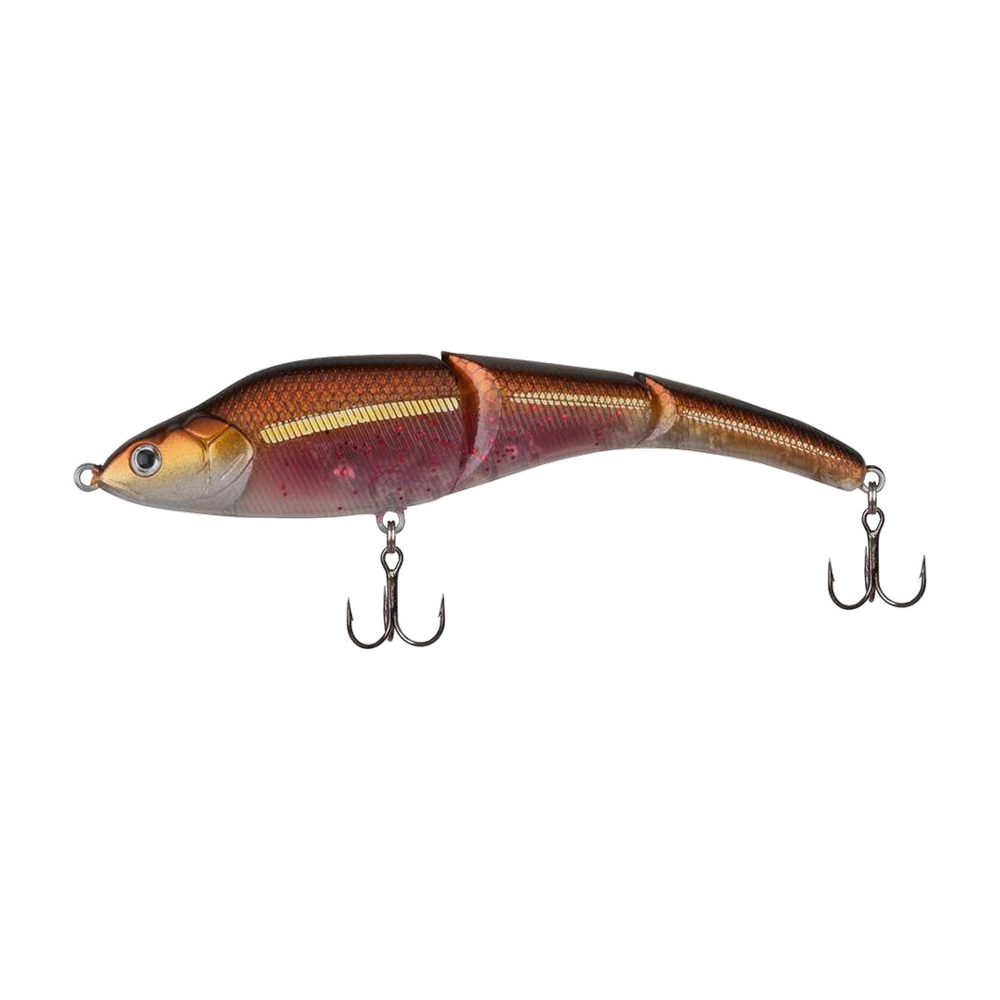
Most jointed lures owe their swim to a bill, a paddle tail, or an offset weight. The Magic Swimmer has none of that: no bill, no plastic tongue, just a body cut into three segments that undulates on its own the moment it moves through water. That near-counterintuitive mechanism is exactly what you need to understand to get the most out of it.
A swim driven entirely by speed
On a standard shad, the swim comes from the tail and stays roughly the same across speeds, as long as you clear a minimum retrieve rate. On the Magic Swimmer, it's the opposite: retrieve speed itself is what creates the undulation across the three jointed segments. Reel faster and the S-shape widens; slow down and the swim turns subtle, almost suspended. That single fact changes how you approach the retrieve entirely: here, speed isn't a secondary setting, it's the only setting.
Three segments, one goal: staying believable at rest
The three-part jointed body lets the lure keep a coherent silhouette even at a dead stop, unlike a rigid hard bait that freezes as one block. During a pause, each segment keeps drifting slightly under its own weight, stretching the illusion of a live fish for a few extra seconds — often enough to trigger a pike that was watching without committing.
Slow sinking, sinking or fast sinking
The Magic Swimmer comes in several fall-rate versions, chosen by depth and how active the spot is:
- Slow sinking: an almost neutral fall, ideal just under the surface or over shallow water without ever touching bottom.
- Sinking: the versatile middle ground, letting you work mid-water while keeping a good window to work the lure before it hits bottom.
- Fast sinking: reserved for deep spots or long casts where you need to reach the target depth quickly.

Not sure what to tie on?
Photograph your spot: CarnaFish reads the scene, cross-checks the conditions and gives you the zone, the lure and the retrieve. Free on iOS and Android.
Vary the retrieve rather than holding it steady
Unlike most lures you fish by settling into a steady cadence, the Magic Swimmer does its best work when you deliberately vary the speed during the retrieve: a few fast cranks to open up the undulation, then a sharp slowdown to close it back in. That variation mimics the erratic behaviour of a stressed baitfish, far more effective than a fish swimming dead straight at a constant pace.
Field rule: if your Magic Swimmer swims the same from the first to the last metre of the retrieve, you're only getting half of what it can do — change speed at least twice per cast.
Colour by light conditions
In clear water and bright light, an ayu or roach finish stays discreet and natural. Under overcast skies or in slightly stained water, a higher-contrast tone helps fish spot the lure from farther off, without needing to force the retrieve to compensate.
A companion to a glidebait or a stickbait
The Magic Swimmer occupies a specific niche between the Salmo Slider, which cuts sideways at a right angle, and a DUO Realis Pencil, which works exclusively on the surface. Where those two demand an active rod-tip retrieve, the Magic Swimmer is happy with a straight retrieve at varying speed — a good pick once your arm starts tiring after hours of jerkbait fishing.
Picking the right lure always depends on the day's conditions, which is exactly what CarnaFish reads from a simple photo of your spot to hand you a matching zone and technique. To build a full season-by-season strategy, the pike lure guide is the place to start.
FAQ
Why doesn't the Sebile Magic Swimmer have a bill?
Its swim doesn't come from a bill but from its three-segment jointed body, which undulates purely from retrieve speed. That's a different mechanism from most swimbaits, and it makes the action fully controllable through speed alone.
What retrieve speed works best for the Magic Swimmer 128?
There's no single ideal speed — the best approach is to deliberately vary between fast and slow within the same cast, opening and closing the undulation to mimic an erratic baitfish.
Should you pick slow sinking, sinking or fast sinking?
Slow sinking for working just under the surface or in shallow water, sinking for versatile mid-water use, fast sinking to reach a deep layer quickly over a known spot.
Does the Magic Swimmer work for bass?
Yes, particularly in clear water where its natural, lipless swim reads well as a tired baitfish, as long as you match the size to the average forage on the water you're fishing.
Can you fish the Magic Swimmer on a full pause?
Yes, and it's one of its strengths: the three-segment body keeps drifting slightly at rest, unlike a rigid hard bait, which stretches the illusion of a live fish.
What's the difference between the Magic Swimmer and a glidebait like the Salmo Slider?
The Magic Swimmer swims a roughly straight line with an internal undulation driven by speed, while a glidebait like the Salmo Slider cuts sharply sideways at a right angle on every rod snap. The two complement each other rather than replace one another.
The full pike lure guideSeason-by-season strategy: which family of lure, when, and why.Go from theory to fish
CarnaFish reads your spot from a photo and gives you the game plan: zone, lure, retrieve. Free on iOS and Android.