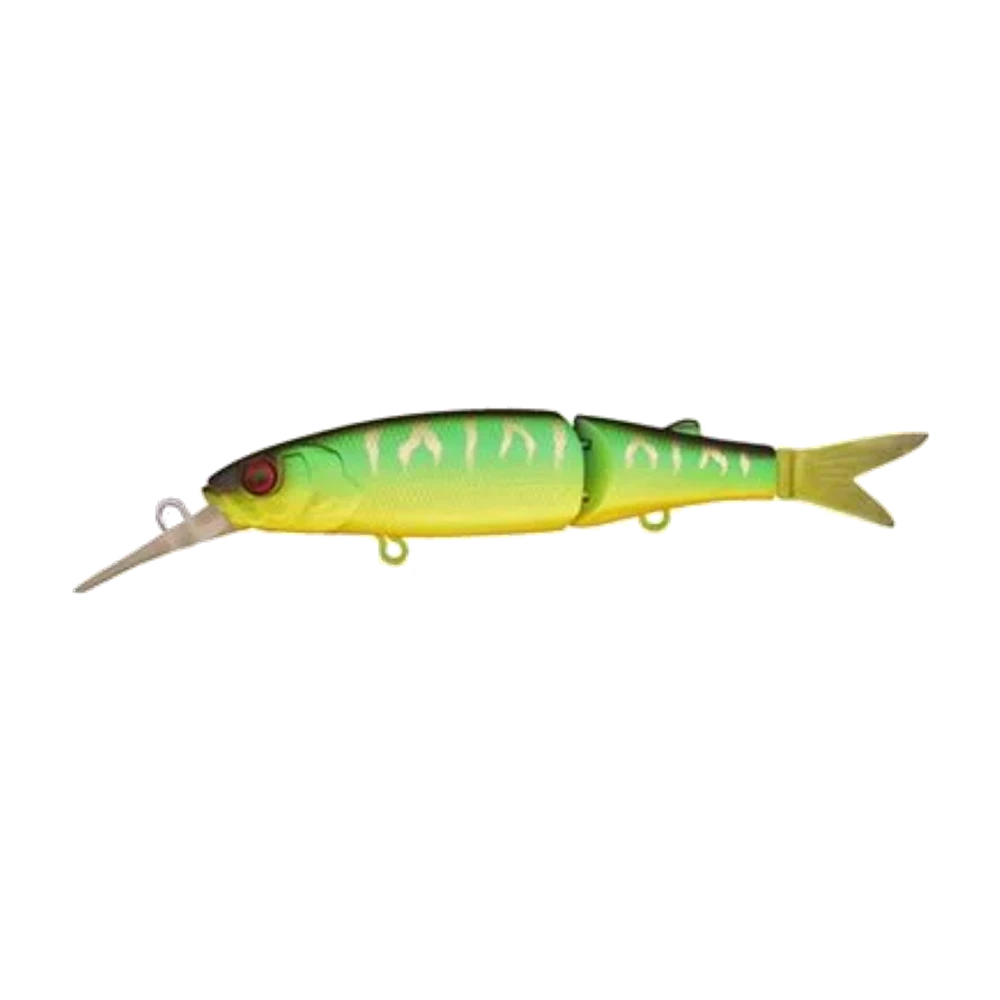
Illex Tiny Magallon: the jointed swimbait you fish on the drift
Before tying this one on, it helps to know if the spot actually calls for it. CarnaFish reads the scene from a photo.
In a river, anything you drag across the current swims wrong. The line bellies, the lure accelerates, it rolls onto its flank and ends up scraping the surface halfway through. Fish holding behind obstacles watch an object go past too fast and in the wrong direction, and they do not move.
The classic answer is to slow down. But most hardbaits have a threshold: below a certain speed the lip stops biting and the swim dies.
The Tiny Magallon solves this differently. Its two-part body generates the undulation through the joint, not through pressure on a lip. Even virtually stationary, pushed only by the current, it keeps snaking. That is what makes it a drifting lure before it is a cast-and-retrieve lure.
Why a jointed body changes things at low speed
On a one-piece lure, the water hitting the lip sets the whole body moving. The signal is strong but it dies abruptly when speed falls off.
On a jointed lure, the mechanism is different. The front section initiates a slight sideways offset, and the joint passes that offset to the rear section with a delay. The result is a wave running from head to tail, as in a real fish. That wave needs almost no energy: a few centimetres per second of relative movement is enough to sustain it.
Two concrete consequences:
- The lure stays alive on a drift, even though you are not retrieving.
- It produces virtually no vibration, which makes it very discreet. In clear water, on educated perch, that is an advantage; in dirty water it is a serious limitation.
Three ways to fish it
On a controlled drift, the main mode in rivers.
- Position yourself upstream or across from the obstacle you want to fish: a boulder, a bridge pier, a stump, the edge of a pool.
- Cast upstream of the lie, three or four metres above it.
- Let the current carry the lure, taking up just enough slack to keep the line semi-tight. You are not pulling: you are following.
- As it passes the lie, stop retrieving for a second. The lure hangs, turns across the current, and that is almost always where the bite comes.
- Carry the drift on downstream, then wind back on a slow straight retrieve.
On a slow straight retrieve, in still water. One turn of the handle per second, with no twitches, at the depth you choose by counting the sink. The lure sinks slowly — count about one second per twenty centimetres to calibrate yourself.
On a broken retrieve, for a follower. Two small twitches of the rod tip followed by a two-second stop. The joint swings the tail sideways during the stop, and that is often enough to convert a follower.
On the water: on a drift, the amount of slack line is your only adjustment. Too much slack and the lure lies over and stops snaking; a tight line and it swings back towards you across the current and swims wrong. Aim for the exact point where you feel a tiny, constant resistance — and correct continuously, not once and for all.
Settings by lie
| Lie | Target depth | Sink time | Approach |
|---|---|---|---|
| Behind a boulder, medium current | 30 to 60 cm | 2 to 3 s | Drift with a stop as it passes |
| Slow river pool | 1 to 1.5 m | 6 to 8 s | Very slow straight retrieve |
| Line of jetties on a lake | 40 cm | 2 s | Straight retrieve plus stops in the shade |
| Current seam below a sill | 50 cm to 1 m | 3 to 5 s | Long drift, no retrieve |
The tackle has to stay light. An L or ML rod of 2 m to 2.20 m, soft in the tip, lets you follow the drift without ripping the lure off course and absorbs the lunges of perch hooked at short range. Fluorocarbon in 0.18 to 0.22 mm is enough: it sinks slightly, which helps hold depth, and stays discreet in clear water. Avoid straight braid, too stiff for a 7 g lure worked in finesse.
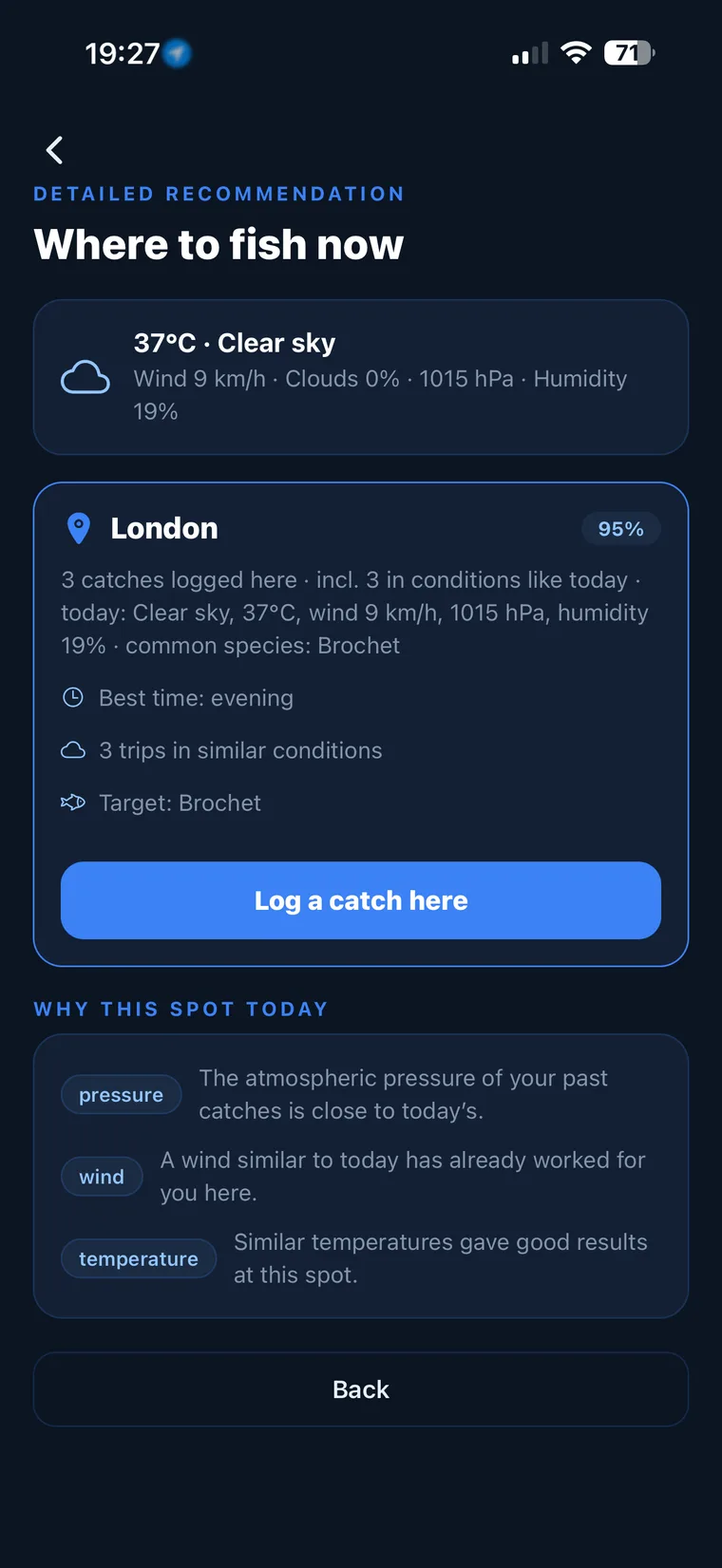
Not sure what to tie on?
Photograph your spot: CarnaFish reads the scene, cross-checks the conditions and gives you the zone, the lure and the retrieve. Free on iOS and Android.
Where it excels, where it is no use
It is at its best:
- In medium rivers, on readable lies: riffles, pool tails, downstream of obstacles.
- On margin perch in late summer and autumn, when they are feeding on fry at the surface but refuse anything that vibrates.
- On bass holding under jetties and submerged trees, where you have to present slowly and quietly.
- In clear, cold water, between 8 and 15 °C, when discretion beats calling power.
It is the wrong choice:
- In stained water or in flood: its signal is too weak, a strongly vibrating lure is called for.
- For searching a large area quickly: it is slow by nature and does not cover ground.
- In strong current: past a certain water speed it lies over and loses its undulation.
- On big fish: the size and the fine hooks are not built for a decent pike.
Tiny Magallon or a small jerkbait
A small jerkbait such as the Illex Tiny Fry 50 demands more and fishes on twitches: it is the tool for provoking a fast reaction from an active perch. The Tiny Magallon works the other way round — it offers a continuous, steady swim, with no spike of aggression, which suits fish that follow for a long time before committing.
On an entirely different scale, a large jointed swimbait like the Gan Craft Jointed Claw uses the same segmented-undulation principle but targets pike and big bass: same logic, different scale. And in a trout river, a sinking lure like the Smith D-Contact stays more relevant as soon as you have to fight a sustained current.
Our guide to lure fishing for perch places these finesse approaches relative to each other. And if you are torn between drifting and retrieving on a river lie, CarnaFish analyses a photo of the spot and answers.
Key takeaways
- The undulation comes from the joint, not the lip: the lure stays alive at almost zero speed.
- In a river, fish it on a followed drift rather than cast-and-retrieve.
- Stop the retrieve for a second at the exact moment it passes the lie.
- The slack is corrected continuously: neither loose nor tight, just in contact.
- Signal too weak in stained water, lure too slow for searching wide.
FAQ
How do you fish a jointed swimbait in a river?
On a controlled drift: cast upstream of the lie, let the current carry the lure and take up only the slack you need to keep contact. The undulation sustains itself, you just have to avoid pulling on it.
How deep does the Tiny Magallon swim?
Between 20 cm and around 1.5 m, depending on how long you let it sink before starting to wind. Count roughly one second per twenty centimetres in still water, and cut that sharply in current.
Is it suitable for perch?
Perch are one of its best targets, especially in late summer and autumn along the margins. Its continuous, very discreet swim gets past perch that refuse vibrating lures, provided the water stays clear.
Should you fish braid or fluorocarbon?
Straight fluorocarbon in 0.18 to 0.22 mm is the best compromise: it sinks a little, helps hold depth, and cushions lunges on a light lure. Straight braid is too stiff and causes pulled hooks on close-range bites.
What do you do when a fish follows without attacking?
Change register rather than speed: give two small twitches of the rod tip, then stop for two seconds. The joint swings the back of the lure round during the stop, and that break often converts the follower.
Does it work in murky water?
Hardly. It produces very little vibration and works essentially on sight. As soon as visibility drops below fifty centimetres or so, a strong-signal lure — a big-tailed soft plastic, a blade bait or a spinnerbait — will be far more effective.
The full perch lure guideSeason-by-season strategy: which family of lure, when, and why.Go from theory to fish
CarnaFish reads your spot from a photo and gives you the game plan: zone, lure, retrieve. Free on iOS and Android.