Sakura Shad Jointed: the big jointed lure you fish on the handle alone
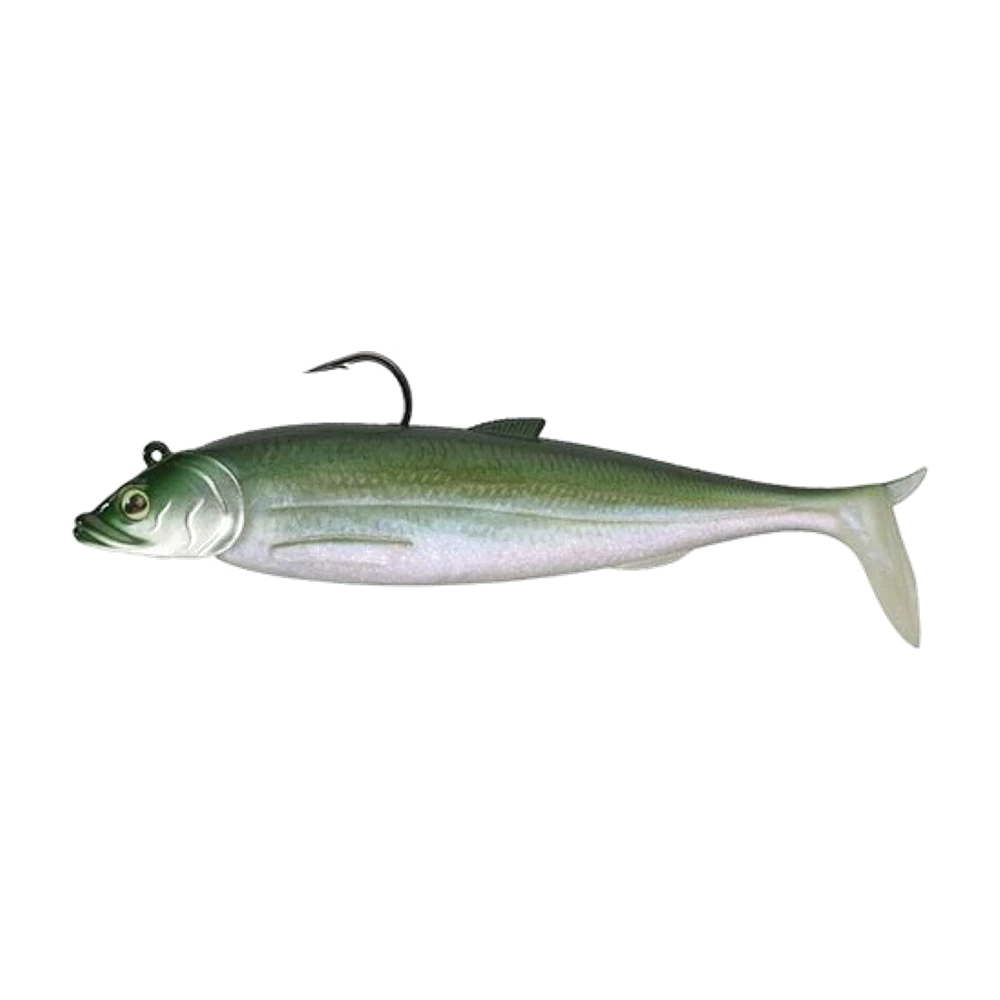
Not sure this lure fits YOUR spot today? CarnaFish tells you in 10 seconds, from a photo.
Big jointed lures scare people off for the wrong reason. The videos that go round almost always show glide baits: single-jointed lures you have to steer with the rod, that swing ninety degrees on every impulse, and that give you nothing until you find the right movement. Plenty of anglers buy one, find it unmanageable, and file the whole category away in the cupboard.
Yet there is another family of big lures that asks for absolutely nothing beyond turning the handle: multi-section swimbaits. Three, four, sometimes five segments linked together, turning a simple straight pull into a continuous wave along the body. Nothing to learn. The lure swims because it moves forward, full stop.
The Shad Jointed belongs to that family. It is the sensible entry format for someone who wants to move up to big volume for pike without changing the way they fish overnight.
What multiple joints actually do
A one-piece lure swims by oscillating around its axis: the tail sweeps, the head stays more or less stable. A multi-section lure works differently.
Each segment receives the movement of the one before it with a slight delay. The result is a wave travelling down the body from head to tail, exactly as on a real fish. In practice that produces three things:
- A silhouette that is constantly changing. Seen from the side, the lure never has the same shape twice on a single pass. That is far harder to identify as artificial than a rigid body.
- A lot of water displaced at low speed. You can retrieve very slowly and still generate pressure a pike can feel on its lateral line at five metres.
- Tolerance of error. Too fast, too slow, with twitches or without: the lure keeps swimming. That is precisely what a glide bait will not forgive.
The trade-off is that a multi-section lure has none of the spectacular glide of a glide bait, and it does not produce the 180-degree turn that converts followers. It is a swimming lure, not a provoking one.
Counting the sink: the only setting that matters
On this type of lure in a sinking version, you do not choose your depth with a lip. You choose it with time.
The method is simple and gets dialled in within two casts:
- Cast and let it sink while counting under your breath, line free but controlled, until you feel the bottom.
- Note the number. Say fifteen seconds.
- Start again, stopping at ten, then seven, then four. You have just mapped the water column in four passes.
- Start the retrieve immediately after the count, without a twitch, at constant speed.
- When you hit a fish, remember the count. On a given spot on a given day, pike are almost always sitting in the same band.
| Sink count | Approximate layer | Typical use |
|---|---|---|
| 2 to 4 seconds | 0.5 to 1 m | Margins, submerged weed, visible feeding |
| 5 to 8 seconds | 1 to 2 m | Flats, gentle drop-offs, early autumn |
| 10 to 15 seconds | 2 to 3 m | Holes, the foot of a drop-off, cold water |
On the water: never bring a big jointed lure all the way in without slowing down over the last three metres. With this type of lure, a huge proportion of pike follow without showing themselves and commit when the lure seems to slow as it arrives under the rod. Slowing down is good; drawing a wide figure of eight with the rod is better.
Terminal tackle, where these fish are really won or lost
An 80 cm pike that hits a 40 g lure sideways is not hooked at the moment of the take. It is hooked three seconds later, or not at all. Three things decide the outcome.
Split rings. The ones fitted as standard on many entry-level swimbaits are the weak link. Move to upgraded rings from your first serious session, without changing the size so you do not alter the balance.
Trebles. Stay with equivalent wire diameters: on a sinking lure, heavier hooks speed up the descent and throw out all your counts. If you want more bite, change the quality, not the calibre.
The leader. Supple titanium of 10 to 15 kg, or 0.70 mm fluorocarbon if you prefer. On a lure of this volume, fifty centimetres is a minimum: pike often roll on the lure after the take and their jaws easily ride thirty centimetres up the line.
As for the rod, you need a model that casts the stated weight comfortably — typically 2.10 to 2.40 m for a 40 to 80 g range. An underpowered rod will not break, it will wear you out in ten casts and stop you setting the hook properly.
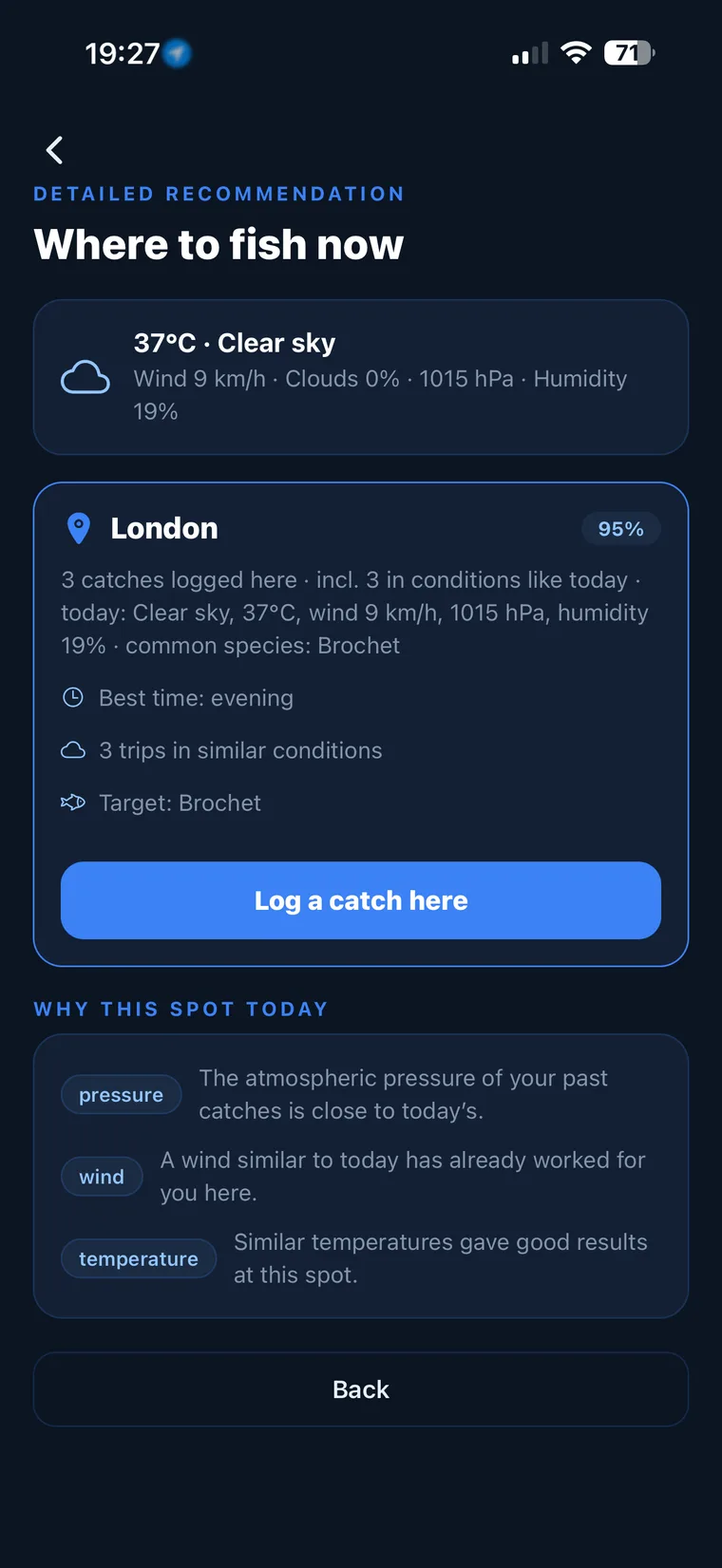
Not sure what to tie on?
Photograph your spot: CarnaFish reads the scene, cross-checks the conditions and gives you the zone, the lure and the retrieve. Free on iOS and Android.
Where it works well, and what not to ask of it
It is at its best:
- From late summer to late autumn, when pike are looking for high-volume prey before winter.
- On big waters and gravel pits, where the volume calls scattered fish in.
- Along drop-offs and flats, with a sink count matched to the contour.
- On unpressured fish, that have not already watched fifty big lures go past this season.
It is unsuited, on the other hand:
- In small cluttered rivers: the volume, the running depth and the cost of snags do not go with fishing in among the wood.
- On completely inactive fish in midwinter: you then need a near-motionless presentation, which this lure cannot do.
- For very fast searching: you make fewer casts per hour than with a soft plastic on a jig head, and fatigue sets in.
- On light tackle: it is the best way to miss hooksets and damage the rod.
Multi-section or glide bait
The Westin Mike the Pike represents the other school: fewer sections, a long sideways glide, and a real need to steer the lure with the rod. Once you have the movement, it provokes takes a straight-swimming lure never will — particularly from followers, thanks to that sharp about-turn.
The Savage Gear 3D Hybrid Pike sits in between, with a bulky profile and a wider action.
The Shad Jointed does not compete with either on spectacle. Its value lies elsewhere: it has you fishing big volume from your very first session, with no technique to acquire and a success rate on casts close to a hundred per cent. It is the right lure for finding out whether big volume catches fish on your water before investing in specialised gear. Our guide to choosing a pike lure places these formats within the season. And if you are unsure which layer to aim at when you reach the bank, CarnaFish analyses a photo of the spot and answers.
Key takeaways
- Several sections: the wave runs down the body and the lure swims on a simple retrieve, with nothing to learn.
- Depth is set by the sink count, not by a lip. Map the column in four casts.
- Always slow down over the last three metres: a lot of pike commit under the rod.
- Upgraded rings and a leader of at least 50 cm; do not change the calibre of the trebles.
- Unsuited to small cluttered rivers, apathetic winter fish and light tackle.
FAQ
Does animating a jointed swimbait need a particular technique?
No, and that is the whole point of the multi-section format: a straight, steady retrieve is enough to make it swim. Twitches are optional, unlike a glide bait, which gives you nothing until you have the movement.
How deep does the Sakura Shad Jointed fish?
Between 0.5 and 3 m depending on the sink time you allow it before starting to reel. Count the seconds until it touches bottom, then divide that count to sweep the water column in steps.
What rod for a lure this size?
A 2.10 to 2.40 m model covering a casting range of roughly 40 to 80 g. An underpowered rod tires your arm within a few dozen casts and will not give you a clean hookset on a big pike.
Do I need a wire leader?
A bite-proof leader is essential, in supple titanium of 10 to 15 kg or in 0.70 mm fluorocarbon. Allow at least fifty centimetres: pike often roll on a bulky lure and easily work their jaws up the line.
What is the difference with a glide bait?
A glide bait has a single joint and produces a wide sideways glide that has to be steered with the rod. A multi-section lure passes a continuous wave down its body and swims on its own; it is more forgiving but less provoking on followers.
What season should I use it in?
Mainly from late summer to late autumn, when pike settle on high-volume prey. In midwinter, on apathetic fish, a near-motionless presentation will be more productive.
The full pike lure guideSeason-by-season strategy: which family of lure, when, and why.Go from theory to fish
CarnaFish reads your spot from a photo and gives you the game plan: zone, lure, retrieve. Free on iOS and Android.