Imakatsu Aventa Crawler Dyvazelle: the winged crawler in casting size
Not sure this lure fits YOUR spot today? CarnaFish tells you in 10 seconds, from a photo.
A windless September evening on a shallow bay where the surface is flat as glass. A buzzbait comes through too fast and leaves nothing but a noisy wake; a popper asks for pauses that feeding fish will not grant you. Between the two sits a family of lures that rolls on itself as it travels and stirs water non-stop: crawlers. The Aventa Crawler Dyvazelle is the upsized version of Imakatsu's, built to be thrown on baitcasting gear.
Two wings, and everything follows from them
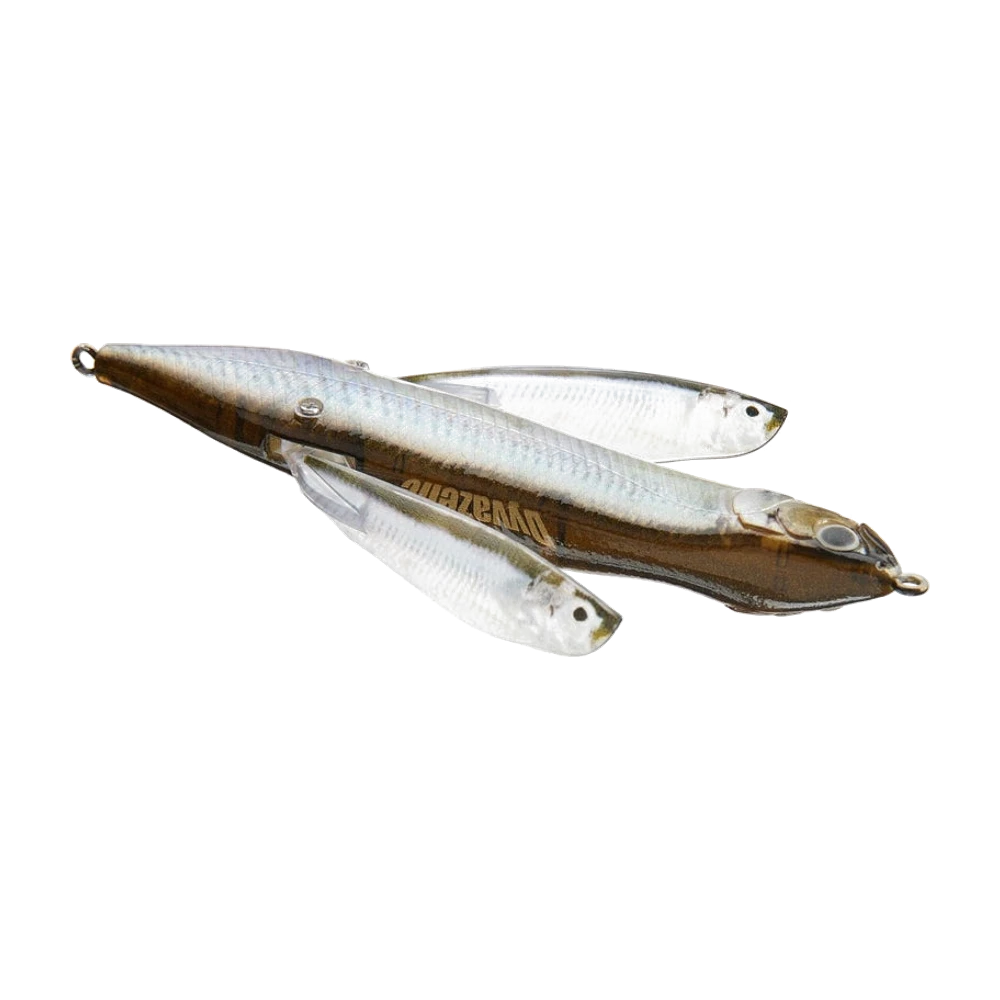
The Dyvazelle is a slim 10 cm body built on a baitfish silhouette, with two side wings screwed onto it. They do the work: on the retrieve they catch water in turn and force the body into an irregular roll that breaks the surface continuously. Imakatsu compares the signal directly to a buzzbait, and that comparison holds for volume and wake, though not for silhouette.
Those wings are described as thin but high strength, and above all they fold in along the body during flight. That is the clever part: a crawler with fixed wings always pays for its wind resistance, which both slows the cast and makes the lure helicopter. Here the profile closes up as the cast starts and only opens again on contact with the water. Imakatsu adds a deliberately asymmetrical body to stabilise flight attitude, which gives straight trajectories and distances this kind of lure does not usually reach.
One small paradox worth knowing: despite the word crawler, this is not a frog or a bug imitation. Imakatsu explicitly describes a shad-shaped body and the behaviour of a baitfish in trouble trying to flee along the surface. The noise comes from the mechanism, the silhouette comes from the baitfish.
What the size increase actually changes
The original Vazelle was designed for spinning tackle: 7.9 cm / 3.1 in, a quarter ounce, a lure you throw on a light rod. The Dyvazelle keeps the same mechanics at 10 cm / 3.93 in for 2/5 oz, about 11 g — an unusual fraction for a maker to publish, but it does work out to 0.4 oz. That mass difference is not cosmetic: it moves the lure from the light spinning category into the casting category, with everything that implies for distance and for control at the end of the cast.
In practice you gain ten metres or so on a flat cast and you lose some stealth. The choice between the two models is therefore not about the size of the fish you want, but about how much water you need to cover and how edgy the spot is. On a short bank fished from close range, the small one stays better.
How to retrieve it
Speed
Imakatsu claims improved behaviour on a fast retrieve, and that is where this lure is most interesting. Start with a medium straight retrieve, just fast enough for the wings to bite and for the body to tip clearly from side to side. If you cannot see the roll from the bank, you are too slow. Then speed up in bursts of five or six handle turns: the lure climbs onto the surface, the clatter tightens, and that acceleration is often what commits a fish that was following without deciding.
Breaking the rhythm
A crawler retrieved at one constant speed from the start of the cast to the end becomes predictable after two or three passes. Break the rhythm: half a second with the handle stopped, the lure floats and settles, then a sharp restart that reopens the roll immediately. You can also give a sideways rod stroke mid-retrieve to skid the body sideways, which the wings allow without the lure falling on its side.
Watch the bubble trail a crawler leaves behind it. When it is regular and wide, your speed is right. When it goes narrow and ragged, a wing has picked up a twig or a strand of weed — clear it straight away, because a crawler unbalanced on one side catches nothing.
Where and when to use it
This is a surface search bait, for shallow zones where fish come up without hesitating: weedy flats in late summer, sheltered bays at either end of the day, the outside edge of lily pads. The continuous signal lets you cover a lot of water quickly, which makes it a good scouting tool before you bring out a finer presentation over the area that gave you a sign.
Imakatsu talks about bass, and that is indeed its primary target. In Europe, a 10 cm crawler making this much commotion also interests pike, especially on shallow ponds in September and October: treat that species as an extrapolation from European fishing, not as a claim from the maker. If you really are after pike, fit a suitable leader before the first cast rather than after the first cut-off.
Not sure what to tie on?
Photograph your spot: CarnaFish reads the scene, cross-checks the conditions and gives you the zone, the lure and the retrieve. Free on iOS and Android.
Rigging and hooks
Imakatsu supplies the Dyvazelle with two fluorine-coated Japanese trebles, a coating meant to drive the point home faster. The sample photographed on this page is shown bare, wings open, with no hooks fitted: do not judge the hardware from the image, judge it from the spec sheet.
For tackle, a medium-power casting rod without too stiff a tip, with braid as the main line. At the surface, braid floats and transmits better the initial slack from a fish striking at an angle. Finish with 50 cm of fluorocarbon for bass in clear water, or a thin titanium leader if the area holds pike. A loop knot or a small soft snap leaves the front of the body free to roll: a knot cinched onto the ring restricts the wing action exactly as it would restrict a diving lip.
The classic mistake
Setting the hook on sight. With a surface lure that leaves a permanent wake, the strike is seen before it is felt, and the natural reaction is to pull. The result is a lure ripped out of the fish's mouth, trebles and all. Keep the rod low, keep reeling for half a second after the blow-up, and sweep the hookset once the weight is genuinely in the rod.
Colours by water and light
Imakatsu airbrushes its finishes and adds 3D eyes and moulded gill plates — visual care that only pays off if the fish has time to look, so mainly in clear water and good light.
- Clear water: the natural shad finish in the photo, olive-brown back and pearly flank. That is the default when water is low and transparent in late summer.
- Low light, dawn and dusk: a solid dark back. Seen from below against the light, only the crispness of the silhouette counts, and a dark tone cuts it out better than a bright finish.
- Stained water: a very pale belly, white or chartreuse, which stays visible in loaded water where flank detail disappears at half a metre.
Where it sits among the other noisy lures
The Dyvazelle attacks the same ground as a River2Sea Whopper Plopper 130, but with a different signature: the Whopper Plopper slaps with a rear propeller, while the crawler rolls and churns along its whole length. Against the classic Arbogast Jitterbug, which owes its noise to a wide front lip and wants a slow retrieve, the Dyvazelle accepts far higher speeds. Three ways of making noise, three retrieve tempos: keep at least two of them in the box.
A topwater is only worth as much as the area you throw it at. That is exactly what CarnaFish makes easier: a photo of the spot, and the app suggests the zone, the depth and the type of lure suited to the conditions. For the rest of the fundamentals, our beginner's guide to bass fishing covers tackle and spot reading.
Key takeaways
- Two side wings that fold on the cast: the distance of a streamlined bait with the wake of a crawler.
- 10 cm / 3.93 in for about 11 g / 0.4 oz, listed as floating, and sized for casting gear where the Vazelle targeted spinning.
- It tolerates high retrieve speeds, which makes it a genuine fast-search tool.
- One wing fouled by a strand of weed is enough to kill the roll: check the bubble trail on every cast.
FAQ
How long and how heavy is the Aventa Crawler Dyvazelle?
Imakatsu's table lists 3.93 in, or 10 cm, for 2/5 oz, meaning about 11 g. The fraction is unusual but does come out at 0.4 oz.
Does the Dyvazelle float?
Yes, Imakatsu explicitly classes it as floating. It therefore stays on the surface at rest, which lets you work in a pause without losing the lure down the water column.
What is the difference with the Aventa Crawler Vazelle?
The Vazelle measures 7.9 cm / 3.1 in for about 7 g / 0.25 oz and was designed for spinning tackle. The Dyvazelle keeps the same mechanics at 10 cm / 3.93 in for about 11 g, to extend casting distance with baitcasting gear.
Does this lure come with its hooks?
Imakatsu lists two fluorine-coated Japanese trebles. The photo on this page shows a bare sample, wings open, with no trebles fitted: that is a presentation image, not the delivered condition.
How fast should it be retrieved?
Fast enough for the roll to be obvious and the bubble trail to be wide. The maker highlights the fast-retrieve behaviour, so do not hesitate to speed up in bursts rather than holding one constant pace.
Can it be fished for pike?
Nothing rules it out, and a crawler this size draws pike well on shallow ponds in Europe. But it is an extension of use: Imakatsu presents this lure for bass. Fit a bite-resistant leader before the first cast.
The full bass lure guideSeason-by-season strategy: which family of lure, when, and why.Go from theory to fish
CarnaFish reads your spot from a photo and gives you the game plan: zone, lure, retrieve. Free on iOS and Android.