Imakatsu Aventa Crawler Vazelle: the small crawler that casts a long way
This lure shines under specific conditions. CarnaFish tells you in 10 seconds if today is one of them.
Schools of baitfish getting hammered at the surface do not wait around. By the time you have swapped lures the activity has moved thirty metres away, and most quiet topwaters simply cannot get there: too light for the distance, too bulky to fly straight. The Aventa Crawler Vazelle was built for that exact problem — make noise like a crawler, but fly like a streamlined bait.
Wings that fold up in flight
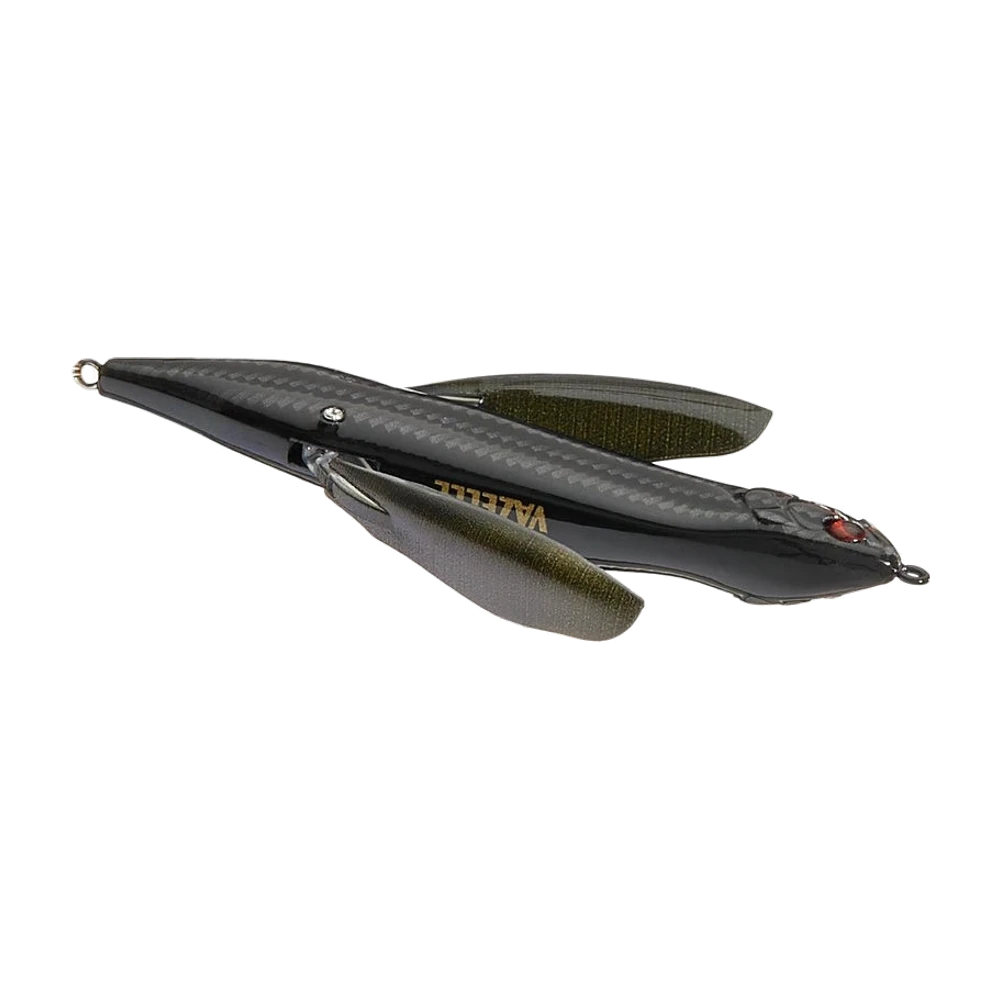
Imakatsu claims more than a year of development on this model, and most of that work went into one part: the wing. There are two of them, very thin, mounted toward the rear of the body and rated as high strength despite their thickness. On the retrieve they catch water in turn and force the body into a characteristic roll that resembles no other family of topwater lures.
Their real trick, though, is that they collapse inward during the cast. A crawler with fixed wings at 7.9 cm / 3.1 in and 7 g flies badly: the wind resistance slows it, the lure helicopters and the line wraps around the trebles. Here the profile closes up from the moment of release and the bait stays on axis — which gives you long casts and, more unusually, accurate ones close to cover.
The smallest and fastest in the series
Imakatsu presents the Vazelle as the smallest and fastest of the Aventa Crawlers. The two adjectives go together: the shorter and lighter the body, the less energy it takes to tip the wings over, so the roll starts earlier and the lure climbs higher on the water when you speed up. At 7 g you stay in light spinning territory — and that is exactly the kind of tackle this model was designed for, the Dyvazelle having come later to cover baitcasting.
In practice this small size gives you two advantages on a worked-over lake. The first is speed: you can sweep a bank quickly without the lure skipping out of the water. The second is a reduced visual footprint, which goes down better with a fish that has already seen three buzzbaits that day.
The Vazelle does not like rod action. It is a reel lure: cast, point the rod at it and turn the handle, that is all. Every rod stroke interrupts the wing roll, and it takes two or three turns to get it going again — that is water fished for nothing.
How to work it
The basic retrieve
Rod low, tip in line with the braid, continuous retrieve at medium speed. You should see the body roll and the surface ripple constantly behind it. If the lure skates without rolling, speed up; if it skips clear of the water, slow down half a handle turn. The usable window is wider than it looks, but it does have two edges.
The three situations that trigger
First, a school of baitfish being attacked in open water: cast past the commotion and bring the lure back through it. Second, an isolated piece of hard cover — a drowned tree, a dock, a rock breaking the surface: the accurate casting the folded wings allow lets you land the lure half a metre off the target. Third, a long, featureless bank you sweep with fan casts to find the active fish before bringing out a slower presentation.
Where and when to use it
The Vazelle is a shallow-water, warm-season bait: weedy flats, pond backs, banks sheltered from the wind. It works through the middle of the day over shaded zones and comes into its own during the activity windows, morning and evening, when predators are feeding near the surface.
Imakatsu aims it at bass, and that is its primary target. In Europe, this 8 cm / 7 g class also falls into perch territory, especially on schools of perch working baitfish at the surface in late summer — treat that as an extrapolation from European fishing, since the maker does not claim it. With perch, fit trebles in slightly finer wire than the originals to improve penetration in a smaller mouth.
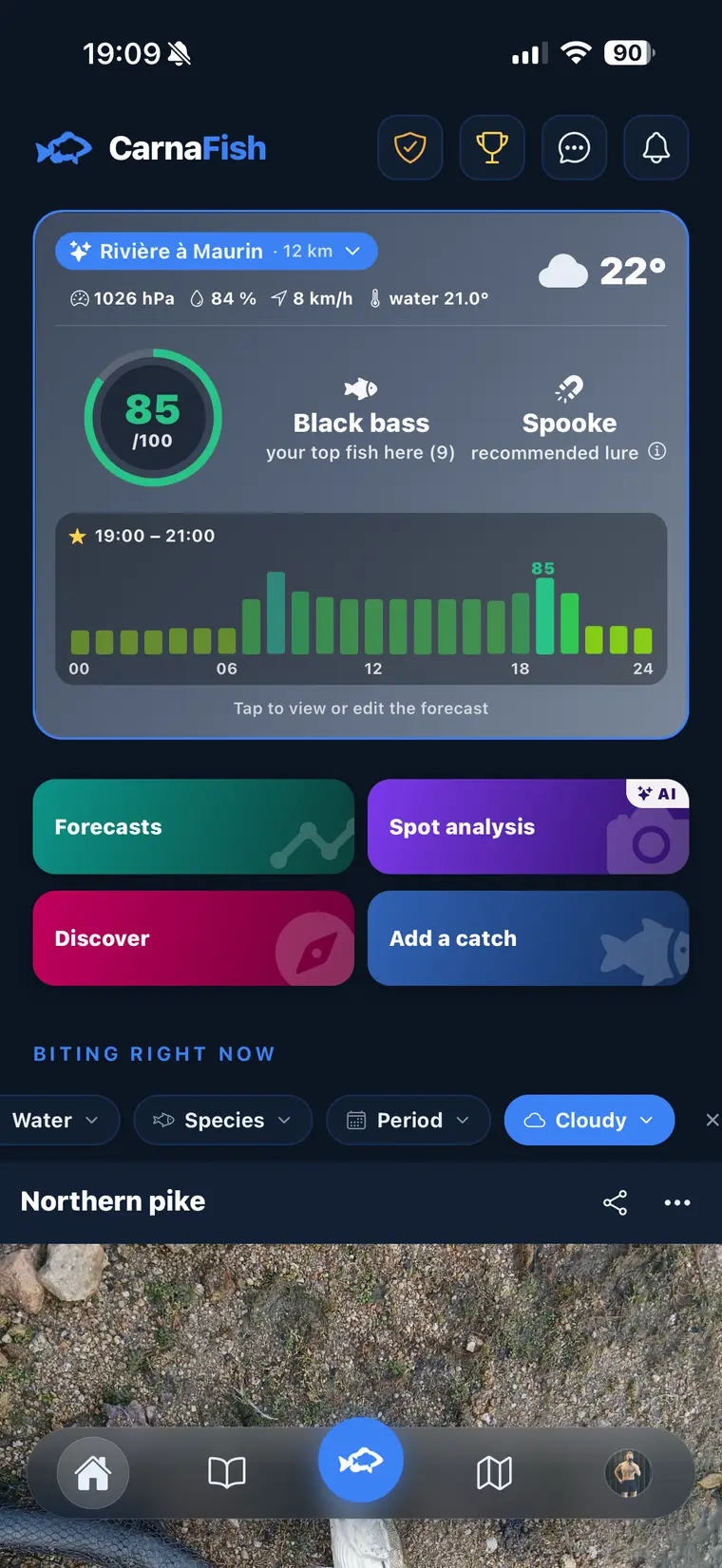
Not sure what to tie on?
Photograph your spot: CarnaFish reads the scene, cross-checks the conditions and gives you the zone, the lure and the retrieve. Free on iOS and Android.
Rigging and hooks
Imakatsu arms the Vazelle with two fluorine-coated Japanese trebles, a coating that reduces friction on penetration. The sample in the photo is shown bare, wings open and with no trebles fitted: that is a catalogue image, not the delivered condition.
For the rest, a spinning rod rated 5 to 15 g with a tip that is not too soft, fine braid and 50 cm of fluorocarbon in 0.25 to 0.30 mm. Braid floats and does not hamper the roll, unlike heavy monofilament that sinks between rod and lure. Finish with a loop knot or a small soft snap: this bait works by rolling on its axis, and anything that stiffens the connection cuts the amplitude.
The classic mistake
Fitting bigger trebles to hold fish better. On a 7 g body, two oversized trebles change the balance, sink the lure a few millimetres and reduce the lift of the wings. The roll goes soft, and sometimes disappears entirely. Stay with the original size, and if you want better holding power, change the quality rather than the gauge.
Colours by light
Imakatsu airbrushes its bodies and adds 3D eyes and moulded gill plates. On a topwater, that detail matters less than you would think: the fish mostly sees a silhouette against the light.
- Low light, dawn, dusk, dark water: the solid black of the photo. It is the most logical colour on this kind of lure, because it cuts a clean silhouette against the sky.
- Clear water, strong light: a natural silver shad, playing the reflection card rather than the contrast card.
- Stained water: a pale belly, white or chartreuse, visible from further away in loaded water.
A size that fills a gap among the noisy classics
The Vazelle covers ground few lures occupy: continuous disturbance in a light package. A Heddon Zara Puppy of comparable size demands rod action and makes no continuous noise; a River2Sea Whopper Plopper 130 churns as much but in a package three times heavier. And if you need to reach further with the same movement, the Dyvazelle repeats exactly these mechanics at 10 cm for casting gear.
A well-chosen topwater is worth nothing if it travels through the wrong place. That is the problem CarnaFish solves: a photo of the spot, and the app suggests the zone, the depth and the type of lure suited to the day's conditions. To go further on small formats and mid-sized fish, our guide to perch fishing with lures runs through the families worth knowing.
Key takeaways
- 7.9 cm / 3.1 in for about 7 g / 0.25 oz, listed as topwater: the smallest and fastest of the three Aventa Crawlers.
- Wings that fold on the cast, giving a crawler the distance and accuracy of a streamlined bait.
- It is a reel lure: any rod action interrupts the roll for two or three handle turns.
- Oversized trebles sink the body and kill the lift of the wings — keep the original size.
FAQ
What are the Vazelle's exact dimensions?
Imakatsu's table lists 3.1 in, or 7.9 cm, for 1/4 oz, which is about 7 g. The maker files it under the topwater class.
Does it need spinning or baitcasting gear?
Spinning. The Vazelle was designed for that kind of outfit, and 7 g stays light for a standard baitcasting reel. It was precisely to cover baitcasting that Imakatsu later released the Dyvazelle, longer and heavier.
How do I get the wings working properly?
Continuous reel retrieve, rod low and in line. The body should roll visibly and leave a permanent ripple behind it. If the lure skates without rolling, speed up slightly.
Does the Vazelle catch perch?
Its size lends itself to that, and it works in Europe on perch feeding at the surface in late summer. It is an extension of use, though: Imakatsu presents this lure for bass.
Which colour should I buy first?
Solid black, especially if you fish early or late. On a topwater the fish is looking at a shadow against the light, and a crisp silhouette counts for more than a detailed finish.
Are the hooks included?
Imakatsu lists two fluorine-coated Japanese trebles. The photo on this page shows a bare sample, wings open, with no trebles fitted: do not use it to judge the hardware.
The full bass lure guideSeason-by-season strategy: which family of lure, when, and why.Go from theory to fish
CarnaFish reads your spot from a photo and gives you the game plan: zone, lure, retrieve. Free on iOS and Android.