SPRO Creeper Topwater: the crawler with tunable metal wings
The right lure in the wrong spot still catches nothing. CarnaFish spots the zone that works, from a single photo.
A July evening, the water flat as an oil slick, and the bass refusing anything that moves fast. You have already run a popper, a stickbait and a frog through it; nothing has come up. This is the crawler's hour: a lure that travels at walking pace while churning the full width of the surface, leaving a trail of bubbles a fish hears long before it sees anything.
Two wings, and that is the whole lure
The Creeper is neither a lipped bait nor a prop bait: it is a crawler, and the two metal wings bolted to either side of the body are what put it in that category. SPRO describes it as moulded with a baitfish body shape and fitted with two metal wings, and states that it crawls along the surface creating a bubbling style action that calls fish out of cover. That is the manufacturer's wording, and it matches what a well-tuned crawler does: water resistance on the wings drags the front back, the body rolls from one flank to the other, and each wing stroke traps air that escapes as a string of bubbles.
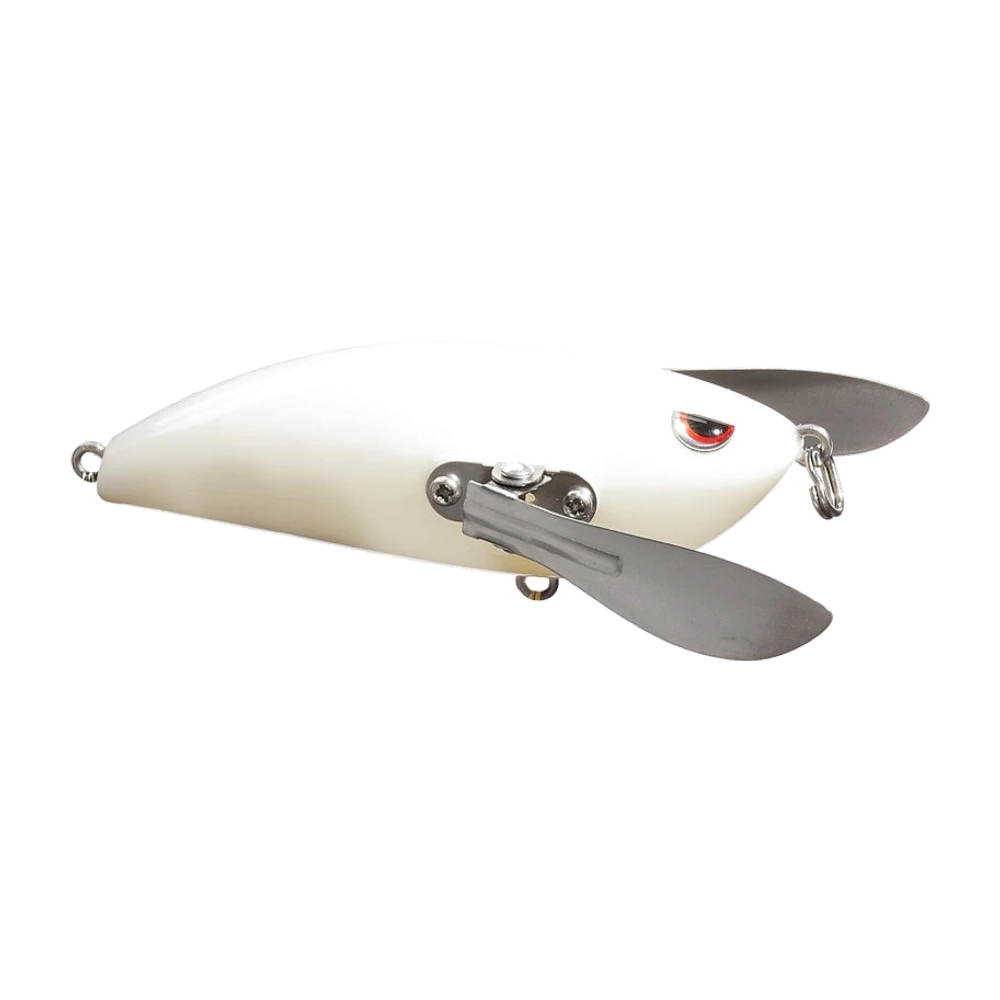
Where most crawlers carry a single moustache-shaped wing, the Creeper has two, mounted independently. In the product photo each one pivots on a plate screwed to the flank with two torx screws, with a central screw acting as the pivot, and the wing is a long ribbed blade reaching well beyond the body. That is an observation from a product photo: SPRO gives neither the material nor the dimensions of those wings.
Two manufacturer claims are worth reporting as they stand: the wings collapse during the cast, which increases casting distance, and they are tunable, for a more subtle or a more aggressive action. The pivot screw visible in the photo makes the second plausible, but SPRO specifies neither an adjustment range nor a method — open them a quarter turn at a time and test.
What the tuning actually does
The more the wings are opened, the more water they catch: the lure gets louder, throws more bubbles, and gets harder to retrieve slowly because drag goes up. The more they are closed, the more it glides: less noise, a finer wake, but a higher minimum speed before anything happens. So you tune for the state of the surface and the distance over which you want to be heard — closed on flat water with active fish, open on a wind-rippled surface or to call across a big shallow flat.
Tuning happens at the water's edge, not at home. Cast five metres out, watch the lure work, then correct. A badly tuned crawler does not give you a bad action, it gives you an irregular one that veers off to one side. If the lure pulls right, the left wing is catching too much water.
The retrieve: the easiest in all of topwater
There is nothing to do but wind. No walking, no rod snaps, no clever pauses. Cast, let the lure settle for a second, drop the rod tip towards the water and wind slowly at a constant speed. This is the topwater you can hand to somebody who has never thrown a lure in their life.
The subtlety is all in the speed. Find the exact point where the wings start to plough: half a crank slower and they stall; half a crank faster and the roll disappears. That low point is where the lure makes the most noise per metre travelled.
The one variation worth using
A clean one- to two-second stop, placed as the lure passes a target you have identified — a sunken branch, a dock piling, the shade line of a tree. On a fish that has heard the lure coming for ten metres, that silence is what makes it commit. Do not overdo it: three or four stops per cast at most, over specific targets, never at random.
Specs, hooks, and what the source leaves out
The retailer's table lists a single version under the heading Creeper 80: 3.14 in and 1/2 oz, so about 8 cm and 14.2 g. The Class column reads Topwater. Read that carefully: Topwater is a usage category, not a measured buoyancy. Nowhere does SPRO state this lure is rated floating. That it crawls across the surface obviously implies it sits on top at rest, but that is not a stated specification, and I would rather say so than invent it.
On hooks, the description mentions two hooks and plays up how sharp they are, with no size, no brand, no type. In the product photo the lure is bare: you can see two screw-in hangers, one under the belly just behind the wing plate and one at the tail, with nothing on them. So check what is fitted on the one you buy, and remember that on a slow topwater a slightly heavy hook changes the trim: test before you bolt on anything very stout.
The photographed model is plain bone white with a red and black 3D eye in a silver rim; that color is not named in the source.
Where and when to tie one on
The crawler is a calm-water lure: closed lakes, backwaters, the shallow end of a pond, a bank sheltered from the wind. It loses a lot as soon as a chop builds, because its signal is a steady noise and ripple drowns it.
The two windows that make it dangerous are dusk and full dark. A bass sitting under a tree at night sees almost nothing and locates with its lateral line: a crawler passing three metres away and making the same sound for twenty seconds gives it all the time it needs. First light works too, especially in late summer.
In Europe, the same spots often hold pike, and an 8 cm crawler worked slowly along a weed edge is a perfectly serious pike lure. Fish it with a heavy fluorocarbon leader at the very least: wire, safer though it is, weighs the nose down and upsets the trim on the surface.
Not sure what to tie on?
Photograph your spot: CarnaFish reads the scene, cross-checks the conditions and gives you the zone, the lure and the retrieve. Free on iOS and Android.
Tackle
Nothing exotic: a 2.00 to 2.30 m rod, medium to medium-heavy, fairly progressive action. A tip that is too stiff rips the lure out of the fish's mouth on a surface strike. Casting or spinning reel hardly matters, but a medium ratio beats a very fast one, which has you winding too quickly without noticing.
Line: braid for sensitivity and long-range hooksets, with a 30 to 40 lb fluorocarbon leader, or straight mono if you prefer the stretch. Tie straight to the nose ring: a crawler's action comes from the wings, not from a free nose.
Colors by light
- At night or first light: plain bone white, as photographed. Seen from below it is the silhouette that counts, and a very pale solid body reads against even a faintly lit sky.
- Overcast, grey daylight: a dark back. Logic inverted: under low ambient contrast, a black silhouette is easier to read than a mid tone.
- Stained or green water: a bright, contrasting flank, white and chartreuse, adding a close-range cue once the noise has pulled the fish in.
The right neighbours in the box
The Creeper fills one precise slot: the slowest topwater in the box. Beside it, an Imakatsu Aventa Crawler Vazelle plays the same tune with a single wing, and a River2Sea Whopper Plopper 130 takes over when you need to cover water fast and loud. For matted weed none of the three will cross, a SPRO Bronzeye Blade Frog 65 is still the answer.
Knowing whether a spot fishes on top at dusk or whether you should go down is half the job. CarnaFish answers that from a single photo of the water, suggesting a zone, a depth and a lure family that fit the conditions. And to read a bank before you even cast, our guide on how to read a fishing spot is the place to start.
The short version
- Two hinged metal wings, folding on the cast and tunable on a screw according to SPRO: that is the heart of the lure.
- One retrieve to learn, a very slow straight wind at the minimum speed that still keeps the wings ploughing.
- About 8 cm / 3.14 in for 14.2 g / 1/2 oz, a single size in the range; the Topwater label is a usage, not a stated buoyancy.
- The photographed sample is bare: check what hooks are fitted, and retest the trim if you change them.
FAQ
Does the SPRO Creeper float?
The description never says so. The table shows a Class column reading Topwater, which denotes surface use rather than measured buoyancy. A crawler obviously has to sit on top to work, but as long as the manufacturer does not state it explicitly, it is better not to present that as a specification.
How fast should I retrieve it?
At the slowest speed that still keeps both wings ploughing the surface. Half a crank slower and they stall; half a crank faster and the body settles and the roll disappears. That low point is what produces the most noise per metre travelled.
How do I tune the wings?
SPRO states they are tunable for a more subtle or more aggressive action, without giving a method. In practice, open them a quarter turn at a time and watch the lure five metres out: open wings mean more noise and more drag, closed wings more glide and a higher activation speed.
What hooks should I fit?
The description mentions two hooks without giving size or type, and the photographed lure is bare, with two screw-in hangers. So check what you receive, and retest the trim every time you change them: a few tenths of a gram at the front are enough to alter the roll.
Is it a good lure for night fishing?
That is its best window. The steady note of the wings gives the fish a continuous reference it tracks with its lateral line, which makes up for near-zero visibility. After dark, along a calm bank, it is one of the most effective surface presentations there is.
The full bass lure guideSeason-by-season strategy: which family of lure, when, and why.Go from theory to fish
CarnaFish reads your spot from a photo and gives you the game plan: zone, lure, retrieve. Free on iOS and Android.