Arbogast Jitterbug: the night-time surface noisemaker you fish by ear
The right lure in the wrong spot still catches nothing. CarnaFish spots the zone that works, from a single photo.
Night falls, the water goes glassy, and you lose every visual reference on the lake. That is exactly when the Jitterbug earns its keep: you do not see it, you hear it. A steady gurgle coming back towards you, then nothing at all — and that half-second of silence before the rod loads is one of the most honest sensations in lure fishing.
The lip does all the work
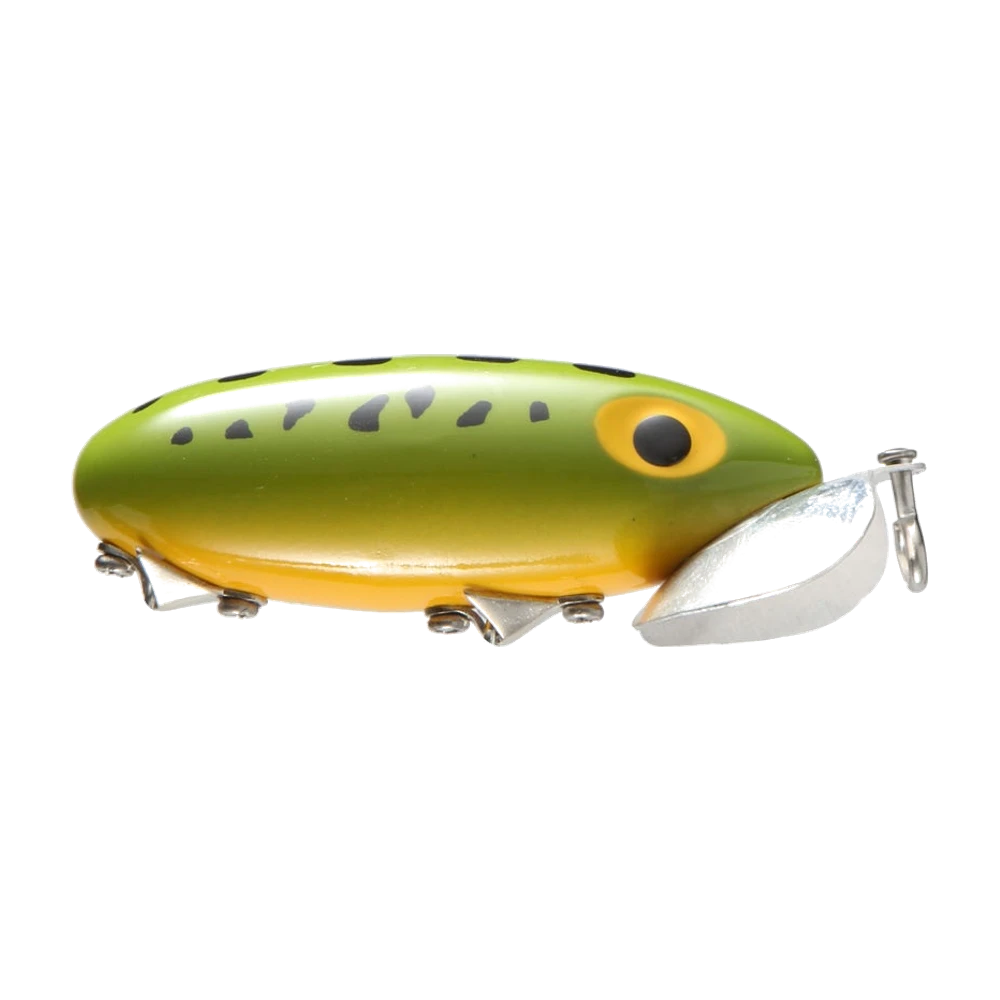
The Jitterbug has no internal rattle, no prop, no jointed tail. Its entire action comes from a single piece of stamped metal shaped into a double cup and fixed to the front of the body at a set angle. As the bait moves forward, each cup catches water in turn, tipping the body left, then right. The lure therefore waddles along, slapping the surface on every tip.
That noise is not cosmetic, it is the main signal. A predator hunting at night sees almost nothing and locates prey by pressure waves and surface noise. The Jitterbug's very regular slapping imitates a large prey item thrashing without managing to escape, and it is that constant rhythm that triggers the strike.
The lip angle is set at the factory and the body shape has been unchanged for decades. That is also the lure's limitation: it does one thing, and you have to let it do it.
Two sizes, two jobs
Arbogast offers the Jitterbug in two formats:
- Jitterbug 600 — 6.3 cm / 2.5 in for 10.6 g / 0.38 oz. The all-round size, light enough for a medium casting rod and loud enough to be heard across a small pond. The one to pick if you only buy one.
- Jitterbug 650 — 7.6 cm / 3 in for 17.7 g / 0.63 oz. Heavier, it casts far better into wind and puts out a deeper gurgle that carries further. Save it for big water and known big-fish spots.
Both are strictly topwater lures: neither version dives, whatever the retrieve speed.
Rhythm, and nothing else
This is where most anglers get it wrong. You do not work the Jitterbug with the rod. No sweeps, no twitches, no walking the dog: a slow, perfectly steady straight retrieve, rod tip low, and that is all.
The right speed is the slowest speed at which the bait tips cleanly from side to side. Below it, the lure drags in a straight line and produces nothing. Above it, the body lies over, the lip takes on too much water and the lure rolls on its flank without making a proper sound. Between the two there is a fairly narrow window: find it over the first few metres of each cast, then hold it.
When the gurgle stops dead mid-retrieve, do not strike. Keep turning at exactly the same speed for one more second. Nine times out of ten the fish missed and will come back on the second pass; strike into nothing and you pull the bait out of the zone with no second chance.
The hookset is the real subject
At night the instinct is to strike at the sound. That is the surest way to miss. Wait until you feel the weight in the rod, then sweep sideways without a vertical snatch. A topwater lure carrying two trebles always finds a hold if the fish is genuinely on it; an early strike simply tears the bait out before the jaws close.
Where and when to tie it on
The Jitterbug is a shallow water, flat calm lure. It is at its best on unrippled water, late in the day, at night, or at first light before the wind picks up. Lily pad edges, grass topping out half a metre down, stumps, tight little coves: anywhere a predator can sit and watch the surface.
In Europe it is also a very good pike bait on shallow flats in late summer, with one clear caveat: both trebles hang bare under a rigid body, and a pike cutting the line right at the nose is a common accident. Rig a heavy fluorocarbon leader, or soft wire if you know the spot holds them.
Its clear limit is wind. As soon as the surface ripples seriously, the bait's noise drowns in the sound of the waves and the point of it disappears. In those conditions a River2Sea Whopper Plopper 130 with its more aggressive prop keeps a far more readable sound signature.

Not sure what to tie on?
Photograph your spot: CarnaFish reads the scene, cross-checks the conditions and gives you the zone, the lure and the retrieve. Free on iOS and Android.
Colour by light level
- Vegetation, pads, failing light: Frog, the pattern in the photo — spotted green back, orange-yellow belly. It reads correctly whether the fish sees it from below or from the side.
- Full dark: black. Seen from underneath, a topwater lure is only a silhouette against the sky, and black is what stands out most sharply, even under a moon.
- Clear water at dusk: Perch, for when the fish still has enough light to study what it is about to hit.
Knowing when topwater is the right bet
A surface lure never rescues bad timing: if the fish are pinned to the bottom under ten degrees and a blue sky, no amount of gurgling will bring them up. That is exactly what CarnaFish is for: a photo of the spot, and the app suggests the zone, the depth and the lure type that fit the day's conditions — enough to know whether topwater is worth it that evening. To widen the thinking to other families, our guide to choosing a pike lure is a good companion read.
Key takeaways
- The whole action comes from the double-cupped lip: you steer this bait with the reel, never the rod.
- There is a narrow speed window where the gurgle is clean; too fast and the body lies over and the noise stops.
- Wait until you feel weight before striking, especially at night.
- A flat calm lure: the moment the surface ripples, its sound signature is lost.
FAQ
Should I work the Jitterbug with the rod?
No, and that is the most widespread mistake. It is fished on a slow, steady straight retrieve with the rod low. Rod sweeps knock it off its plane and interrupt the gurgle, which is its only real argument.
Jitterbug 600 or 650, which one?
The 600 (6.3 cm / 2.5 in, 10.6 g / 0.38 oz) is the more versatile and suits most waters. The 650 (7.6 cm / 3 in, 17.7 g / 0.63 oz) casts better into wind and carries further in sound: save it for big water or when you are clearly targeting larger fish.
Does the Jitterbug work in daylight?
Yes, but in specific windows: first light, last light, or in broad daylight under dense overhead cover and an overcast sky. In bright sun on clear water a subsurface bait will be more consistent.
Can it be fished in weed?
In scattered vegetation, yes, keeping it right on top. In a dense mat the two bare trebles foul every time: switch to a hollow body frog, or to an Arbogast Hula Popper worked on the spot in the holes.
Do I need a wire leader?
If pike use the spot, yes: the body is short and the fish often takes the whole bait. On a pure bass spot, 30-40 lb fluorocarbon is plenty and stays more discreet.
Why does my Jitterbug roll onto its side?
Almost always too much speed: the lip takes on too much water and the body lies over. Slow down until you get a clean left-right tip again. If it still does it at slow speed, check that the lip has not been bent by an impact or by freeing a snag.
The full bass lure guideSeason-by-season strategy: which family of lure, when, and why.Go from theory to fish
CarnaFish reads your spot from a photo and gives you the game plan: zone, lure, retrieve. Free on iOS and Android.