Kuusamo Räsänen: the heavy spoon you fish in a sawtooth
The right lure in the wrong spot still catches nothing. CarnaFish spots the zone that works, from a single photo.
November, a big lake, a thirty-kilometre crosswind. The pike have left the margins and settled on the drop-off, between four and seven metres, a good fifty metres out from the bank. You have a soft plastic on a jig head: it gets down fine, but you can barely feel it in the chop and you never really know where it is.
In those conditions a heavy spoon solves two problems at once: it gets the distance despite the wind, and it tells you what it is doing at all times. Its beat reads in the rod tip, its descent can be counted, its bottom contact is crisp. It is a reading tool as much as a lure.
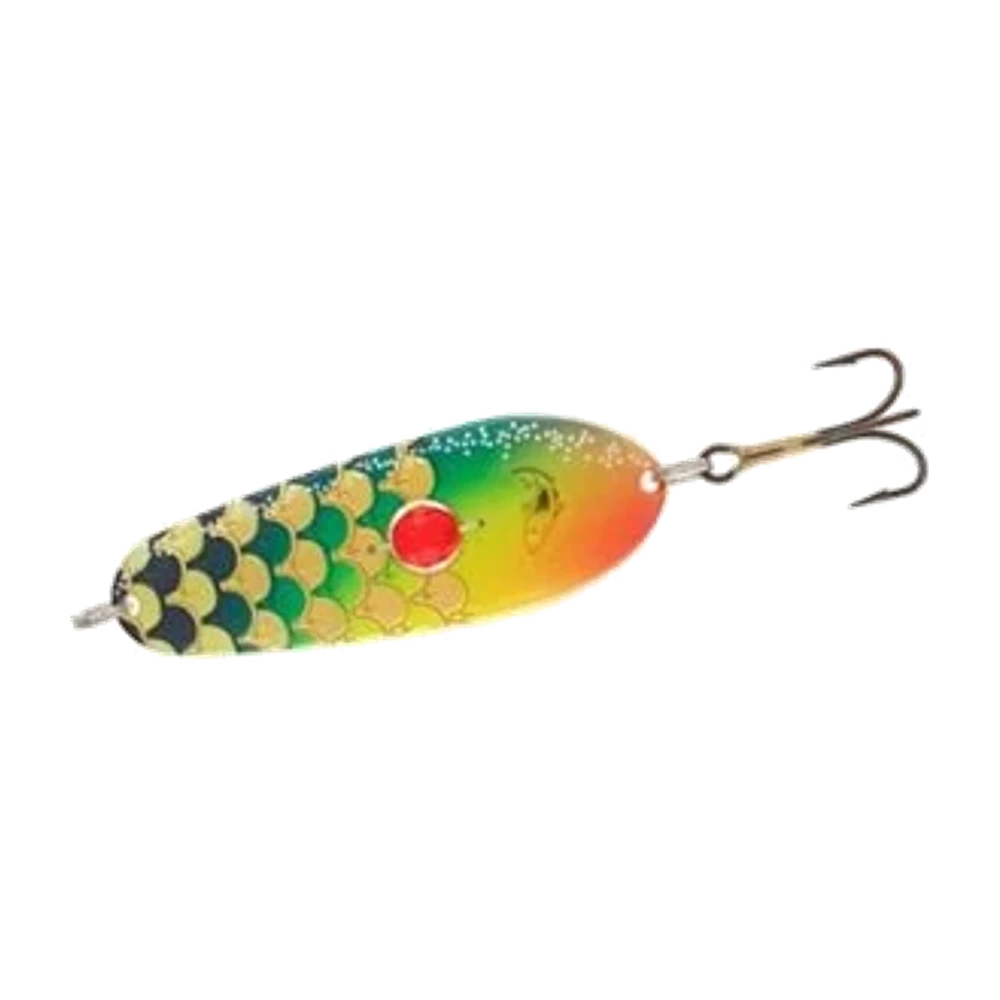
The Räsänen is the Finnish take on that idea: a thick, short, very dense body, built for the big northern lakes where you often have to fish far, deep, and in bad weather.
Concentrated mass, and what that implies
The Räsänen packs its weight into a small surface. Three consequences, one of which nobody anticipates.
- It sinks fast and straight. Count roughly one second per metre on a free drop in the middle weights. That consistency is what makes the counted drop reliable: you can reproduce exactly the same depth cast after cast.
- It vibrates tight rather than wobbling wide. On a straight retrieve the beat is short and fast, transmitted cleanly up the line. You feel it the instant it touches weed or breaks away.
- It rolls violently on the release. This is the key point. The moment you cut the tension, the dense body pivots on its axis and kicks sideways, throwing a single harsh flash quite unlike the steady blinking of the retrieve. That roll is the lure's real trigger, not its straight swim.
The yo-yo: the retrieve that justifies the weight
Fishing a Räsänen on a straight retrieve uses about a third of the lure. On a deep drop-off, the right retrieve is the sawtooth.
- Cast beyond the drop-off, onto the shelf, and let it sink on a semi-tight line, counting until it touches down.
- Two fast turns of the handle, rod horizontal, to lift the lure off and start its vibration.
- A rod lift of sixty centimetres to a metre, firm but not snappy. The lure rises, vibrating.
- Release while following it down, rod dropping back, line semi-tight. The lure rolls and glides downward. Count two to four seconds.
- Regain contact and start again. On a drop-off you work down the slope step by step.
The bite comes almost always during phase 4, and it rarely announces itself with a thump: most often the line tightens abnormally early, or the contact you expected never arrives. Set the hook on any anomaly.
On the water: always follow the drop down instead of letting the line run free. A Räsänen released on a slack line spins on itself instead of gliding, produces nothing but a messy flash and twists your line within three casts. Semi-tight line, rod tip following the fall: you keep the flank roll and you detect the bite that would otherwise be invisible to you.
Choosing the weight by depth and wind
| Spot | Indicative weight | Counted drop |
|---|---|---|
| Margin 2 to 3 m, calm weather | 15 to 18 g | 2 to 3 seconds |
| Drop-off 4 to 6 m | 20 to 28 g | 4 to 6 seconds |
| Deep shelf 6 to 8 m or strong wind | 30 to 40 g | 6 to 9 seconds |
A useful trick for calibrating your count: make a first cast deliberately "wasted", purely to time the drop to bottom contact at three different points on the spot. In three minutes you get a rough map of the contours, and from then on you know exactly how many seconds to allow each fall phase depending on where your lure is in the retrieve. It is a time investment that pays for itself by the fifth cast.
The forty-centimetre wire trace is not optional. With a yo-yo retrieve, pike attack on the rise and often take the lure across the body, line against teeth. Add a decent rolling swivel: despite the controlled roll, a heavy spoon always puts a little rotation into the line over a long session.
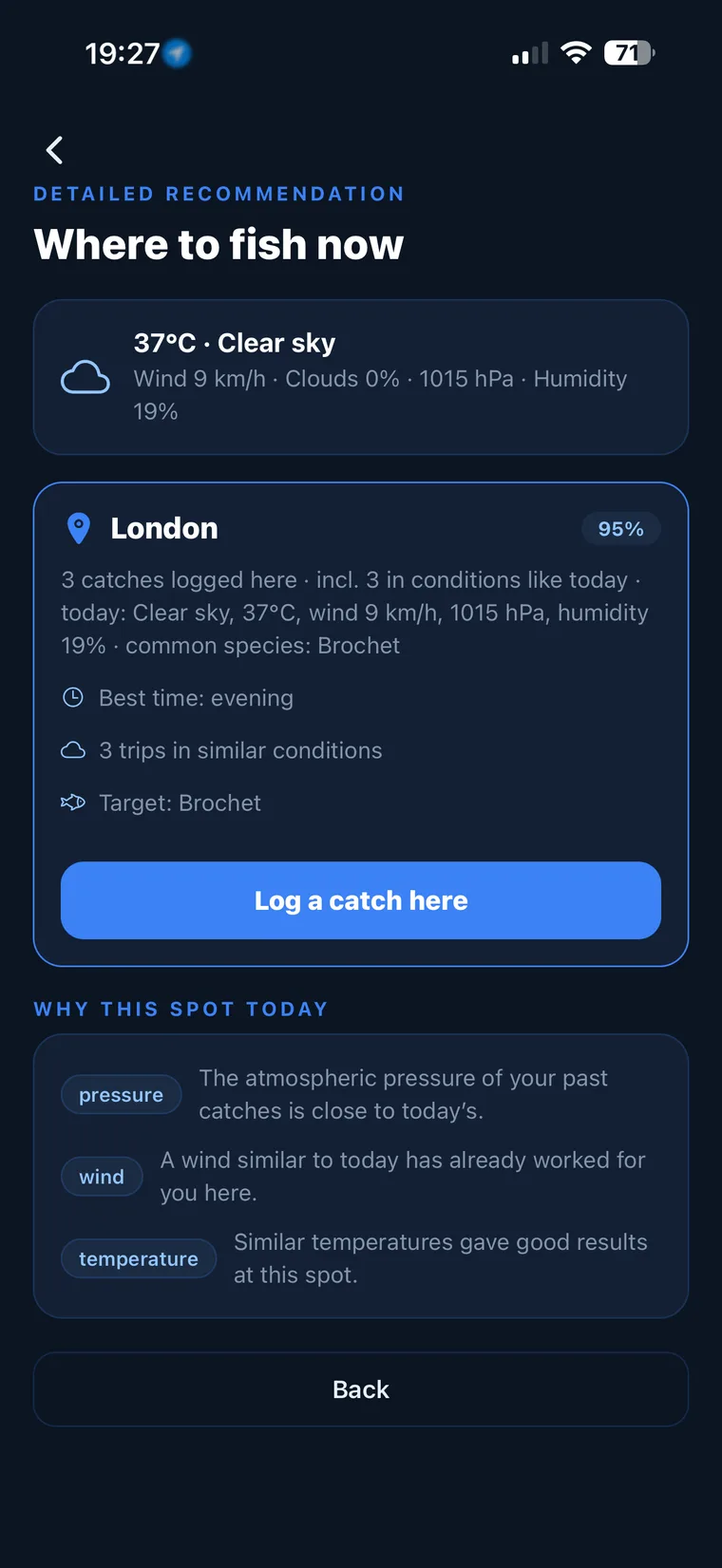
Not sure what to tie on?
Photograph your spot: CarnaFish reads the scene, cross-checks the conditions and gives you the zone, the lure and the retrieve. Free on iOS and Android.
Its windows and its blind spots
It is at its best:
- From late October to March, when pike leave the weed and settle on deep structure.
- On drop-offs, shelves and submerged points of big lakes and reservoirs.
- In strong wind, where the mass lets you both cast and stay in contact.
- From the bank, when the fish are out of range of a light lure.
It is unsuited:
- Over a weed bed: it drops into it on every descent, that is the Professor's ground.
- In very shallow water, under two metres, where the fall phase does not exist and the lure loses its point.
- Over bottoms littered with dead wood: losses get expensive fast.
- On active surface fish, where a faster, higher lure will cover more.
Räsänen or Professor: same country, two tools
The Kuusamo Professor is long, slim and light for its surface. It swims high, very slowly, and is there to pass over dense vegetation without fouling. Its minimum swimming speed is extremely low, its lift is high, its casting distance modest.
The Räsänen does the exact opposite: short, thick, dense, it sinks fast, handles wind, casts a long way and is fished in vertical phases. These are not two variants of the same spoon, they are two answers to two opposite questions — "how do I stay high without fouling" on one side, "how do I reach the bottom far out and read it" on the other.
Against an Acme Little Cleo, another heavy spoon already covered here, the split is about the water: the Cleo uses its cupped face to hold a fast river current, the Räsänen uses pure density for distance and vertical work in lakes. Our guide to choosing a pike lure sets this style of retrieve in the context of the fishing year. And if you cannot tell where the drop-off runs from the bank, CarnaFish analyses a photo of the spot and answers.
Key takeaways
- Thick, dense body: a fast, consistent drop of about one second per metre, so depth is reproducible.
- The trigger is the roll on the release, not the straight swim.
- Work it in a sawtooth: a one-metre lift, then a controlled two to four second drop.
- Window: autumn and winter, drop-offs of 4 to 8 m, strong wind, long-range bank fishing.
- Avoid it over weed, in under two metres, and over dead wood.
FAQ
How do I fish the Räsänen yo-yo style?
Let it sink to the bottom on a count, then alternate a rod lift of about a metre with a controlled two to four second drop on a semi-tight line. That way you cover the full height of a drop-off without changing lures.
What weight for fishing at five metres?
Between 20 and 28 g in most cases, which gives a drop of about four to six seconds. Go to 30 g or more if the wind is pushing your line or you have to cast a long way from the bank.
Why does my line twist with this spoon?
Almost always because the drop happens on a slack line: the lure spins on itself instead of gliding. Follow the fall with the rod tip and add a rolling swivel forty centimetres from the lure.
Is the Räsänen suitable for small ponds?
Hardly. Under two metres the fall phase that makes it interesting disappears, and its mass becomes a handicap. A light spoon or a light soft plastic will be far more relevant.
Do I really need a wire trace?
Yes. On a vertical retrieve the pike rises onto the lure and often grabs it across the body, which puts the line straight onto the teeth. Forty centimetres of soft wire solves the problem without spoiling the roll.
What colour in overcast weather and deep water?
Copper or brass. Warm tones keep a usable contrast where silver goes neutral, and an orange or red flank adds a useful visual reference point when light is poor at five or six metres.
The full pike lure guideSeason-by-season strategy: which family of lure, when, and why.Go from theory to fish
CarnaFish reads your spot from a photo and gives you the game plan: zone, lure, retrieve. Free on iOS and Android.