Johnson Silver Minnow: the weedless spoon patented back in 1923
Rather not fish it blind? Photograph your spot — CarnaFish cross-checks the conditions and points you the right way.
Every water has spots you look at but never cast into: a bay carpeted in lily pads, a pondweed edge that tops out eight inches under the surface, a summer weed mat so thick you would lose three lures in four casts. That is exactly the ground the Johnson Silver Minnow was patented for in 1923, and it is about the only lure you can drag through it without thinking twice. A century later, the principle has not moved a millimetre.
A wobble stated at 35 degrees
Johnson quotes an actual figure, which is rare enough to be worth noting: the spoon is built to produce a thirty-five degree wobble, meaning a measured side-to-side roll, neither sloppy nor frantic. That is not cosmetic. A wobbling spoon that rolls too far ends up spinning on its own axis and twisting your line within ten minutes; one that barely rolls throws almost no flash and disappears the moment the water colours up. Thirty-five degrees is the compromise that lets you grind a slow straight retrieve for an hour without untangling a corkscrewed leader.
In the water you get a steady back-and-forth: the dished body tips from one flank to the other, kicks light out in pulses, and puts out a low-frequency vibration a pike picks up from a long way off. It is a far blunter signal than a soft swimbait gives, and that is precisely what you want when the fish is tucked under a weed mat and only sees the lure at the last second.
What the wire weedguard actually does
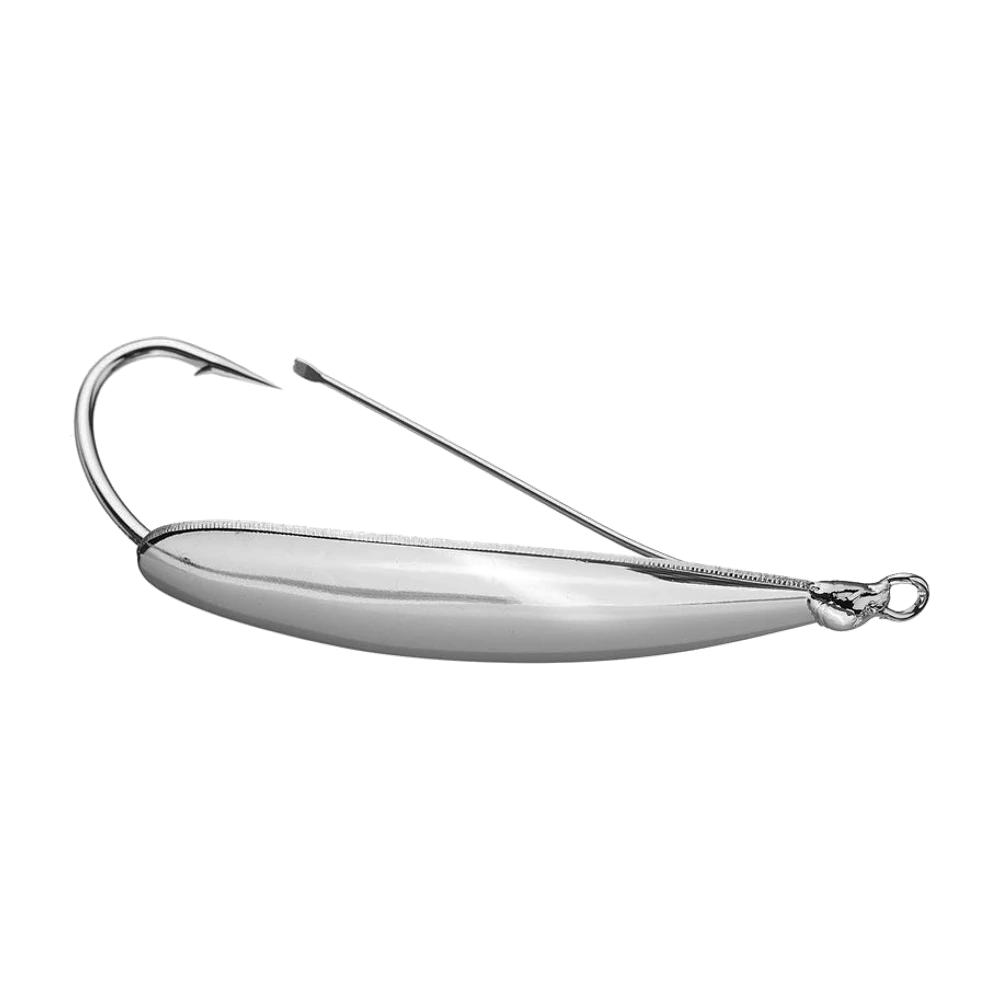
This is the part everything else hangs on. A single metal wire runs from the nose of the lure and sits just above the point of the single hook, which is itself welded to the body — not hung on a split ring, welded. The result is one continuous surface with no sharp angle and no protruding ring: when the spoon hits a lily stem, the wire pushes the obstacle aside and the point stays protected. It is not a gimmick, it is the whole reason the lure exists.
The most common mistake is flattening that wire against the body in the name of "adjusting" it. A weedguard that is too soft lets the point grab the first strand it meets; one that stands too far out stops you hooking anything. Check the tension with your thumb: it should take a firm push, the kind of pressure a fish applies when it clamps down, to lay the wire flat and expose the point. If you can press it in with a fingertip, it is too soft.
Setting the hook on a weedless spoon
A guarded single hook is not set like a treble. Let the fish take the lure properly — a short but real pause — then sweep hard and low to the side so the wire folds and the point drives through. The reflex of striking the instant the water explodes costs a lot of fish on this kind of lure. A moderate-action rod and non-stretch braid help a great deal, especially when ten metres of your line is lying across floating vegetation and soaking up everything.
Four sizes, four jobs
The range runs to four versions, and each one has a fairly distinct role:
- 5.1 cm / 2 in for about 7 g / 1/4 oz: the lightest version, best kept for bass and perch over shallow weed. The low weight limits casting range but it stays high in the column even at a crawl.
- 6.4 cm / 2.5 in for about 14 g / 1/2 oz: the most balanced freshwater size, heavy enough to punch into wind and discreet enough for pressured water.
- 7 cm / 2.75 in for about 21 g / 3/4 oz: nearly the same visual footprint but a higher density, which lets you fish a notch deeper or hold in light current.
- 9.5 cm / 3.75 in for about 32 g / 1-1/8 oz: the big one, for autumn pike, large windswept bays and saltwater edges where a decent sea bass may follow.
The maker quotes weights in ounces; the metric figures above are rounded conversions. As often happens with an old design, density does not track length in a straight line: the 7 cm version weighs half as much again as the 6.4 cm for three or four extra millimetres. If you want to fish deeper without growing the silhouette, that is the lever to pull.
Before your first cast, slide the lure through a foot of water alongside the boat or the bank and watch it work. If the spoon spins instead of rolling, you are retrieving too fast: slow down until the clean side-to-side kick comes back. On this lure, the right speed shows up to the eye before you feel it in the rod.
Working a lure that needs almost no work
A slow straight retrieve does eighty percent of the job. Cast past the weed, wind at the slowest speed that keeps the roll alive, and let the spoon shave the top of the mat. Over the holes — those small patches of open water between two clumps of pads — just stop winding for a second: the spoon noses down and flutters, and that is very often where the pike commits. Start again immediately, or it will settle into the bottom growth.
Adding a soft trailer to the single hook changes the behaviour noticeably. A grub body such as the Keitech Flapper Grub or a legged chunk like the Keitech Flex Chunk slows the fall, bulks up the profile and adds movement of its own on the drag. That is the classic answer when fish refuse bare metal. The trade-off is that a trailer damps the wobble, so keep the volume moderate or you will kill those thirty-five degrees.
The classic mistake
Trying to turn the Silver Minnow into an open-water search bait. It can do that, but it has no advantage over a more modern wobbler such as the Delalande Illico Spoon or a dedicated vertical spoon like the 6th Sense Flutter Spoon 120. Its value begins where other lures stop: in the salad. Outside that context it is just another spoon, with one hook and a guard that costs you hook-up ratio.
One oddity in the official copy is worth flagging: it praises a "vertical presentation" while also explaining that the lure is built to slide through heavily vegetated areas. Both uses exist — you can let it drop down a piling or a steep edge — but the flat retrieve over weed is what the weedguard was drawn for. Do not let that phrase push you toward a vertical game where this is not the best tool.
Not sure what to tie on?
Photograph your spot: CarnaFish reads the scene, cross-checks the conditions and gives you the zone, the lure and the retrieve. Free on iOS and Android.
Finishes to match the light
On a metal spoon the thinking is about finish rather than colour patterns, and the product copy gives no colour chart. Three lines of reasoning cover it:
- Clear water, hard sun: bare silver, the one in the photo. It throws a clean cold flash, close to the glint of a baitfish turning on its side.
- Stained water or a murky back bay: a gold finish, whose warmer flash carries better when light is filtered by weed and suspended particles.
- Overcast, dawn, dark water: a dark finish, which does not flash at all but cuts a clean silhouette seen from below against the sky.
A working lure, not a display piece
The Silver Minnow replaces nothing: it opens up water you were not fishing. On a hundred-year-old lure that is the only argument that counts, and it is more than enough to keep it in a box in 2026. The remaining question is which weed beds are worth the effort, and no spoon will answer that. CarnaFish will: one photo of the spot, and the AI suggests the zone, the depth and the kind of presentation that fit the conditions of the day. To place this lure among the other families that catch pike, our guide to choosing a pike lure covers the ground.
Key takeaways
- The single wire weedguard and the welded single hook are the whole point: this spoon fishes where a treble snags on the first cast.
- The stated 35-degree wobble calls for a moderate speed; push past it and the spoon spins and twists your line.
- Four sizes from 5.1 to 9.5 cm / 2 to 3.75 in for roughly 7 to 32 g / 1/4 to 1-1/8 oz, with density that does not track length.
- Set the hook wide and firm after a short pause so the wire folds and the point can drive home.
FAQ
Does the Johnson Silver Minnow really come through lily pads?
Yes, that is the water it was born for. The guard wire stretched above the point pushes stems and pads aside, and the hook welded to the body leaves no free ring for weed to wrap around. In very dense filamentous algae a hollow-body frog is still cleaner.
Which size for pike?
The 7 cm / 2.75 in and 9.5 cm / 3.75 in versions, around 21 g / 3/4 oz and 32 g / 1-1/8 oz. The bigger one casts into a headwind and suits autumn pike; the 7 cm is more versatile over shallow weed where a heavy spoon would sink too fast.
Should I always add a soft trailer?
No. A trailer slows the fall, bulks the profile and helps when fish ignore bare metal, but it also damps the wobble. Keep the volume moderate, and take it off if the spoon stops rolling cleanly.
Why do I miss so many bites on this lure?
Almost always the hookset or the weedguard tension. Sweep wide and firm after a short pause, and check that the wire lays flat under solid thumb pressure. Too stiff, and the point never gets through.
Can it be used in saltwater?
The maker rates it for fresh and salt alike. Along posidonia edges or algae flats where sea bass hunt, the weedguard principle still makes sense. Rinse the lure in fresh water after the session, bare metal is not immune.
How is it different from a standard wobbling spoon?
A standard wobbler carries a treble on a split ring and is fished in open water. The Silver Minnow has a welded single hook and a guard: it gives up a little hook-up ratio but becomes usable in cover where a standard spoon snags on the first cast.
The full pike lure guideSeason-by-season strategy: which family of lure, when, and why.Go from theory to fish
CarnaFish reads your spot from a photo and gives you the game plan: zone, lure, retrieve. Free on iOS and Android.