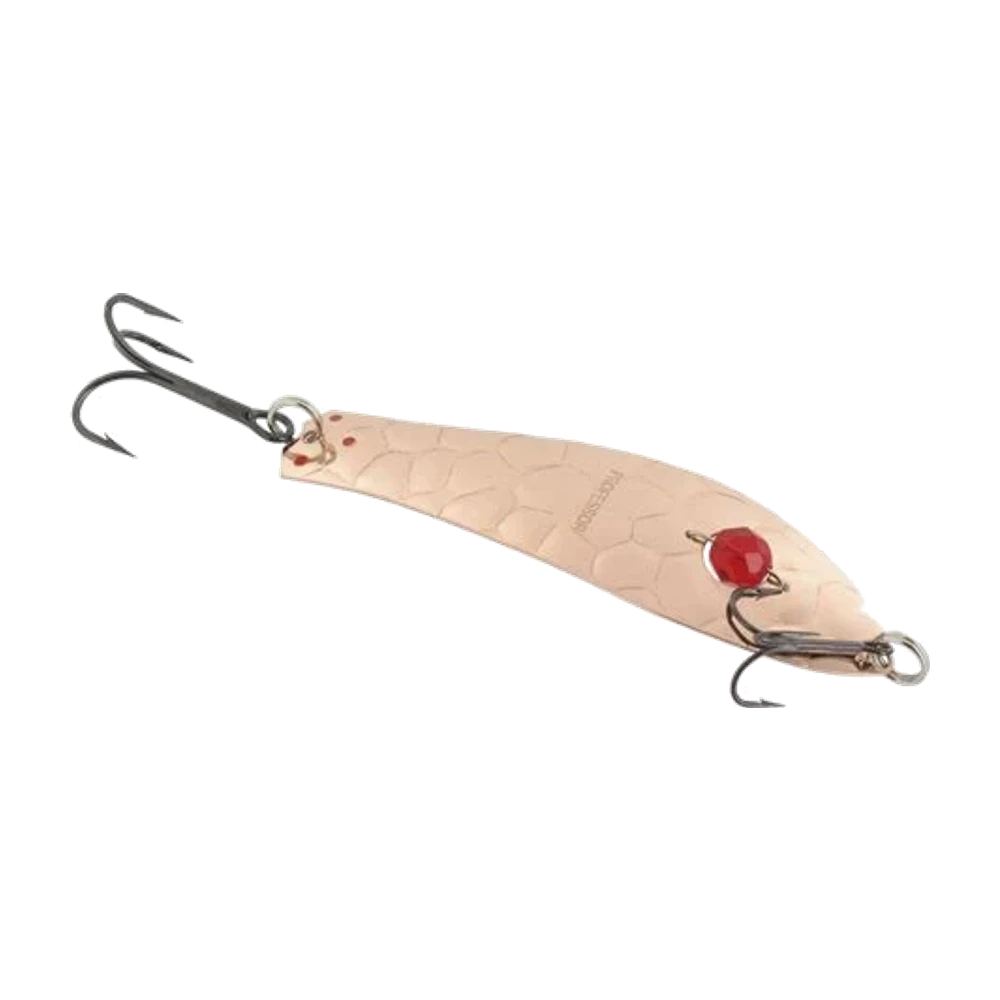
Kuusamo Professor: the spoon that still swims when everything else stalls
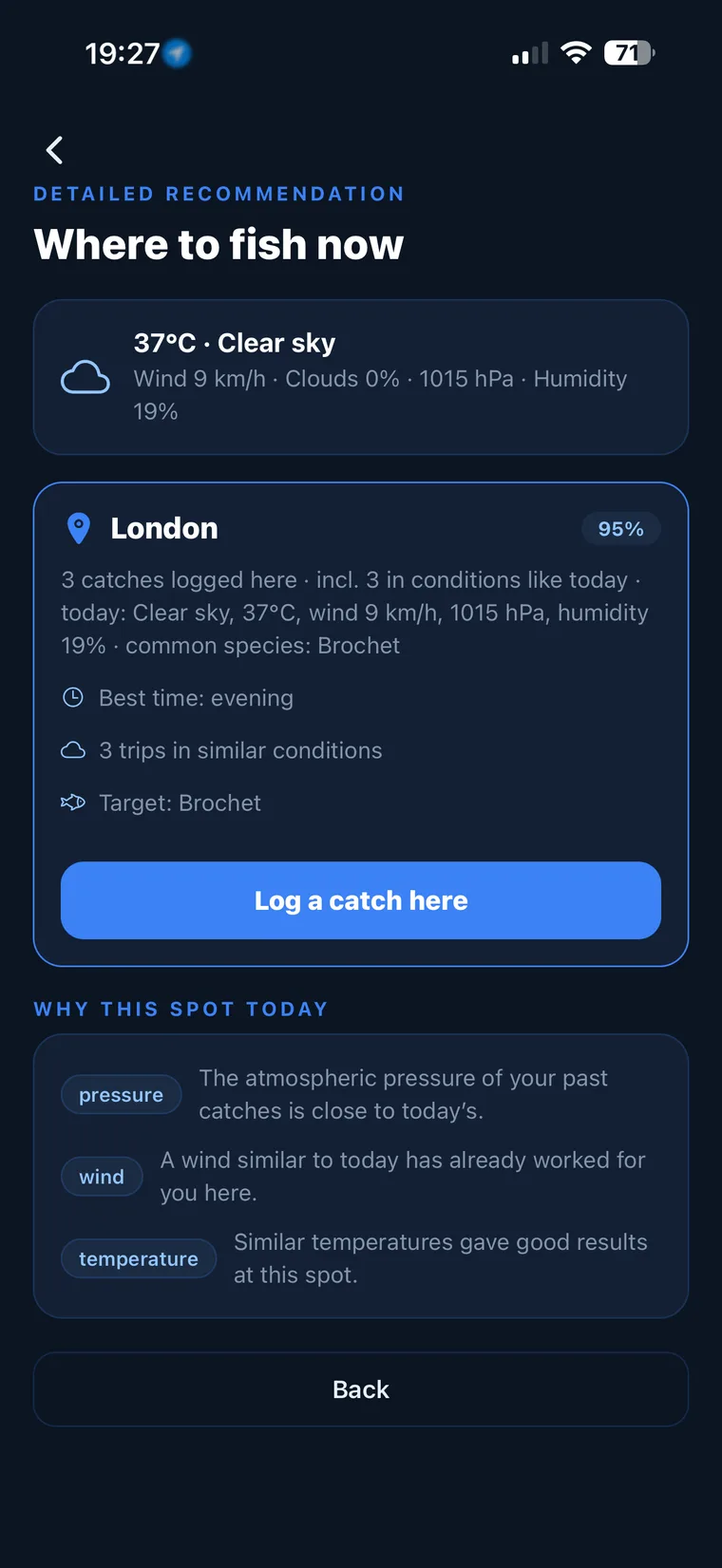
This lure shines under specific conditions. CarnaFish tells you in 10 seconds if today is one of them.
A late-spring weed flat: a metre twenty of water, milfoil growing to within thirty centimetres of the surface, and pike lying in it that will not move more than two metres to feed. You cannot run a weighted shad through it, it picks up salad on every cast. You cannot run a dense spoon through it either, it drops into the vegetation the moment you slow down.
What you need is a lure that can stay in that thirty centimetres of open water above the weed while swimming slowly. Not on the surface, not on the bottom: in that narrow band, at a speed where a pike can make up its mind without leaving cover.
That is exactly the Professor's ground — a long, slim Finnish spoon, light for its size, whose entire design comes down to a single ratio: plenty of surface, very little mass.
Surface-to-weight ratio, the only spec that matters here
Two 18 g spoons can behave in opposite ways. The short, thick one sinks fast and vibrates tight. The long, slim one — the Professor's case — presents a large surface to the water for the same mass, with three consequences.
- High lift. As soon as the lure moves forward, water flowing over its concave face holds it high in the column. You can fish it fifty centimetres under the surface over a metre of weed without it fouling.
- A very low minimum speed. Where a dense spoon stops swimming and starts spinning, the Professor keeps rolling from one flank to the other. That is what lets you slow down to an almost stationary rhythm.
- A wide, slow wobble. The body rolls right over, showing the concave face then the convex face in turn. The flash produced is broad and widely spaced, closer to an injured fish turning over than to a fish fleeing.
The downside is predictable: it casts shorter than a dense spoon of the same weight, it gets blown off line in wind, and it becomes hard to control as soon as there is any current.
Fishing it slow without losing the action
The classic mistake is to retrieve it "normally". At medium speed the Professor swims well but offers nothing special: any spoon does the same. All its advantage lies in the slow zone, and you have to go and find it.
- Cast and let it sink for three seconds maximum over a weed bed. Semi-tight line — you should see the rod tip register the roll.
- Start with a wide sweep of the rod tip to engage the wobble, then switch to the handle.
- Slow down to the limit. You feel the beat in the rod tip, a dull, regular knock about one per second. When that beat turns irregular you are too slow: speed up just a fraction.
- Lift the rod to forty-five degrees to keep the lure high. Swimming depth is steered as much by rod angle as by speed.
- Pause for one second every ten turns. The lure glides sideways then noses down. On a following pike, that is where it happens.
- Do not lift the lure out vertically. Finish by sweeping to the side, rod low, over the last three metres.
On the water: with a very light spoon it is not handle speed that sets depth, it is rod tip height. Hold a constant speed and steer the water layer by raising or lowering the rod twenty centimetres. That way you can follow the contour of an uneven weed bed without ever changing rhythm — and a constant rhythm is precisely what a waiting pike needs before it commits.
Sizes and uses
| Size | Indicative weight | Use |
|---|---|---|
| Small | 7 to 10 g | lake trout, perch, clear water and wary fish |
| Medium | 12 to 18 g | pike over shallow weed, the do-everything size |
| Large | 20 to 26 g | big pike, slow trolling from a boat, deep lakes |
For pike, a thirty-centimetre soft wire trace is compulsory. Over genuinely dense weed, swap the treble for a single rigged point up with a weedguard: you lose a little hooking power, you gain the ability to fish where nobody else goes.
Not sure what to tie on?
Photograph your spot: CarnaFish reads the scene, cross-checks the conditions and gives you the zone, the lure and the retrieve. Free on iOS and Android.
Slow trolling, its other ground
The Professor is also a boat spoon. On a very slow troll, on the oars or on an electric motor at tick-over, it keeps working while most hard lures need more speed to come alive. Two practical points:
- Thirty to fifty metres of line behind the boat in clear water, less in tannin-stained water.
- Change course regularly. On every turn, the inside lure slows and noses down while the outside one accelerates. The bite often comes on those variations, not in a straight line.
On the other hand, as soon as you speed up to cover water, switch lures: the Professor breaks away and starts spinning on itself, which twists your line and catches nothing.
Professor or Räsänen: two Finns, two philosophies
Both come from the same country and target the same fish, but they do not replace each other.
The Kuusamo Räsänen is the exact opposite: a thicker, heavier body that sinks fast, vibrates tight and holds its action at speed and in wind. It is the lure for deep margins, rough days and big lakes where you have to cast far and get down.
The Professor is the lure for shallow water and slow speeds. Over a weed flat in a metre fifty, the Räsänen is unmanageable — it drops into the vegetation. On a five-metre drop-off in a crosswind, the Professor never gets down. A serious lake angler carries both and chooses by the spot, not by preference.
Against a Mepps Syclops, the difference is more subtle: the Syclops is a balanced spoon, more versatile across speeds but less extreme in the slow register. Our guide to choosing a pike lure places the spoon among the other families by season. And if you are unsure which water layer to target over a weed flat, CarnaFish analyses a photo of the spot and answers.
Key takeaways
- Plenty of surface, very little mass: the Professor still swims at speeds where other spoons stall.
- You steer it with rod height, not with handle speed.
- Main window: weed flats of 1 to 2 m, waiting pike, and very slow trolling from a boat.
- Weedless single over dense vegetation, soft wire trace every time for pike.
- Unsuited to strong wind, current and fast searching: that is where the Räsänen takes over.
FAQ
How deep does the Kuusamo Professor swim?
From about twenty centimetres to three metres, but its comfort zone is the top metre. Its lift holds it high as soon as it moves forward: to go deeper you have to slow down drastically, drop the rod and accept losing part of the action.
What size should I choose for pike?
The middle size, around 12 to 18 g, covers most lake and pond situations. The big 20 to 26 g sizes are useful for trolling and on large lakes, but they are tiring to cast all day on a rod.
Do I need a wire trace?
Yes for pike, no exceptions. A spoon is often taken across the mouth and the line ends up on the teeth. Thirty centimetres of soft wire or titanium is enough and does not spoil this lure's action.
Can it be fished in rivers?
Only in slack areas, back eddies and old side channels. In real current its lightness makes it break away and swing off line: a dense or deeply cupped spoon will hold the flow far better.
What is the difference with the Räsänen?
The Räsänen is heavier: it sinks fast, vibrates tight and handles wind and speed. The Professor is slim and light: it swims high, very slowly, over weed. They are two complementary tools, not two versions of the same lure.
What colour in a tannin-stained lake?
Copper or gold, possibly with a red flank. In peat-coloured water, warm tones stay readable deeper than silver, which is at its best in clear water and strong light.
The full pike lure guideSeason-by-season strategy: which family of lure, when, and why.Go from theory to fish
CarnaFish reads your spot from a photo and gives you the game plan: zone, lure, retrieve. Free on iOS and Android.