Luck-E-Strike Redman Colorado: the cold dirty water spinnerbait
Not sure this lure fits YOUR spot today? CarnaFish tells you in 10 seconds, from a photo.
Late February, the water is at 7 °C and the level has come up forty centimetres after three days of rain. Visibility doesn't reach past thirty centimetres, and anything that relies on sight is out of the game. These are exactly the conditions where a big Colorado blade spinnerbait takes back the advantage over everything else: it doesn't ask the fish to see, it asks the fish to feel. The Luck-E-Strike Redman is a 1970s drawing brought up to date for that job, and that is precisely what it claims to do.
Why the big blade turns slowly, and why that's deliberate
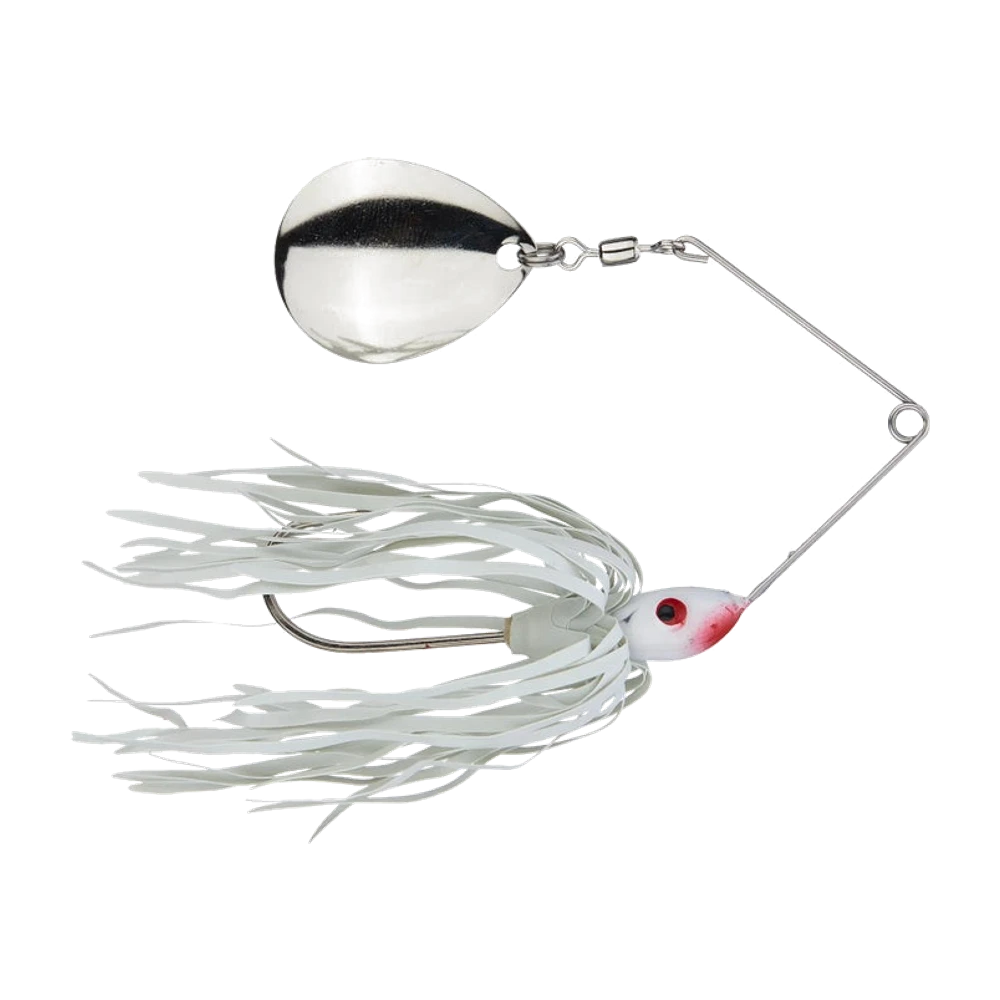
A Colorado blade is almost round and deeply cupped. At equal diameter it meets far more water resistance than an elongated willow, so it turns further out from the shaft and more slowly. Luck-E-Strike pushes the logic by fitting a blade described as oversize on a classic barrel swivel: the rotation point is deliberately slowed to produce heavier vibration and a more definite feel in the rod.
That runs against the grain of modern spinnerbait fashion, which tends to spin small blades very fast to generate flash. Here flash is secondary. What this lure produces is a low, widely spaced pulse that a fish picks up through its lateral line long before it sees anything. In water below 10 °C, where a bass or a pike won't travel three metres to intercept something, that distant signal is what makes it shift a metre.
The short arm, and what it implies
The Redman is built on a safety-pin frame with a short upper arm. Two consequences follow. The first is mechanical: the shorter the arm, the less leverage it offers, so the less it bends under load. The maker stresses the durability of the frame, built to take heavy cover and repeated fish, and a short arm is the first condition of that toughness.
The second consequence is on the swim. A short arm brings the blade closer to the skirt. The lure then presents a more compact package, closer to a stocky baitfish than a long spindle, and the turbulence off the blade washes straight over the skirt strands instead of dissipating behind them. The strands move more at slow speeds, which is exactly what you want when the retrieve is a crawl.
The closed eye, the detail you notice too late
On many spinnerbaits the line tie is a simple open R-bend: the knot sits on it but nothing stops it sliding along the wire when you set the hook or when a fish pulls at an angle. The knot drops, the lure's geometry changes, and the swim degrades without you understanding why.
Luck-E-Strike closes that loop completely, and the photo shows it without ambiguity: it's a round ring closed on itself, not a bend. The knot stays put, cast after cast. The practical result is that you can tie straight through without a snap, removing one more piece of hardware from a rig that already has plenty. If you'd still rather use a snap for quick changes, you can, but it's no longer a necessity.
The flat rubber skirt, not silicone
This is the most dated feature of the Redman, and the most interesting. The maker advertises vintage flat rubber skirts, not the round silicone strands found on virtually every current spinnerbait. The two don't behave the same in the water. A round silicone strand is stiff and snaps back to its rest position fast; a flat rubber strand is supple, it undulates, folds and breathes, and it keeps moving when the lure has stopped.
That has a direct consequence on how you fish this lure. A silicone-skirted spinnerbait loses much of its interest once it slows below a certain threshold. A flat rubber skirt stays alive at a standstill: you can let it fall alongside a piling, park it against an obstacle, and the skirt keeps working on its own. Paired with a blade that still turns at a crawl, that's what makes the whole thing coherent.
When the blade picks up weed, don't pull. Give one short sharp lift and immediately drop back half a turn of the handle. The big Colorado clears itself by flipping over and starts turning again — and the bite very often comes within the second after that release, because the lure has just produced an irregular signal in the middle of a regular vibration.
Where and when it takes over
The maker says it plainly: this lure excels in cold dirty water, and that's where it should come out first. In practice that means late winter and early spring, flood events, waters that colour up after a blow, silty pond backs. The head of a reservoir where the river comes in and drops its sediment is the textbook spot.
The classic mistake
Reeling it too fast. That's the reflex of anyone who learned spinnerbaits on double willow models, which need speed for the blades to lift and spin properly. On a big Colorado, speeding up gains nothing: the blade is already turning, and past a certain speed the lure starts losing its attitude and climbing towards the surface. Retrieve at the slowest speed where you can still feel the pulse. If you can't feel it any more, slow down one more notch before you think about speeding up.
Not sure what to tie on?
Photograph your spot: CarnaFish reads the scene, cross-checks the conditions and gives you the zone, the lure and the retrieve. Free on iOS and Android.
Colours by water clarity
The description doesn't publish a colour list. So reason by visibility logic:
- Cold, stained water: the white and chrome combination, the one in the photo — white skirt, white head with red gill marks, chrome blade. White is the shade that keeps the most contrast as light drops below the surface, and chrome returns what little light there is.
- Very dirty water, under twenty centimetres of visibility: dark tones, black or deep chartreuse. At that turbidity the fish works on its lateral line, and colour only serves to give a sharp silhouette in the last metre.
- Water clearing after a flood: natural shades, roach or perch. Once visibility is back above a metre, heavy contrast becomes a handicap.
A classic alongside modern spinnerbaits
Against a Bizz Baits Big Thump, also built around a single Colorado, the Redman plays the material card rather than the geometry card: the rubber skirt is where its difference lies. Against a Booyah Covert Spinnerbait or a Strike King Tour Grade Spinnerbait rigged with double willows, it loses in search speed what it gains in slow fishability. These are two different tools, not two versions of the same one.
Knowing which to pull out when depends first on the water in front of you, and that's what CarnaFish is for: one photo of the spot, and the AI suggests the zone, the depth and the lure type that match the day's conditions. To widen out to the other families worth having when the water colours up, our guide to choosing a pike lure covers the ground.
Key takeaways
- The oversize Colorado blade is rigged to turn slowly: low vibration and a very clear return in the rod, at the expense of flash.
- The flat rubber skirt keeps working at a standstill where a silicone skirt freezes — that's what makes genuinely slow fishing possible.
- The line tie is a fully closed loop: the knot can't slide along the wire, and a snap becomes optional.
- The maker publishes neither length nor weight for this model: check in the shop if you need to match a specific rod.
FAQ
How much does this spinnerbait weigh?
The maker publishes no spec table for this model, neither weight nor length. That's awkward if you want to match a rod precisely: check the packaging in the shop rather than trusting a figure quoted elsewhere.
Why a single Colorado blade instead of double willows?
Because the two do different jobs. A Colorado turns slowly, lifts well and vibrates low, which lets you fish very slowly in cold or dirty water. Double willows flash more and need speed, which suits clear water and fast searching better.
Is a rubber skirt really better than silicone?
Not better at everything: it ages worse and gets tacky over time. But it undulates and keeps moving when the lure slows or stops, where silicone freezes. On a lure designed for slow fishing, that's a real advantage.
Do I need a snap to rig it?
No, and that's the point of the closed eye. The knot stays put instead of sliding along the frame wire the way it does on an open R-bend. A snap is still possible if you change lures often, but it adds nothing to the swim.
Does it suit pike in Europe?
Yes, that's one of its natural grounds: big-bladed spinnerbaits work well on pike in cold, stained water. Add a wire or heavy fluorocarbon leader, because bare frame wire offers no protection at all against those teeth.
The full bass lure guideSeason-by-season strategy: which family of lure, when, and why.Go from theory to fish
CarnaFish reads your spot from a photo and gives you the game plan: zone, lure, retrieve. Free on iOS and Android.