Lucky Craft Sammy 100: tuning the width of your walk
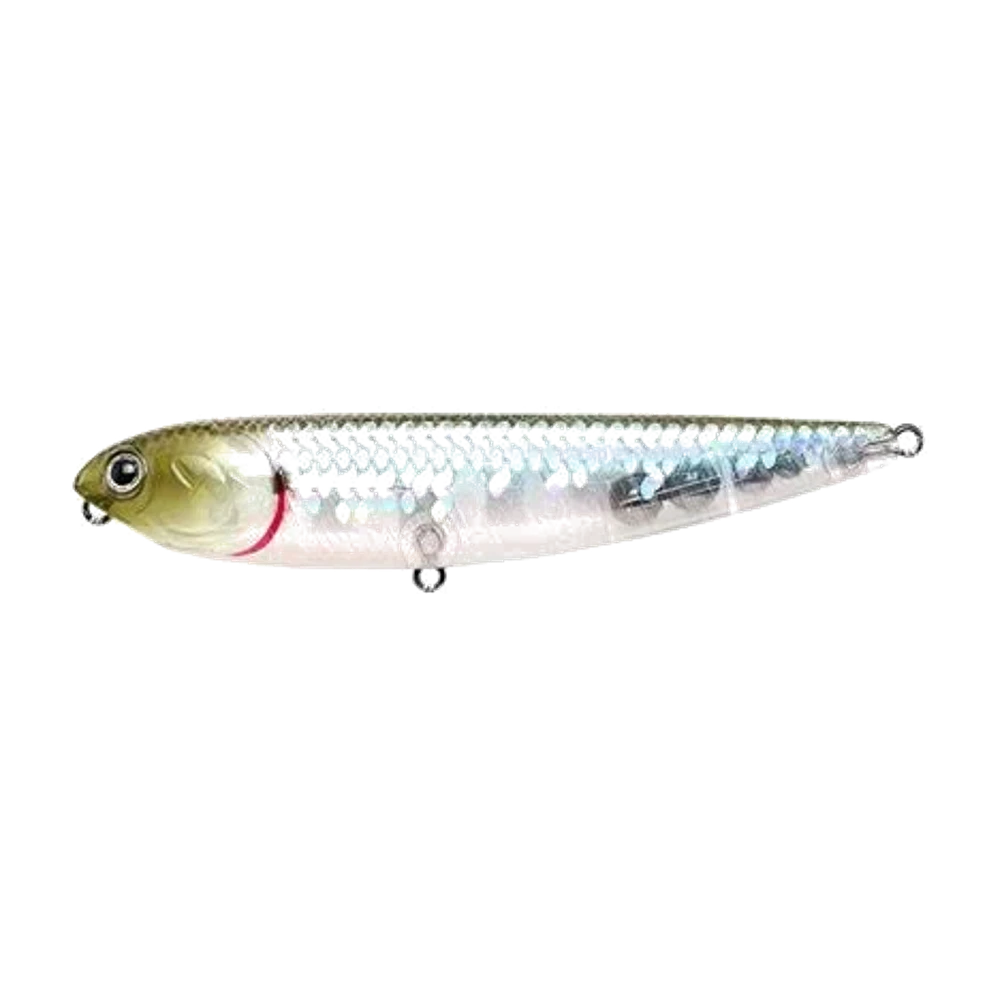
This lure shines under specific conditions. CarnaFish tells you in 10 seconds if today is one of them.
A metre and a half wide channel between two weed beds. A lily edge running along the bank. A lane of open water beside a jetty. These are the best topwater spots there are — and they are the ones a poorly controlled walking bait makes impossible to fish, because it walks out of the zone on the third zigzag and buries itself in the salad.
The problem is not the lure. It is that walk the dog gets taught as one single stroke when in fact the width of the walk is adjustable. On a slim, relatively light body like the Sammy 100, that modulation is unusually clear: depending on how much tension you leave in the line, the same lure takes twenty centimetre strides or sixty centimetre ones.
Being able to switch between the two means you can fish a narrow lane as well as a wide flat, without changing lure.
The three width settings
| Setting | Line tension | Rod tip angle | Stride width | Use |
|---|---|---|---|---|
| Tight | line almost taut | tip low, towards the water | 20 to 30 cm | narrow lane, margin, channel |
| Standard | slight slack between strokes | tip at 45° downwards | 40 to 50 cm | general searching |
| Wide | clear slack, longer strokes | tip horizontal | 60 cm and more | large flats, calling from afar |
The controlling variable is the slack you leave in the line between two wrist strokes. The more slack, the more room the lure has to pivot before the line pulls it back. With a near-taut line it barely pivots and moves forward in short nervous steps, almost in a straight line.
Rod tip angle backs that up: the lower it is, the more horizontal the pull, and the more the lure stays locked in its axis.
The stroke by stroke, in tight mode
This is the most useful setting and the least practised. It lets you fish a lane over its whole length.
- Cast along the lane, not across it. A perpendicular cast leaves you three metres of useful fishing.
- Rod tip pointed at the water, 20 or 30 cm above the surface, arm by your side.
- Very short wrist strokes, 5 to 8 cm of travel, at a fast and perfectly even cadence.
- A quarter turn of the handle between strokes, just to stop slack building up.
- Do not stop. In tight mode a stop drops the lure flat and it takes you two or three strokes to find the rhythm again.
In wide mode everything reverses: more arm, longer strokes, a full turn of the handle between each, and one second pauses every five or six zigzags.
On the water: consistency matters more than power. A walking bait that gets strokes of varying intensity changes stride every time and eventually veers off. Count a cadence in your head — one, two, one, two — and hold it through the whole cast. It is that metronome, not the force of the stroke, that produces a clean walk.
Why a slim body changes things
The Sammy 100 is a slender profile, moderately heavy for its length. Three consequences:
It glides rather than shoves. The lateral movement happens without throwing much water. In clear, calm conditions that is a direct advantage: you can run the lure over the same spot several times without flooding the zone with noise.
It is less forgiving of your mistakes. Unlike a heavy walking bait that carries on through its own inertia, a light body falls out of its walk the moment a stroke goes wrong. This is a lure that teaches consistency, sometimes the hard way.
It suffers in wind. At 12 g for 10 cm, a crosswind lifts the line and corrupts the whole pull. Beyond a light breeze you either shorten the cast or move up to a heavier model.
Bass and sea bass: two readings of the same lure
For bass, it is a margin and structure lure. The best windows are the two hours after first light and the last hour before dark. Target channels between weed beds, lily edges and sunken trees, in tight mode, and run it back over a spot that looks good two or three times.
For sea bass, it is more of a hunting and clear water lure. Wide mode to call fish over rocky plateaus, standard mode once they are located. The stock hooks blunt fast in salt: check the points after every fish and rinse in fresh water at the end of the session.
In both cases, never set the hook on sound or on sight. Wait until you feel the weight in the rod — that is the common rule for every topwater lure, and the mistake that costs the most fish.
Not sure what to tie on?
Photograph your spot: CarnaFish reads the scene, cross-checks the conditions and gives you the zone, the lure and the retrieve. Free on iOS and Android.
Where it is out of place
- In sustained wind or marked chop: too light, the retrieve becomes uncontrollable.
- In heavily stained water: its signal is mostly visual and subtle, it does not call from a distance.
- On big areas you need to cover quickly: it does not cast far enough, a heavier model will be more productive.
- Below about 13 °C: the fish stop coming up, and no width setting will change that.
Sammy 100 or a heavy walking bait
Against the Heddon Super Spook the split is clear cut. The Super Spook casts much further, calls from a distance thanks to its rattles, and forgives a rough rhythm: it is the choice on big water and in wind. The Sammy 100 does the opposite — it demands a precise stroke, but it fishes lanes the other one cannot hold, and it stays credible in clear, calm water.
Against the Lucky Craft Gunfish 115 the difference lies elsewhere: the Gunfish can also spit water thanks to its cupped mouth, where the Sammy only walks. If you want to alternate between popper and walking bait, the Gunfish is more versatile; if you want a pure, tunable walk, the Sammy is finer.
Our beginner's guide to bass fishing sets out the time windows and spots where topwater takes over. And if you are unsure whether a surface lure makes sense when you reach the bank, CarnaFish analyses a photo of the spot and answers.
Key takeaways
- The width of the walk is set by the slack you leave in the line, not by how hard you pull.
- Tight mode, 20 to 30 cm strides: that is what lets you fish a lane without leaving it.
- Cast along the lane, never across it.
- Steady cadence beats power: hold a mental metronome.
- Slim, light body: very precise in calm water, unmanageable as soon as it blows.
FAQ
How do I make a walking bait zigzag tighter?
Keep the line almost taut between strokes, point the rod tip at the water and shorten the travel to 5 or 8 cm at a fast cadence. The lure pivots less far and moves in short strides, which lets you stay inside a narrow lane.
Why does my Sammy 100 veer off course?
Usually because your strokes are not all the same intensity. A light body loses its rhythm as soon as one stroke is missed or overdone. Count a steady cadence and keep the same amplitude through the whole cast.
Sammy 100 or Super Spook?
The Super Spook for big water, wind and long distances: it carries far and forgives an imperfect rhythm. The Sammy 100 for clear, calm water, narrow lanes and precise spots, provided your stroke is consistent.
What line should I use with this lure?
Fluorocarbon of 0.25 to 0.30 mm straight through works well in fresh water. In the sea, braid with a one metre leader gives more distance and a crisper hookset, but then leave a little more slack between strokes.
Should I strike as soon as the fish hits the surface?
No. Wait until you feel the weight of the fish in the rod. A hookset triggered by sound or sight rips the lure out of the mouth, and it is the commonest cause of missed topwater strikes.
At what temperature is the water too cold?
Below roughly 13 °C, fish stop coming up for a surface meal and walking bait fishing becomes anecdotal. Better to drop down the water column with a diving lure or a soft plastic.
The full bass lure guideSeason-by-season strategy: which family of lure, when, and why.Go from theory to fish
CarnaFish reads your spot from a photo and gives you the game plan: zone, lure, retrieve. Free on iOS and Android.