Megabass Dog-X: the walking bait that stays put
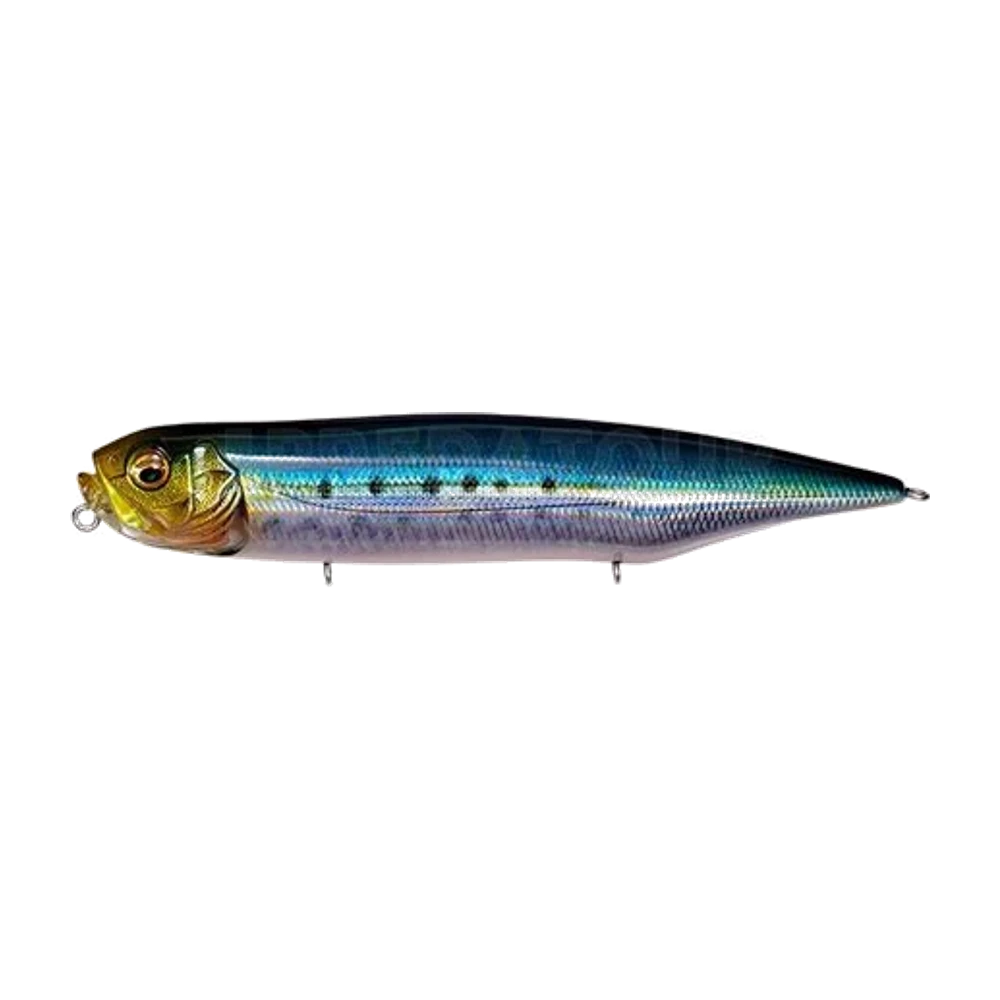
This lure shines under specific conditions. CarnaFish tells you in 10 seconds if today is one of them.
A walking bait that travels fast has a mathematical problem: over a two-square-metre spot — a gap in the lily pads, the shade of a jetty, the tip of a fallen tree — it crosses the zone in three zigzags. Three zigzags is a second and a half. The bass sitting underneath does not have time to come up.
That is the limit of every big searching stickbait: they are built to cover, not to insist. And when the interesting zone is only a few square metres, covering is not what you need.
The Dog-X is built for the opposite use. On every twitch it pivots hard on itself and moves only a few centimetres forward. You can run fifteen zigzags and have travelled only a metre and a half. Over a gap in the weed, that means ten seconds of presence instead of one and a half.
What produces the on-the-spot pivot
Three elements combine to produce this behaviour, and they hold together.
The body length relative to its weight. The Dog-X is short and relatively heavy, which gives it strong rotational inertia. On the twitch, that concentrated mass turns it around its vertical axis rather than driving it forward.
The shape of the head. The nose is rounded and slightly blunt, without the tapered profile of long-casting stickbaits. It pushes water sideways instead of slicing it, which brakes forward progress and amplifies the sideways swing.
Its attitude at rest. The lure sits slightly tail down, nose barely out. That position means the twitch braces against the back of the body and pivots the front, like a rudder.
On the water the consequence is clear: the zigzag angle is very wide, close to ninety degrees each side, where a big stickbait opens at forty-five and runs straight.
The retrieve: tight cadence, rod tip low
This lure calls for a different motion from classic walking baits. Faster, shorter, more contained.
- Position yourself so the lure lands a metre beyond the target spot, never on it.
- Rod tip pointed at the water, almost touching it, line slightly slack.
- Give short twitches from the wrist only, at a cadence of about two per second. No arm, no amplitude.
- Wind half a turn of the handle between each twitch to take up just the slack you created, without dragging the lure.
- Run eight to fifteen zigzags over the spot, then stop dead for three seconds.
- Start again on an irregular cadence: two fast twitches, one slow, two fast. That break often triggers followers.
- Do not strike at the sound. Wait until you feel the weight in the rod, or you will pull the lure out of its mouth.
On the water: on a walking bait that stays put, the amount of slack in the line sets the zigzag angle. Too tight and the lure runs straight at you and loses all its point. Too much slack and the twitch no longer transmits. Look for the point where the line makes a slight curve that comes tight just as the lure pivots — that is the most important setting in this fishing, well ahead of speed.
Where it comes into its own
| Spot | Why the Dog-X | Sequence |
|---|---|---|
| Gap in the lily pads | 10 s of presence over 2 m² | 12 zigzags + 3 s stop |
| Under a jetty | Wide angle means it stays in the shade | 8 zigzags, slow cadence |
| Edge of a fallen tree | Follows the branch without drifting off | Zigzags along the trunk |
| Clear water, visible fish | Small profile, little noise | 6 zigzags then a long stop |
The time of day matters as much as the spot: early morning and late evening, calm water, clear or lightly veiled sky. As soon as there is chop, the tight zigzag drowns in the surface movement and the point of it collapses.
Where not to use it
The flip side of its advantage is immediate: the Dog-X is a poor searching lure. On a two-hundred-metre bank you would take an hour to cover it, where a big stickbait does it in twenty minutes. If you are still looking for where the fish are, this is not the tool.
It is also badly suited to wind and distance. Its short body and rounded nose limit the cast, and a crosswind puts a bow in the line that destroys the retrieve. On a large windy expanse, forget it.
Finally, it is too discreet for stained water. A walking bait draws part of its effectiveness from the noise and the wake it leaves. The Dog-X produces little of either by design. In murky water the fish has to find it by sound, and there is not enough of it.
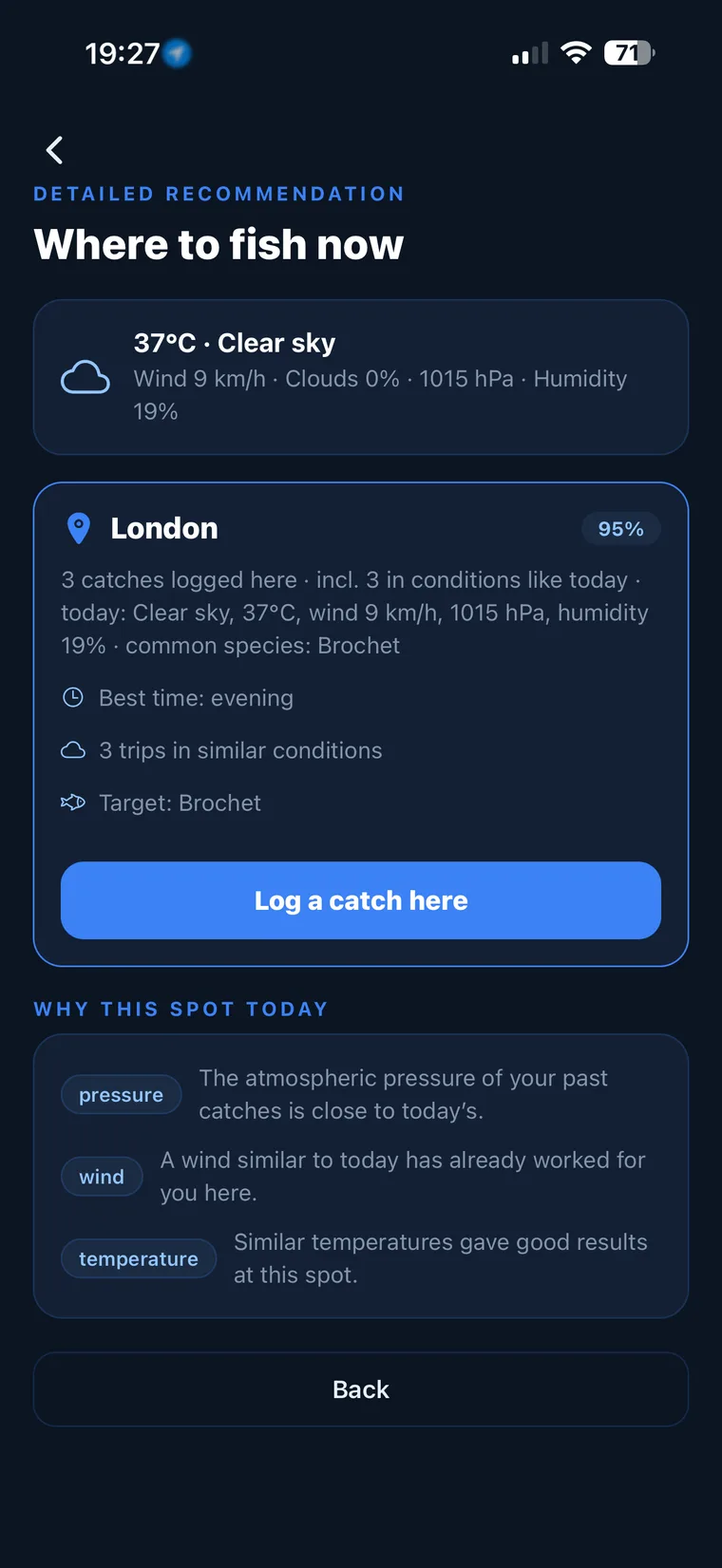
Not sure what to tie on?
Photograph your spot: CarnaFish reads the scene, cross-checks the conditions and gives you the zone, the lure and the retrieve. Free on iOS and Android.
Dog-X, Super Spook or Sammy 100
All three walk the dog, and yet none replaces the other.
The Heddon Super Spook is the searching lure par excellence: big, heavy, noisy thanks to its rattles, it casts a very long way and calls fish over a wide area. It is the choice when you do not know where the bass is and you need to bring it to you. Its smaller version, the Heddon Super Spook Jr, keeps that calling logic with a profile that is more acceptable to average fish, but it still moves forward decisively on every twitch.
The Lucky Craft Sammy 100 holds the middle ground. Its glide is long and fluid: it covers a good distance per zigzag, with a wide track and a readable wake. It is an excellent searching-to-finishing compromise in clear water, but it still crosses a small spot quickly.
The Dog-X plays in neither of those categories. It sacrifices distance and coverage speed for one thing: time spent over a single square metre. An efficient session often means using a Super Spook to locate a zone of activity, then bringing out the Dog-X to work the three or four precise spots you have found methodically.
Our beginner's guide to bass fishing sets out the time windows where topwater beats everything else. And if you are unsure which spot to work first when you arrive at a lily pad margin, CarnaFish analyses a photo of the spot and answers.
Rigging and settings
The line is a genuine parameter. Fluorocarbon in 0.25 to 0.30 mm sinks slightly and pulls the lure's nose down, which sharpens the pivot. Floating mono keeps the lure flatter and lengthens the glide a little. Try both: the difference is noticeable.
A snap is recommended on this type of lure, unlike on many hardbaits. A small round snap gives the lure the freedom to pivot without the knot restricting it. A tight knot on the nose ring noticeably reduces the zigzag angle.
The stock hooks are fine and light. Replacing them with heavier trebles weighs the lure down, changes its attitude at rest and can make it sink when stopped. If you must change them, stay with an equivalent wire diameter and compensate at the rear rather than the front if needed.
Key takeaways
- It pivots almost without moving forward: ten to fifteen zigzags over a metre and a half of travel.
- A very wide zigzag angle, close to ninety degrees each side.
- Short wrist twitches at two per second, rod tip almost in the water.
- The slack in the line sets the zigzag angle: that is the central parameter.
- A poor searching lure, unusable in wind and disappointing in stained water.
FAQ
Why does the Dog-X move forward so little?
Its short, heavy body concentrates the inertia, and its rounded nose pushes water sideways instead of slicing it. On the twitch it pivots around its vertical axis rather than driving forward.
What twitch cadence should I use?
About two twitches a second, very short, from the wrist only, rod tip pointed at the water. A slow, wide cadence suits big stickbaits, not this model.
Do I need a snap on a walking bait?
Yes, a small round snap is recommended. It lets the lure pivot freely, whereas a tight knot directly on the nose ring noticeably reduces the zigzag angle.
How does it differ from a Super Spook?
The Super Spook is a calling lure: big, noisy, a great caster, it covers a wide area and brings fish in. The Dog-X covers almost nothing but stays ten seconds over a two-square-metre spot.
Does the Dog-X work in stained water?
Hardly. It produces little noise and little wake by design, so the fish has to see it to find it. In murky water, a bigger, louder walking bait is far more relevant.
Mono or fluorocarbon with this lure?
Fluorocarbon sinks slightly and makes the nose dip, which sharpens the on-the-spot pivot. Floating mono keeps the lure flat and lengthens the glide. Both work, with noticeably different behaviour.
The full bass lure guideSeason-by-season strategy: which family of lure, when, and why.Go from theory to fish
CarnaFish reads your spot from a photo and gives you the game plan: zone, lure, retrieve. Free on iOS and Android.