Lunkerhunt Compact Frog: the short frog bass can inhale whole
One lure, endless conditions. CarnaFish reads your spot from a photo so you are not just guessing.
A whole morning over a lily pad field, five blow-ups, nothing in the net. The story is so common among frog anglers that most of us treat it as inevitable. It isn't: nine times out of ten the bass aimed at a bundle of rubber strands trailing ten centimetres behind the lure and closed its mouth on nothing. The Lunkerhunt Compact Frog goes after that problem from the only angle that matters, the size of the target.
A short body and legs that are already trimmed
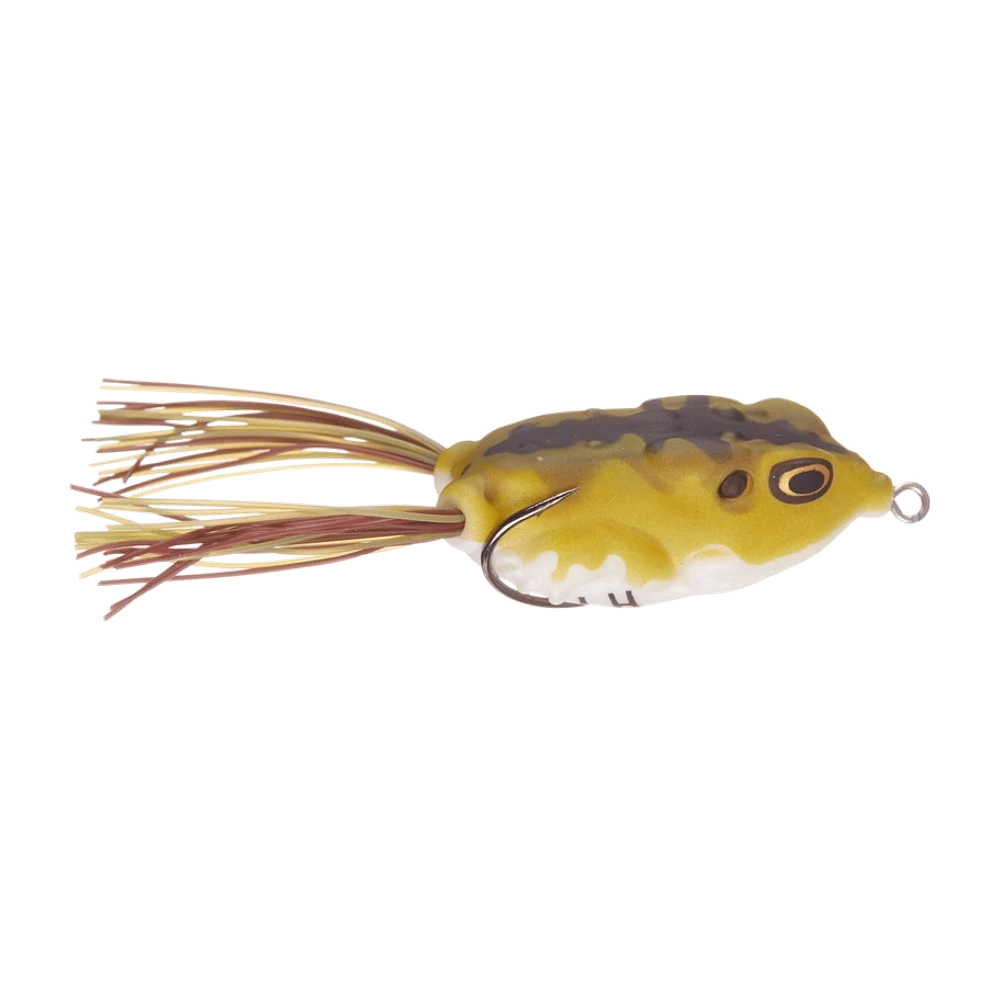
Lunkerhunt says it plainly in its own description: tournament anglers have been cutting down frog skirts with scissors for years, to shrink the silhouette and pull the strike onto the part of the lure where the hook points actually sit. The Compact Frog does that modification at the factory. The strands come pre-trimmed out of the pack, and the body itself is short rather than elongated, which brings the whole package down to a volume a fish can swallow in one gulp.
The maker's spec table lists two versions, and this is one of the cases where you want to read the numbers to the end. The first is 2.25 in, so 5.7 cm, at 1/2 oz — about 14 g. The second goes to 2.5 in, 6.4 cm, at 3/4 oz, roughly 21 g. Both are classed topwater, so strictly surface, with no ambiguity.
What stands out is the density. Twenty-one grams for 6.4 cm of hollow body is heavy: plenty of frogs that size sit between 15 and 18 g. On the cast, that mass lets you reach out and punch through a crosswind. In the water it makes the frog float lower, sitting deep in the film — an advantage over a thick mat of grass, much less so over very light duckweed where a loaded lure starts to sink in.
Walking it, but never on a tight line
The maker promises a smooth, consistent walk-the-dog action, and that is where this lure lives. The short body shoves a disproportionate amount of water for its volume: every tap of the rod tip raises a small bulge on the surface, a signal bass pick up from a distance even under a layer of vegetation.
The cadence that works is short and tight. Rod tip down, you give small sharp wrist taps — not arm sweeps — taking up just enough line between taps for the lure to pivot one way then the other. Two to three taps a second over open water, then a one to two second pause as soon as you pass an object: a sunken branch, a hole in the grass, a reed edge.
The most common mistake is keeping the line tight. A frog dragged on a tight line moves forward but never turns: it barely zigzags and reads as a small fish in a hurry. You need a little slack loop between the rod tip and the lure so the body can pivot freely on each impulse.
The hookset, where it all plays out
This is where most fish are lost, and the Compact Frog's design changes part of the equation. The body is moulded straight around a beefy wide-gap double hook, with no bolted-on parts: the lure stays genuinely weedless as long as it is moving, and collapses easily under pressure when a fish bites, which frees the points.
You still have to give it half a second to do so. The rule is universal in frog fishing: never set on the sound or the splash. Wait until you feel the weight of the fish in the rod, then set hard, arm driving back. Setting on what you see means tearing the lure out of a mouth that is still open eight times out of ten.
Count under your breath after the blow-up: "one", then you set. It sounds silly but it fixes the problem in a single session. The day the reflex is built in, you stop counting — and you keep setting a beat after the noise anyway.
Where it belongs, and where it struggles
This lure's natural home is vegetation cover: lily pads, surface grass mats, reed edges, fallen timber. The shortened skirt changes nothing about how it clears cover — the hollow body and the folded hook do that job — but it clearly improves your return on fish that strike half-heartedly, in the middle of the day or after a cold snap.
In open water the Compact Frog still works, but it no longer has any particular edge: a surface stickbait will do the same job with better casting range. Keep it for what it does best, crossing the uncrossable. If you want a longer frog with a wider glide, the Spro Bronzeye Frog fills that slot with a very different profile, while the LiveTarget Hollow Body Frog bets on finish realism rather than compactness.
Species-wise, this is a bass lure first. Pike will also take a frog in summer over shallow grass, and a heavy double stands up to a mid-sized pike — provided you add a leader. Don't count on perch: the volume is too large and the hook gap too wide for its mouth.
Line, leader and rod
Braid is mandatory, 30 to 40 lb, tied straight to the wire ring at the nose — no snap, it picks up weed. Fluorocarbon is a bad idea here: it sinks, it pulls the frog's nose under the film and it handles lily stem abrasion poorly. A 2.00 to 2.20 m rod, heavy power, fast action, and a high-speed casting reel so you can pick up slack instantly on the set.
Not sure what to tie on?
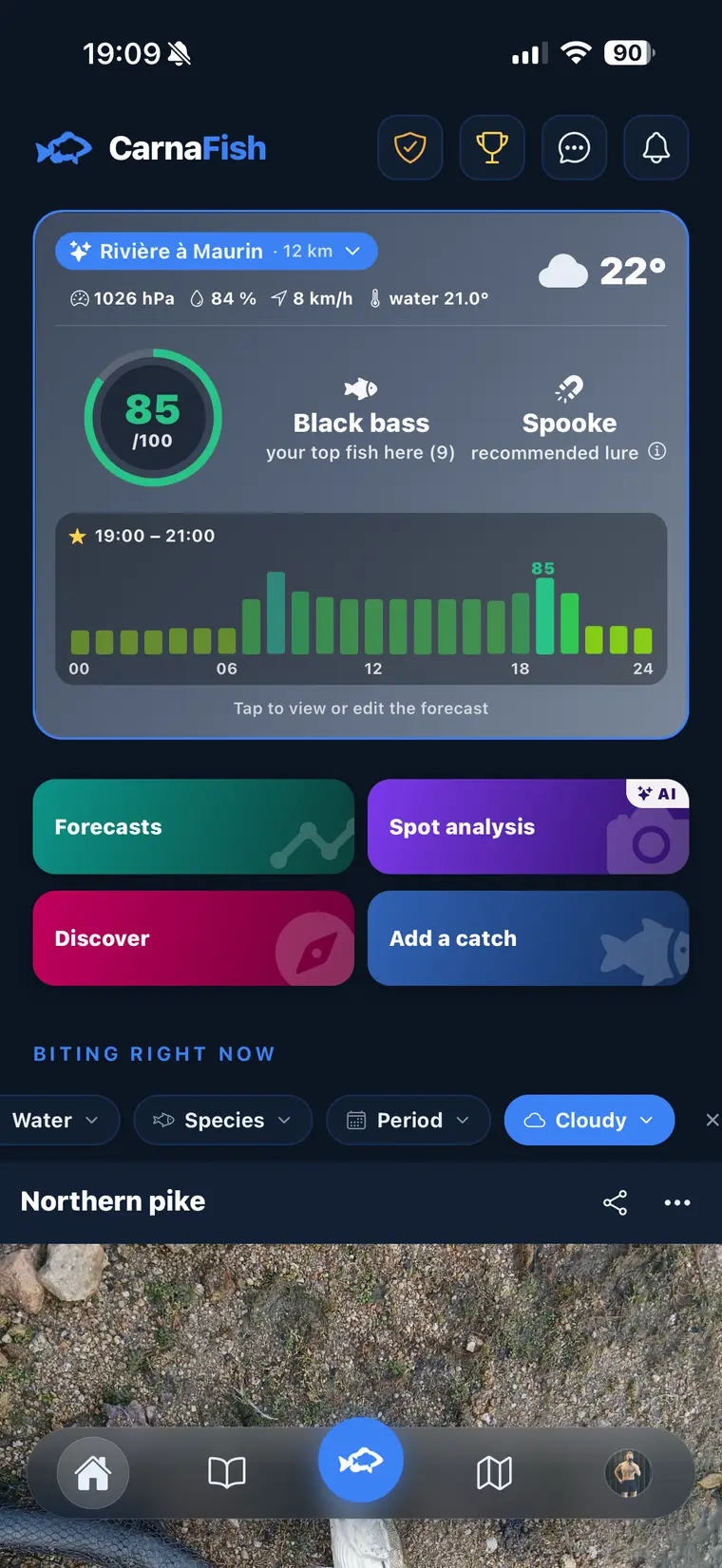
Photograph your spot: CarnaFish reads the scene, cross-checks the conditions and gives you the zone, the lure and the retrieve. Free on iOS and Android.
Colours by water and light
- Clear water, bright sky: a green and brown frog pattern like the one in the photo, olive blotched back over mustard flanks. That finish works everywhere the fish sees the lure clearly.
- Stained water or a thick weed mat: a dark back over a pale, yellow-dominant belly. Bass attack from underneath and the belly is what they see; a bright belly gives them a clean aiming point.
- Low light, dawn, dusk, dark water: solid black. You are not picking a colour, you are picking a silhouette, and nothing else cuts out against a pale sky as sharply.
Lunkerhunt names no individual colours in its spec sheet, only a wide, highly detailed range: think in patterns rather than product names when you compare two packs.
A frog is only worth anything where it lands: a lily pad field with no holes and no edges will produce nothing, whatever lure you tie on. That is exactly what CarnaFish makes easier — a photo of the spot, and the AI suggests the zone to attack and the presentation that fits the time of day. For the groundwork on swims, tackle and seasons, our guide to getting started with bass fishing covers the rest.
Key takeaways
- The legs come out of the pack already shortened: the silhouette is reduced for you, no scissors required.
- Two sizes in the catalogue, 5.7 cm at 14 g and 6.4 cm at 21 g, both listed as topwater by the maker.
- The 21 g version is dense for its size: superb on the cast, a little heavy over very light surface cover.
- Set on the weight, never on the noise: that is where most frog fish are lost.
FAQ
Which Compact Frog size should I start with?
The 6.4 cm at 21 g is the more versatile one: it casts a long way, handles wind and still stays compact enough to be inhaled in one go. Keep the 5.7 cm at 14 g for tough days or waters holding smaller fish.
Why does trimming a frog's legs actually matter?
Because a bass aims at the most visible point of the silhouette. A long skirt trailing behind the lure shifts that point behind the hook points, and the fish closes on rubber. With short strands, the target and the hardware sit in the same place.
Do I need a wire leader with this lure?
Only if the swim holds pike. On a pure bass spot, braid tied straight to the ring is enough and keeps every bit of hookset sensitivity. Over a pike weed bed, thirty centimetres of heavy fluorocarbon or a supple titanium leader prevents a bite-off.
Does the Compact Frog really clear lily pads?
Yes. The body is moulded around the double hook, whose points stay flat against the flanks until something presses on them. It slides over pads and stems without grabbing, and only opens up on the hookset.
Can I fish it in open water, away from any cover?
Yes, the walking action works just as well. But a surface stickbait suits that job better: it casts further and its trebles hook more reliably in clear water. Keep the frog for places nothing else can go.
Why won't my frog zigzag?
Nine times out of ten the line is too tight. The body needs a slack loop to pivot on each impulse. Drop the rod tip towards the water, shorten your wrist taps and only take up the bare minimum of line on the reel.
The full bass lure guideSeason-by-season strategy: which family of lure, when, and why.Go from theory to fish
CarnaFish reads your spot from a photo and gives you the game plan: zone, lure, retrieve. Free on iOS and Android.