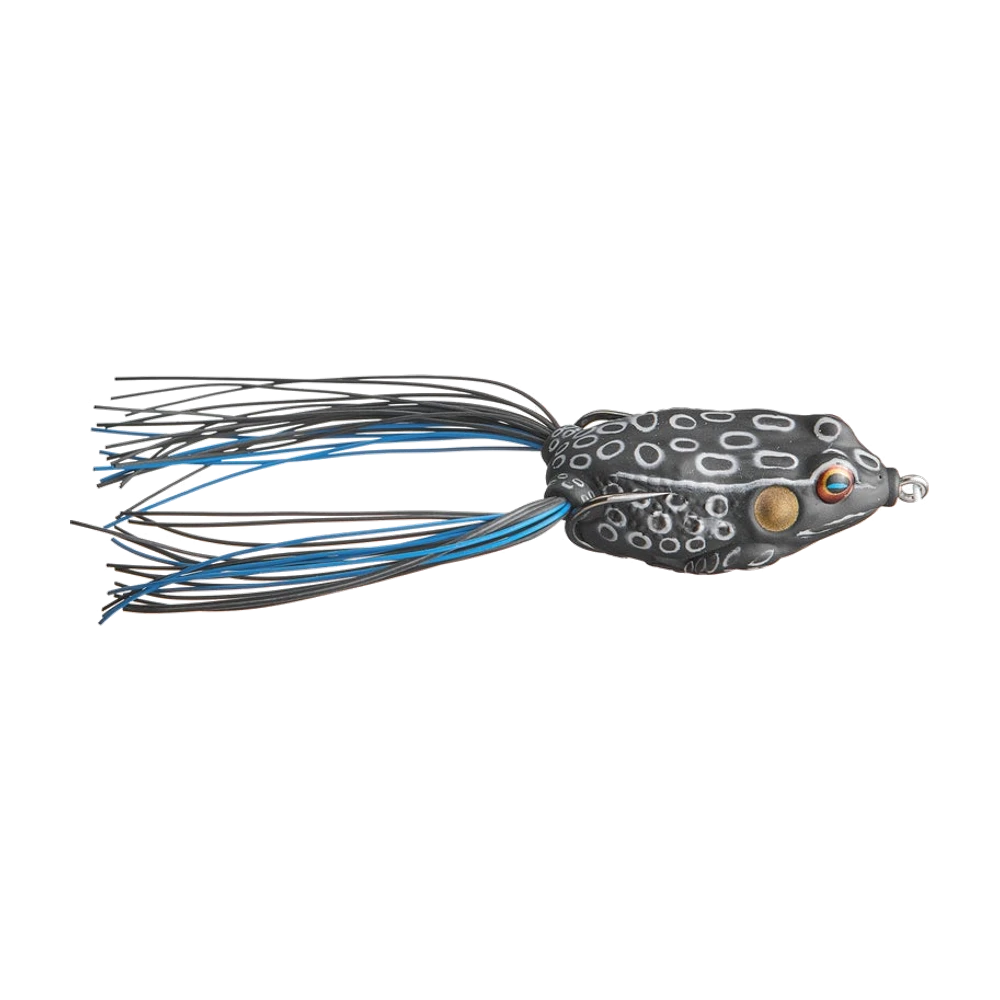
LiveTarget Hollow Body Frog: the hollow frog for the thickest mats
One lure, endless conditions. CarnaFish reads your spot from a photo so you are not just guessing.
A forty-metre raft of duckweed, thick enough that you can no longer make out the surface underneath. No conventional bait belongs there: a crankbait picks up a kilo of vegetation on the first turn of the handle, a Texas-rigged shad passes under the mat without ever being seen. One family of baits can still work on top of that green, and LiveTarget's Hollow Body Frog has belonged to it for fifteen years.
What the manufacturer actually states
The bait won the Best Soft Lure Award at the 2010 ICAST show. The description leans on three concrete points, and that is about all there is in the way of fact: an extremely soft body with excellent collapsibility, a super sharp wide-gap double hook that comes clear easily once the shell gives way, and a design meant for fishing way back in the thickest mats and vegetation you can find. The maker adds that the frog sits in the water on the pause just like a real one.
The spec table is short but clear:
- FGH45T: 1-3/4 in, which is 4.4 cm, class Floating.
- FGH55T: 2-1/4 in, which is 5.7 cm, class Floating.
- FGH65T: 2-5/8 in, which is 6.7 cm, class Floating.
Two points matter here. First, all three sizes are explicitly listed as floating in the Class column — that is stated, not inferred. Second, the table carries no weight column at all. The manufacturer does not publish the mass of its frogs, so no figure will be quoted here. That is awkward when picking a rod, and we will come back to how to get round it.
The codes 45T, 55T and 65T suggest 45, 55 and 65 millimetres. The table gives 44.5, 57.2 and 66.7 mm: the gap runs from one to two millimetres, and the table is what counts. Half an inch either way on a frog genuinely changes the mouth size needed to swallow it.
Picking a size is less obvious than it looks
The beginner's reflex is to grab the biggest one, because a frog is supposed to be a big-fish bait. That is often a mistake. The FGH65T, 6.7 cm, is a heavy cover bait aimed at good bass: it casts a long way, it shoulders vegetation aside, and it forgives nothing with the average-sized fish that cannot get it in.
The FGH55T, 5.7 cm, is the format that draws the most bites in Europe on a water holding average bass. It still clears a mat very well and remains swallowable by a 35 cm fish. The FGH45T, 4.4 cm, is a finesse format: clear water, educated fish, thin pad edges, or perch over pond weed.
For pike the reasoning changes. A pike sitting under a canopy has no mouth-gape problem at all, so the FGH65T becomes the default, and a short wire leader becomes mandatory — a frog costs far too much to leave behind in a set of jaws.
Working it: walk, stop, let it sit
A hollow frog is walked like a dog, but across the mat rather than open water. Rod tip down, short crisp twitches from the wrist only, taking up slack between each one. The frog zigzags a few centimetres either side and creeps forward slowly.
The pause is what counts. The description says so outright: at rest the frog settles on the water in a natural posture. Over a hole in the mat, two to five seconds of stillness beats ten metres of retrieve. The fish has often tracked the bait from under the vegetation without you knowing, and it waits for the bait to stop before it commits.
When the mat is very thick, stop hunting for holes and fish the shade line instead. The border between mat and open water holds more fish than a gap in the middle, and the hookset there is ten times easier because you have no thirty centimetres of salad to pull through.
The classic mistake, and the fix
Setting too early. It is the universal frog-fishing error, and the design of the bait explains it entirely: until the jaws have crushed the shell, both hook points stay pinned against the body and cannot bite into anything. The maker sells that body softness precisely as the key to its collapsibility.
The discipline to build: see the blow-up, drop the rod, count a beat, come tight with the reel and set only when you feel the weight. On a properly matched outfit, that one second of patience doubles your landing rate. It is extremely hard to hold on your first few sessions.
The detail that sinks a frog
A hollow frog takes on water. After a few fish and a handful of hooksets in the stems, the hook holes widen and the shell fills. A bait listed as floating that starts nosing down is not faulty, it is full: squeeze it out, points down, every ten minutes or so. It is a routine move nobody explains when you buy your first one.
As for the rest of the tackle, with no published weight the only reliable method is to test: put the frog on a kitchen scale before choosing a rod, or simply go with a heavy casting outfit of 2.00 to 2.20 m and 40 to 50 lb braid, which handles all three sizes without argument.
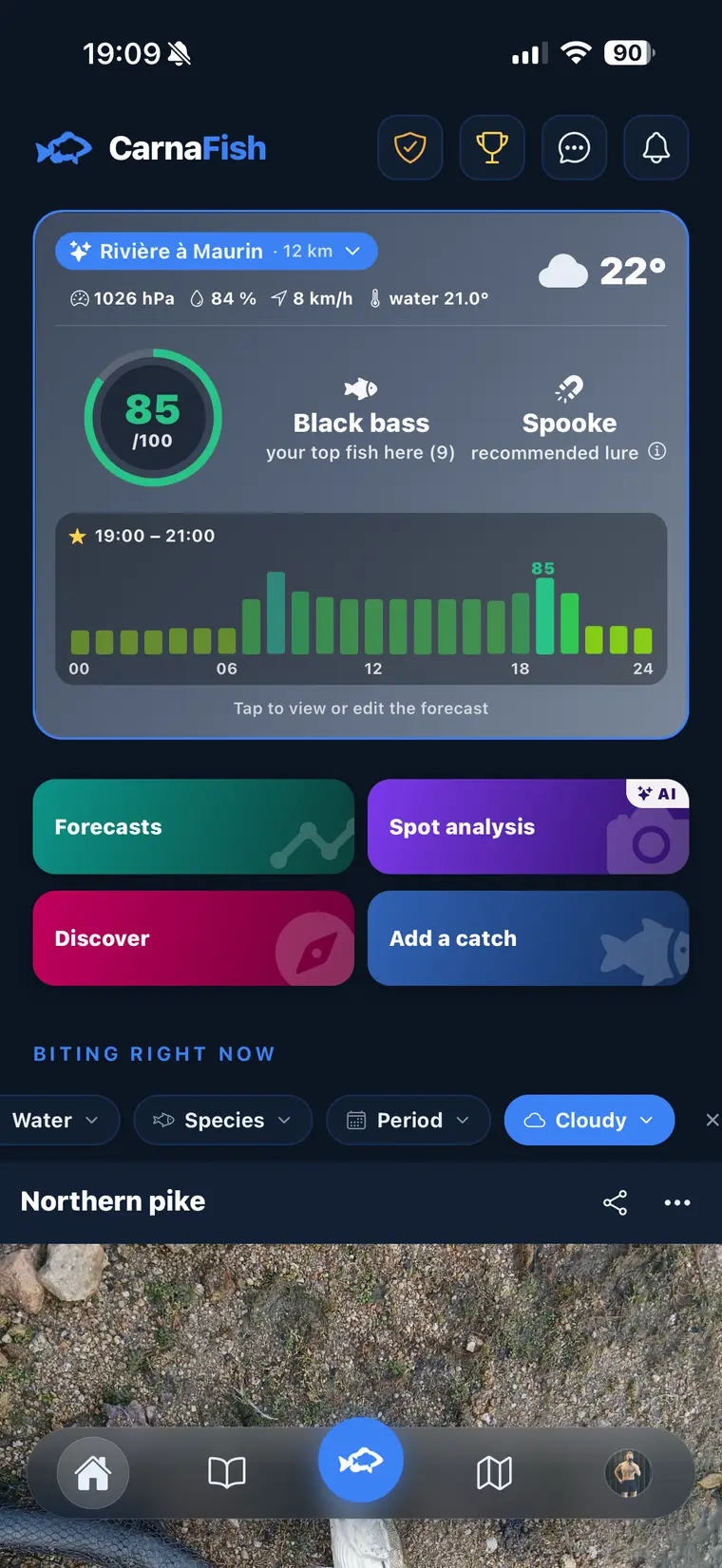
Not sure what to tie on?
Photograph your spot: CarnaFish reads the scene, cross-checks the conditions and gives you the zone, the lure and the retrieve. Free on iOS and Android.
Colour by light
- Stained water or overcast: the white-spotted black of the unit photographed, with its blue and black strand skirt. Seen from below, that is the most readable silhouette against the sky.
- Clear water, wary fish: a natural green tree-frog tone, where the detail of the moulding finally earns its price.
- Bright light, high noon: white, which reads differently and sometimes restarts a spot that has gone quiet.
In the box next to the other cover baits
The Hollow Body Frog is a gliding frog, not a noisy one. When you need to call fish from a distance over rippled water, the same maker's Live Popper Frog works with a cupped mouth and a rattle. When fish have watched frogs go by all summer, the Hollow Body Field Mouse offers a profile they do not know. And a Spro Bronzeye Frog remains the reference point for comparing shell density and behaviour on the pause.
Whether a mat is worth fishing with a frog is decided by looking at it: density, edges, depth underneath, presence of holes. That is exactly what CarnaFish does from a photo of the spot, suggesting the zone and the kind of presentation that fits. For the rest of the fundamentals, our beginner's guide to bass fishing covers tackle and classic spots.
Key takeaways
- Three sizes, 4.4, 5.7 and 6.7 cm, all listed as floating by the manufacturer in the class column.
- No weight is published: weigh the bait yourself if you want to match a rod precisely.
- The pause draws more bites than the retrieve, especially over holes and along shade lines.
- A delayed hookset is mandatory: until the shell collapses, the double hook cannot bite into anything.
FAQ
Does the Hollow Body Frog really float?
Yes, and that is not an inference: the manufacturer's table lists class Floating for all three sizes. A frog that has taken on water through the hook holes will eventually nose down, though, so empty it regularly.
Which size should I start with?
The FGH55T, 5.7 cm, is the best compromise: discreet enough to be swallowed by an average bass, bulky enough to clear a thick mat and cast properly.
How much does this frog weigh?
The manufacturer does not publish a weight, and none of the three sizes is documented on that point. If your outfit depends on it, weigh the bait yourself — that is the only reliable figure.
Why do I miss so many fish on a frog?
Because you set into the spray. Both points of the double hook stay pinned to the body until the jaws compress the shell. Drop the rod, count a beat, come tight, then set.
Can you fish pike with this frog?
Yes, especially the FGH65T over a weed canopy in summer. Add a short wire leader: pike teeth cut braid right at the bait, and a hollow frog is not a cheap consumable.
Hollow frog or popping frog?
The hollow frog glides silently and suits wary fish or very dense mats. The Live Popper Frog, with its cupped mouth, calls from further away but is spotted more easily in clear, calm water.
The full bass lure guideSeason-by-season strategy: which family of lure, when, and why.Go from theory to fish
CarnaFish reads your spot from a photo and gives you the game plan: zone, lure, retrieve. Free on iOS and Android.