Lunkerhunt Lunker Frog: swimming legs and a 45-degree pause
Before tying this one on, it helps to know if the spot actually calls for it. CarnaFish reads the scene from a photo.
Most frogs on the market treat the legs as an accessory: a handful of rubber strands pushed into the back end, vibrating a little, and usually cut shorter with scissors sooner or later. The Lunker Frog comes at it from the other end. Its legs are moulded, jointed parts that open and fold on their own according to line tension. That kind of detail changes how you work a lure, not just how it looks in the tray.
Legs that do the work for you
The maker describes a leg design that extends and retracts during the retrieve. In practice: you pull, the legs open backwards like a frog mid-kick; you release, they fold along the body, exactly like an amphibian that has just kicked and is now gliding.
That mechanism dictates its own rhythm. A continuous straight retrieve locks the legs open and cancels the whole point of the design: the lure becomes a rigid silhouette you are dragging. So you work it in short pulls separated by genuine pauses, a little like a popper but without trying to make noise. Two or three sharp twenty-centimetre pulls, then a one to three second pause — the legs fold during those pauses, and that is the movement the fish sees.
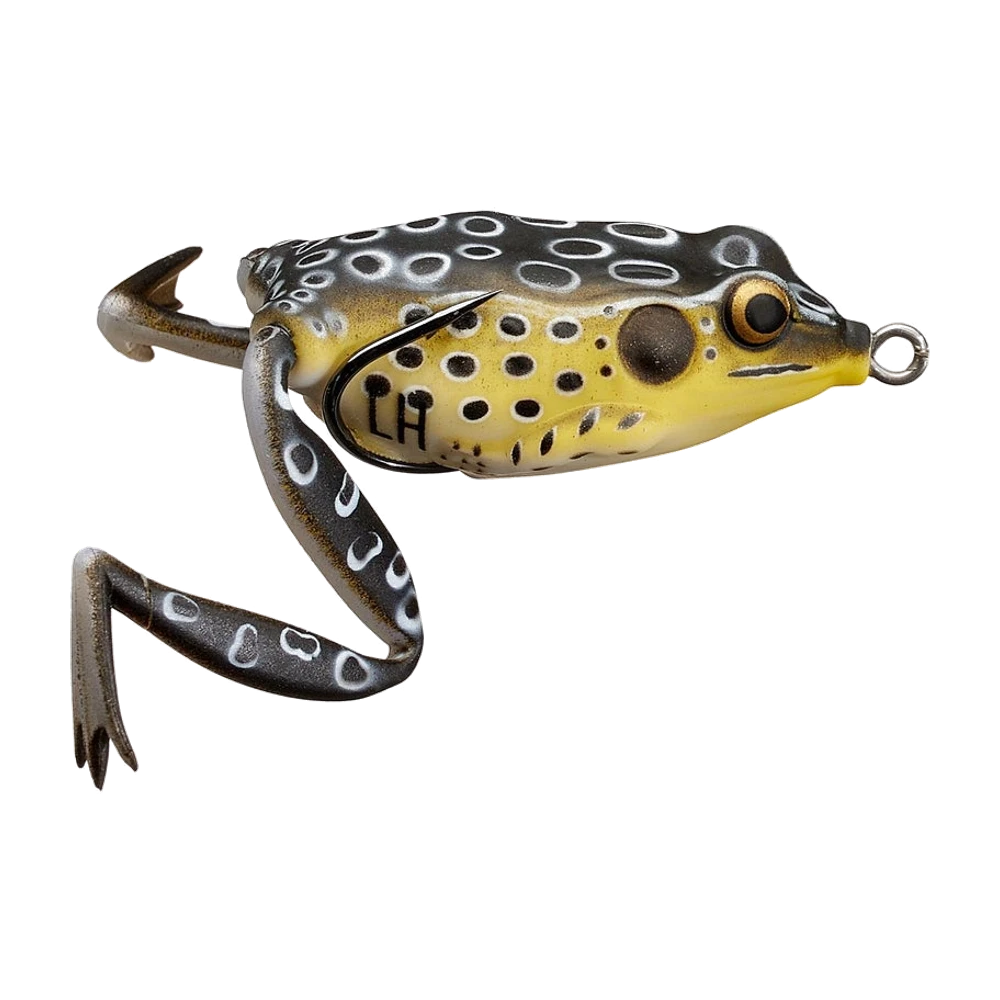
The photo of the bare lure shows the construction clearly: two long jointed hind legs with webbed feet, two shorter front legs, and a soft body in a leopard pattern — grey-brown back scattered with black spots ringed in white, yellow flank and belly.
The 45-degree attitude, and what it implies
The maker's second argument is a resting posture: the Lunker Frog, it says, settles at 45 degrees when you stop working it, an angle presented as more natural and credited with better hook-up percentages. The idea holds up: a motionless frog does not float flat on its belly, it hangs head up and rear down, ready to kick again.
What the spec table does not say
This needs stating precisely, because this lure is a textbook case. The maker's published spec table has two columns only, length and weight: 2-1/2 in, so 6.4 cm, at 1/2 oz, about 14 g. No class column, therefore no official buoyancy information at all — not floating, not sinking, not topwater. On many other lures from the same brand that column exists and settles the question; here it is absent.
The copy, for its part, describes a 45-degree resting attitude and explosive surface blow-ups, which clearly points to a surface lure. But that is marketing description, not a technical figure, so it does not go down as a spec. Hold it this way: everything points to surface use, the table does not confirm it in black and white. A model like the Spro Bronzeye Frog, whose buoyancy is beyond doubt, remains the reference if you need certainty on that point. If you are fishing a swim where the difference matters, test it at your feet before casting into the middle.
Before you put anything onto a lily pad field, drop the lure at your feet and watch it for ten seconds without touching it. Five seconds of observation along the margin saves you an hour of fishing wrong — and that is even truer on a model whose maker publishes no class.
Where it scores and where it shows its limits
The soft body collapses on the strike and frees a weedless double hook described as razor-sharp — in the photo one black point rests along the flank, the other is hidden by the body. It is the classic frog arrangement, with the same strength: complete clearance over pads, weed mats and branches, and the same flaw: the fish has to really crush the body for the points to come through.
This model's own trade-off is its realism. Detailed moulded legs give a credible silhouette, but they also catch on stems and leaves more than a skirt of soft strands, which simply slides. In very dense, stringy vegetation a skirted frog like the Lunkerhunt Compact Frog will travel more cleanly. Keep the Lunker Frog for water where the fish sees the lure: pad edges, holes in the grass, clear water, sight fishing.
The mistake that cancels the design
Working it too fast. The natural reflex when a lure feels dead is to speed up. On this frog, speeding up locks the legs open and removes the only movement that sets it apart. If nothing comes up, slow down instead of accelerating, and lengthen the pauses rather than shortening them.
Tackle calls for nothing exotic: 30 to 40 lb braid tied straight to the front ring, a 2.00 to 2.20 m heavy rod, a high-speed casting reel. On a pike swim, add thirty centimetres of heavy fluorocarbon or a titanium leader. And set on the weight of the fish, never on the noise.
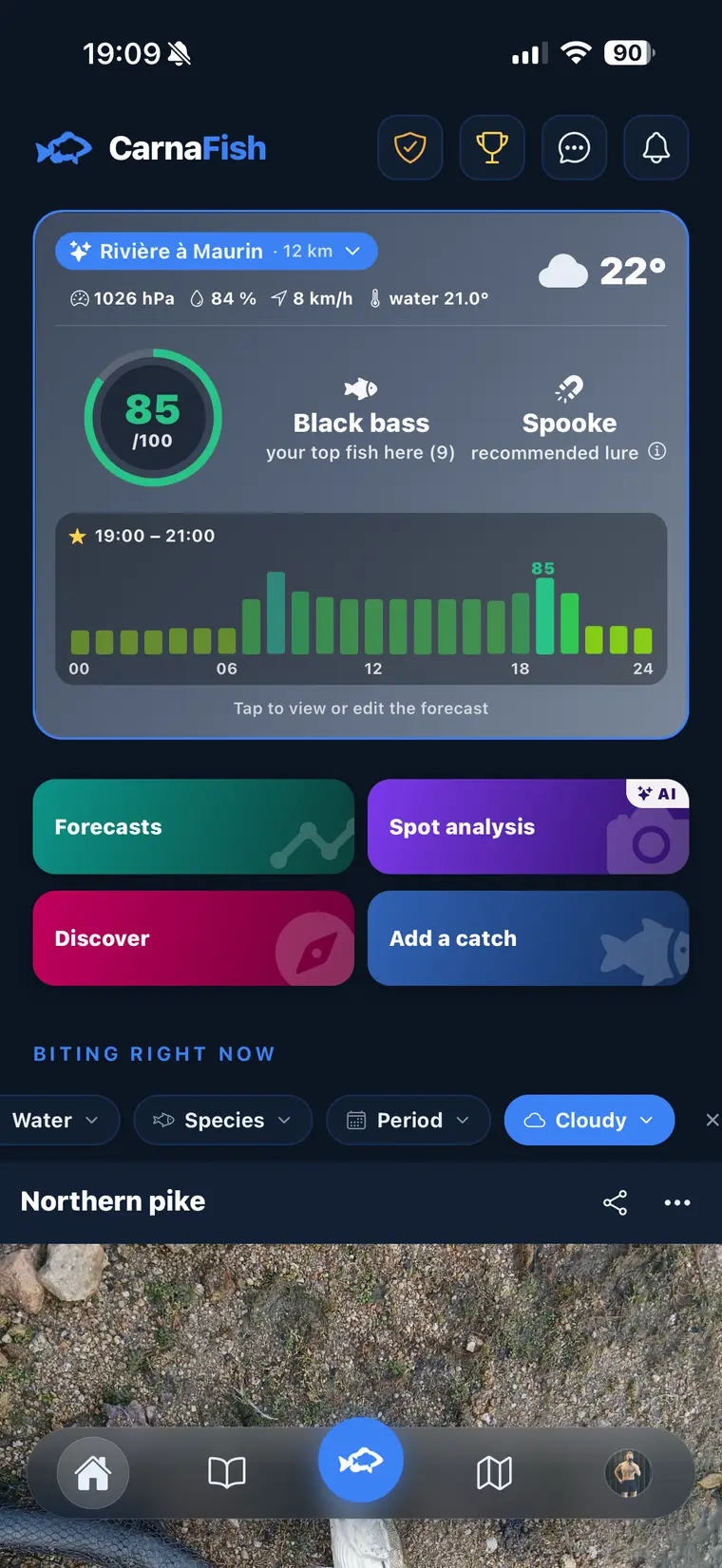
Not sure what to tie on?
Photograph your spot: CarnaFish reads the scene, cross-checks the conditions and gives you the zone, the lure and the retrieve. Free on iOS and Android.
Colours by water and light
- Clear water, sight fishing: the leopard pattern from the photo, spotted grey-brown back and yellow belly. That is where the realism of the legs and spots genuinely earns something.
- Stained water: a dark back over a pale belly. Bass attack from below and aim at the belly; contrast matters more than detail.
- Low light, dawn, dusk: solid black, for a clean silhouette against the sky.
The maker mentions very vivid frog colours without naming a single one in its spec sheet: think in contrasts.
A lure's realism never makes up for a bad swim. A weed bed with no edge, no hole and no depth nearby will produce nothing. That is exactly what CarnaFish makes easier: a photo of the spot, and the AI suggests the zone to attack and the presentation that fits the day's conditions. For the rest of the fundamentals, our guide to getting started with bass fishing covers swims, tackle and seasons.
Key takeaways
- One published size: 6.4 cm at 14 g, in a table that carries length and weight only.
- The maker gives no buoyancy class; its copy describes a 45-degree resting posture and surface strikes, but the table does not confirm it.
- The jointed legs only work on a jerky retrieve with pauses: on a continuous straight retrieve they stay locked open.
- Highly detailed, therefore less slippery than a strand skirt in stringy vegetation.
FAQ
Does the Lunker Frog float?
The maker does not say so in black and white: its spec table has no class column, unlike other models from the same brand. Its description mentions a 45-degree resting attitude and explosive strikes, which clearly indicates surface use, but that is not a verifiable technical figure. Test it along the margin.
What sizes are available?
One in the table: 2-1/2 in, so 6.4 cm, at 1/2 oz, about 14 g. That is a mid-sized frog, versatile on most bass waters.
How do I work the jointed legs?
In short sharp twenty-centimetre pulls, two or three in a row, then a one to three second pause. The legs open on the pull and fold on the pause: that fold is what triggers. A continuous straight retrieve locks them open and cancels the effect.
Does it clear dense weed?
In moderate vegetation yes, thanks to the hollow body and the folded double hook. In very stringy grass its moulded legs grab more than a skirt of soft strands: a skirted frog will run cleaner.
Can I fish it for pike?
In summer over shallow weed beds, yes, the double is stout enough for a mid-sized pike. Add thirty centimetres of heavy fluorocarbon or a titanium leader without fail, as braid cuts on pike teeth.
Why am I missing fish on this frog?
Two usual causes. Either you are setting on the noise instead of waiting for the weight of the fish in the rod, or the body is not collapsing enough because the strike was half-hearted. Give it a full second, then set long and firm while picking up slack.
The full bass lure guideSeason-by-season strategy: which family of lure, when, and why.Go from theory to fish
CarnaFish reads your spot from a photo and gives you the game plan: zone, lure, retrieve. Free on iOS and Android.