Z-Man Finesse Frogz: the small soft frog that floats flat
Not sure this lure fits YOUR spot today? CarnaFish tells you in 10 seconds, from a photo.
Some days the lily pad mat gives a bite every third cast, and others the fish follow the frog all the way to the bank without ever committing. In the second case the useful reflex is not to change colour but to downsize. The Finesse Frogz measures seven centimetres, roughly a third less than a standard hollow-body frog, and that is exactly the point.
What the buoyancy really changes
ElaZtech, Z-Man's in-house plastic, is advertised as extremely buoyant. On a soft frog that is the decisive property, and it produces two concrete effects.
The first is that the bait floats at rest. At every pause in the retrieve the frog stays on the surface instead of sinking slowly, which lets you leave it sitting for several seconds in a hole in the vegetation — the exact spot where a waiting fish is sitting.
The second is subtler and worth even more: the body keeps a horizontal profile, even rigged with a heavy hook. Most soft frogs nose down as soon as you fit a stout wire, ending up head under water with their feet in the air, a silhouette the fish no longer recognises. This one stays flat. So you can rig a wide, strong Texas hook without sacrificing posture, which is exactly what you need to set the hook through a mat.
Resist the urge to strike at the sound. On a frog the rule is to strike on weight: you wait until you feel the resistance of the fish in the line, then pull. Striking at the splash pulls the lure out of the mouth nine times out of ten.
Two paddle feet and a bubbling noise
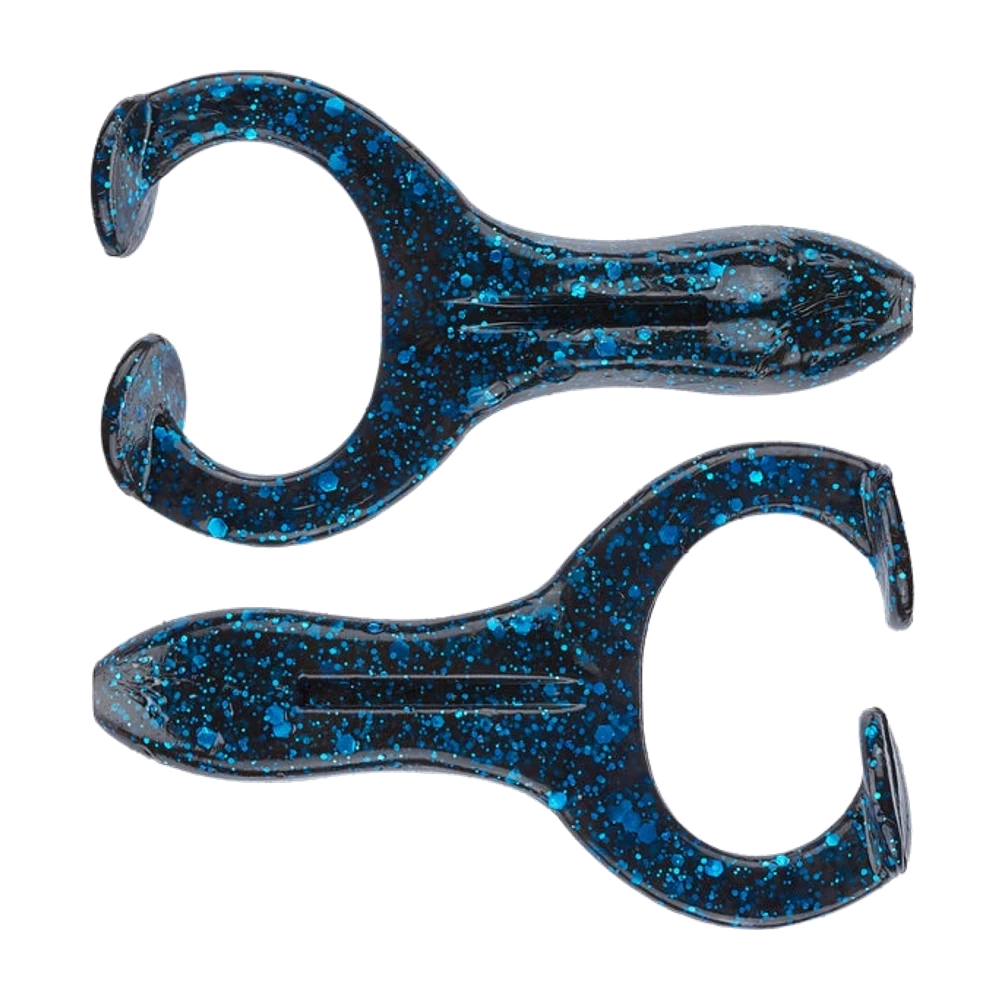
The body is short and tapered, extended by two long paddle feet that curl into a C at rest, clearly visible in the photo. On a constant straight retrieve those two paddles churn the surface alternately and produce a continuous bubbling, gurgling sound — not the pop of a popper, but a steady rustle of water, much closer to the noise of a frog actually crossing a mat.
That acoustic signal is the lure's real weapon. In dense vegetation the fish sees almost nothing: it locates by hearing and lateral line, then attacks a silhouette it only makes out at the last moment. A continuous noise gives it a trajectory to anticipate, whereas an intermittent one forces it to relocate the target every time.
Rigging, and why there are two pockets
The Finesse Frogz has a belly hook pocket and a dorsal one. That is not redundancy.
Dorsal pocket
This is the default rig in dense vegetation. Wide-gap Texas hook pushed in from below, point brought out and then tucked into the groove along the back. The bait then slides over the mat without catching anything, and the point stays protected until the hookset.
Belly pocket
Use it over thinner cover — a lily-pad edge, low weed, open water between two mats. With the hook tucked in from the belly, the point sits closer to the contact surface when the fish eats, so you get slightly more hooking power. You trade weedlessness for penetration.
Either way, stick with a 3/0 to 4/0 hook, 30 to 50 lb braid with no fluorocarbon leader, and a medium-heavy rod able to pull the fish off the mat before it wraps itself up.
The classic mistake
Working the frog like a stickbait, with sharp pulls and long pauses. On this model the signal comes from a constant retrieve: the paddles have to churn without interruption. A choppy retrieve cuts the noise and turns the lure into a plain piece of floating plastic. Wind steadily and slowly, and only pause over the holes you specifically want to work.
Where and when
The register is summer cover: lily-pad mats, weed beds breaking the surface, dead wood in thirty centimetres of water. The reduced seven-centimetre size targets finicky fish and heavily pressured waters, the ones where a ten-centimetre hollow frog gets followed but not eaten.
Across Europe this fishing works on bass in lakes and gravel pits, and it also interests pike sitting under the pads — with the usual caveat: a seven-centimetre soft bait does not survive a run of pike for long, ElaZtech or not. A plastic rated up to ten times tougher than ordinary plastisol copes well with the fine teeth of a bass, not with a pike's jaw.
Not sure what to tie on?
Photograph your spot: CarnaFish reads the scene, cross-checks the conditions and gives you the zone, the lure and the retrieve. Free on iOS and Android.
Colors: a discrepancy worth flagging
The manufacturer advertises a range of natural colors — greens, browns, frog shades. Yet the sample photographed here is black with heavy blue flake, which does not belong to that family. In other words, the actual range on the shelf is wider than the description suggests. So reason by conditions rather than by reference names:
- Clear water, bright sun: natural greens and browns, which read as a frog seen by transparency from below.
- Dark water, thick mat, low light: the black with blue flake from the photo. Seen from underneath against the light, a dark lure gives the crispest possible silhouette — counter-intuitive, but it is what works.
- Stained water, overcast sky: a pale belly, white or yellow, which stands out better when low-angle light no longer passes through the mat.
Placing it among the other frogs
A soft frog does not replace a hollow one: it complements it. The LiveTarget Hollow Body Frog keeps the advantage over a genuinely thick mat thanks to a hollow body that collapses on the hookset, while the Lunkerhunt Compact Frog plays the same downsizing card with a different construction. The Finesse Frogz brings a solid body that never fills with water and a material that does not tear. And if the fish refuse the surface altogether, the Z-Man FattyZ Worm uses the same buoyant material for a presentation lying on the bottom.
You still need to know whether the mat in front of you deserves a frog or whether its edges are the better bet. That is exactly what CarnaFish is for: one photo of the spot, and the AI suggests a zone, a depth and a lure type suited to the conditions of the day. For the rest of the fundamentals, our beginner's guide to bass fishing covers the classic holding spots and the tackle.
Key takeaways
- The high buoyancy of ElaZtech keeps the body flat on the surface even on a heavy hook.
- Two paddle feet produce a continuous bubbling noise on a steady retrieve, not on a choppy one.
- Two hook pockets: dorsal for dense cover, belly for more hooking power.
- The description advertises natural colors, but the version photographed is black with blue flake: the real range is wider.
FAQ
Exactly how big is the Finesse Frogz?
The manufacturer states 2.75 in, about 7 cm, in packs of four. No unit weight is published, and the table needs care when reading: the figure 4 is the pack count, not a mass.
Do I need a special frog hook?
A wide-gap Texas hook in 3/0 to 4/0 is fine. The bait has a dorsal pocket and a belly pocket to house the point: dorsal in dense cover, belly when you want more hooking power.
Why does the body stay horizontal?
Because ElaZtech is extremely buoyant and offsets the weight of the hook. Many soft frogs nose down as soon as you fit a stout wire; this one keeps its flat posture, preserving the silhouette as seen from underneath.
How should I work this frog?
With a slow, constant straight retrieve and no jerks. The two paddle feet churn the surface and make the bubbling noise. Pauses only serve over a specific hole, since the bait floats and stays put.
Does it work for pike?
Yes, a pike sitting under the pads will happily hit a frog. But even a plastic rated ten times tougher will not last long against a pike's jaw: treat it as a consumable on that kind of spot.
Why fish a black frog rather than a green one?
Because the fish sees the lure from below, against the light. In dark water or under a thick mat, a black silhouette stands out far more sharply than a natural colour, which blends into the diffuse light.
The full bass lure guideSeason-by-season strategy: which family of lure, when, and why.Go from theory to fish
CarnaFish reads your spot from a photo and gives you the game plan: zone, lure, retrieve. Free on iOS and Android.