Lunkerhunt Prop Frog: two props on the end of the back legs
Before tying this one on, it helps to know if the spot actually calls for it. CarnaFish reads the scene from a photo.
There are two families of topwater lure: the ones that draw a discreet track the fish has to find, and the ones that make enough noise to go and fetch the fish from twenty metres away. The hollow body frog normally belongs to the first. The Lunkerhunt Prop Frog switches to the second without giving up what makes a frog useful: it keeps complete clearance over cover, but it swaps soft legs for two propellers.
Two legs that are really two propellers
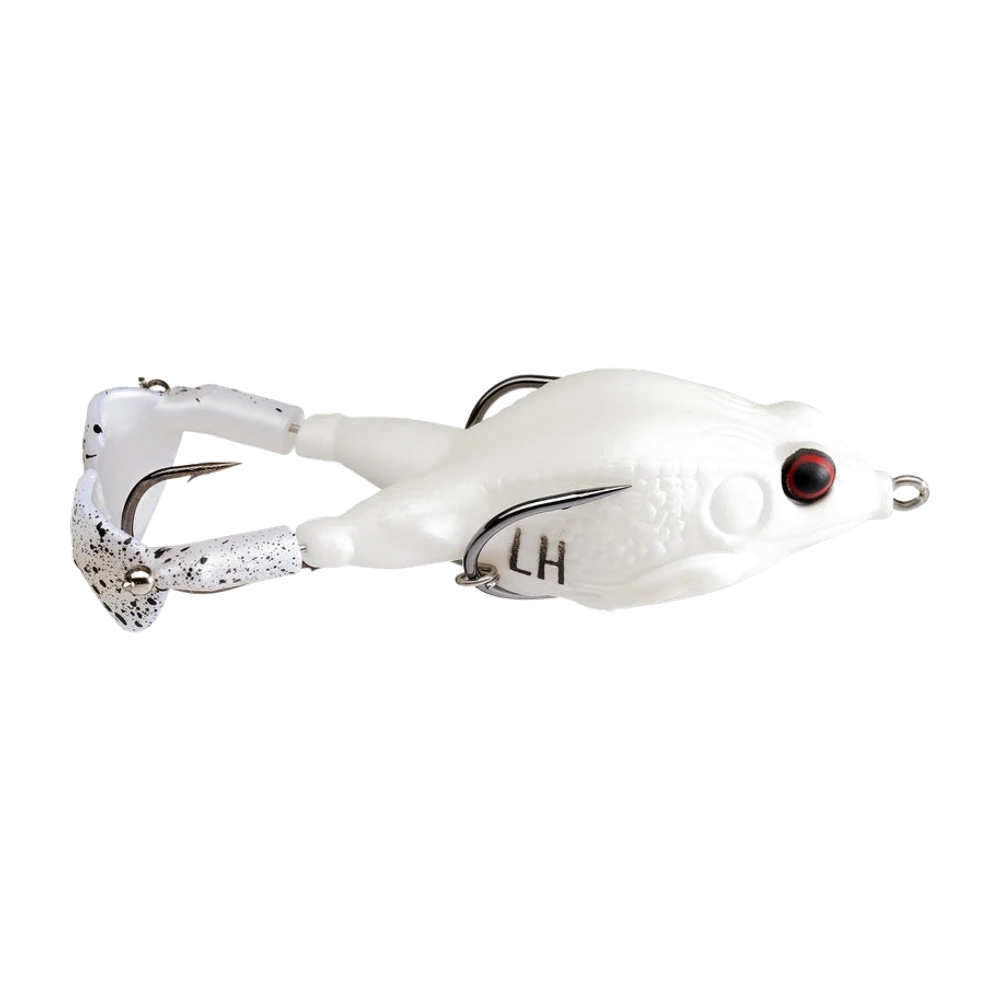
In the photo of the bare lure the arrangement reads immediately: each hind leg is a rigid white shaft ending in a speckled blade, mounted on a small metal bearing that lets it spin on its axis. These are not decorative appendages, they are two passive propellers that start turning as soon as the lure moves.
The maker stresses one particular quality of that setup: the props clear cover — pads, wood, slop — then drop back into the water and start churning again immediately, with no dead time. That detail is what separates the Prop Frog from a conventional buzzbait, which stalls the moment it rides up onto a leaf and has to be restarted.
On dimensions, the maker's table lists one version only: 3-1/4 in, so 8.3 cm, at 1/2 oz, about 14 g. Compare that with the brand's other frogs and the figure gets interesting: 8.3 cm for 14 g is far less dense than a 6.4 cm body at 21 g. In other words the Prop Frog is a big light volume, which is exactly what it needs to stay high in the surface film so the props work on top rather than drowned.
What the table does not say, and what the copy says anyway
As on several models from this brand, the spec table is limited to two columns, length and weight, with no class column. There is therefore no official floating, sinking or topwater statement to put in a spec sheet.
The maker's prose, however, is explicit: it describes a lure that moves over pads, wood and slop, that re-enters the water and that starts churning back up. You do not describe a sinking lure that way. Surface use is stated in black and white in the text even though the table carries no class: that wording is what is reported here, not an inference.
A straight-retrieve lure, not a walking lure
The opening mistake would be to work it like a standard frog, walking the dog. The props only turn if the lure moves forward continuously: a pull followed by a pause stops them, and you lose the whole signal.
The right retrieve is therefore a steady straight one, slow enough that the lure does not break out of the water, firm enough that the blades slap. You should hear a continuous churning and see two trails of bubbles behind the lure. If the noise cuts out, speed up slightly; if the lure starts skipping clear of the water, drop the rod tip and slow down.
Pauses are a matter of millimetres on this lure. Never stop in open water — you kill the signal for nothing. Keep the only pause that pays: just after you clear an obstacle, a stump or a pad edge. Half a second of stillness exactly there, then you restart and the props fire up again. It is that abrupt restart that triggers.
Where it scores and when to tie it on
This is a search lure, for when you have to cover a lot of water fast: big grass flats, long pad edges, shallow cluttered zones. Its noise works best in stained water, under cloud, or early in the morning, when fish hunt by ear more than by eye.
In clear water under full sun on a pressured fish, that same sound output works against you: a silent frog like the Lunkerhunt Lunker Frog or a very compact profile like the Lunkerhunt Compact Frog will make more sense. If you want a noisy topwater without the cover-clearing constraint, an externally rigged prop lure like the Deps Buzzjet converts strikes better in open water.
The target species is bass. Pike will also rise to this kind of lure in summer over shallow weed — a heavy leader then becomes essential, since neither the props nor the soft body offer any protection against teeth.
Hardware and hookset
The maker describes an integrated hook system that encases the body and sits between the two props, designed to deflect cover while holding on to fish. In the photo several silver points are indeed visible: one over the back, one along the flank joined to a split ring, and a two-point hook between the legs.
In practice that means two things. First, the assembly stays weedless as long as nothing presses on it, just like a standard frog. Second, with several points spread out, the hooking window is wider than on a single double — a real advantage on half-hearted strikes along an edge. The hookset is unchanged: wait for the weight of the fish in the rod, then set long while picking up slack. Braid of 30 to 40 lb, heavy rod, fast casting reel.
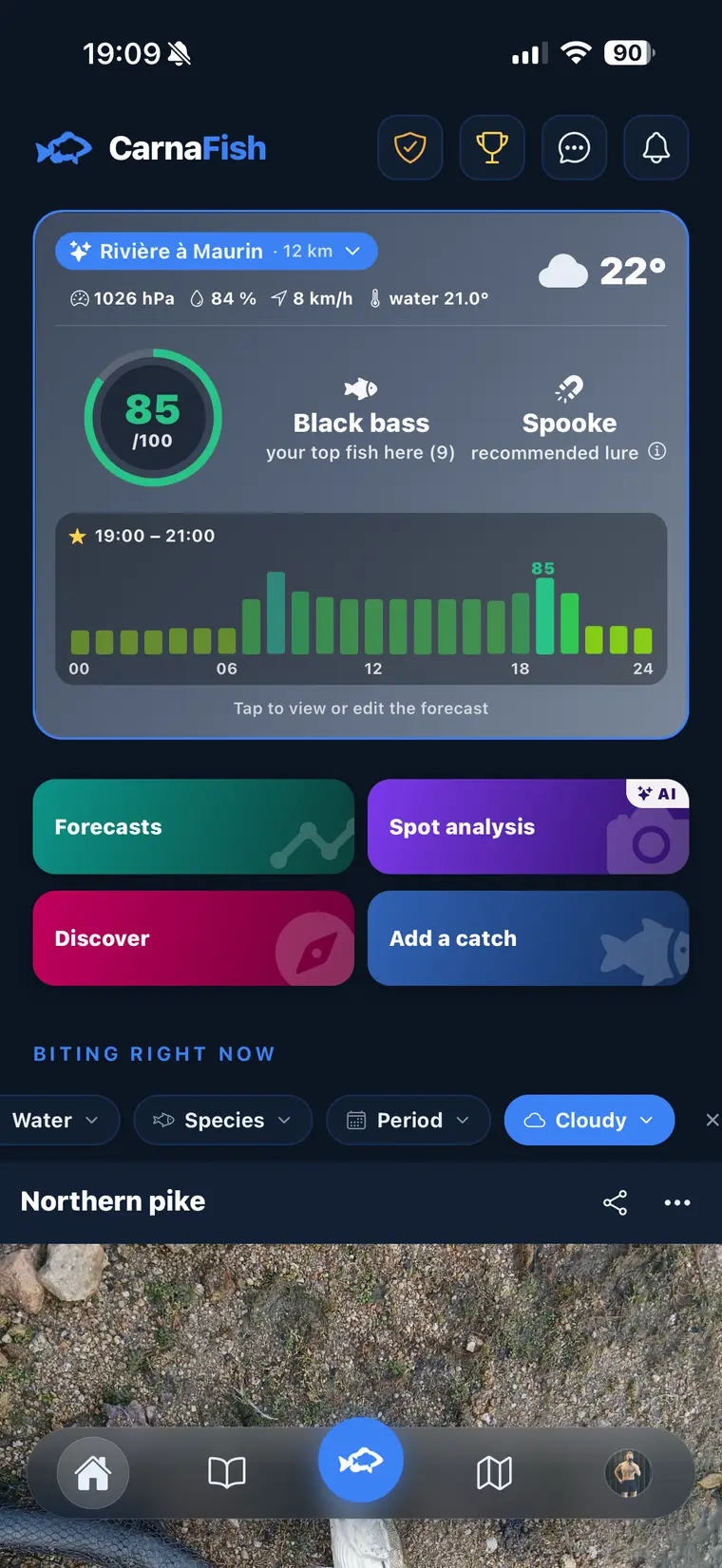
Not sure what to tie on?
Photograph your spot: CarnaFish reads the scene, cross-checks the conditions and gives you the zone, the lure and the retrieve. Free on iOS and Android.
Colours by water and light
- Overcast sky, stained water: the solid white from the photo. A white belly is the most readable aiming point for a fish striking from below in loaded water.
- Clear water: a natural frog pattern, dark back and pale belly, on a lure that is already conspicuous through its noise.
- Dawn, dusk, low light: black, which cuts out against a pale sky better than any bright colour.
Lunkerhunt advertises several detailed colours without naming a single one in its spec sheet: think in contrasts.
A noisy lure is no substitute for reading the swim: you still have to know where the fish sits on a big uniform grass flat. That is exactly what CarnaFish makes easier: a photo of the spot, and the AI suggests the zone to attack and the presentation that fits the day's conditions. To sharpen that reading before you even pick a lure, our guide to reading a fishing spot sets out the method.
Key takeaways
- One version in the table: 8.3 cm at 14 g — a big light volume that stays high in the surface film.
- The two props clear cover and restart the moment they land back in the water, where a conventional buzzbait stalls.
- This is a continuous-retrieve lure: any pause stops the props and kills the signal.
- The table has no class column, but the maker's copy explicitly describes a lure that clears pads and churns the surface.
FAQ
Should I walk the Prop Frog?
No, and that is the most common mistake. The props only turn under continuous forward movement. A steady straight retrieve, slow enough not to lift the lure out of the water, is the only presentation that really uses the design.
Is it a floating lure?
The spec table has no class column, so there is no official statement. The maker's description, however, explicitly mentions a lure that clears pads, re-enters the water and starts churning again: that is surface use, stated in the text if not in the table.
Does it really go over lily pads?
Yes, that is the model's central argument. The props ride up onto the leaf, clear it and restart as soon as they land back in the water, while the hardware built into the body stays weedless. A conventional buzzbait stalls dead on the obstacle.
When should I prefer a silent frog?
In clear water, full sun, on fish that have already seen pressure. The Prop Frog's noise is an asset when visibility is poor and a handicap when the fish can inspect the lure at leisure.
What size and weight is it?
One version in the catalogue: 3-1/4 in, so 8.3 cm, at 1/2 oz, about 14 g. That is long but light for a topwater, which is what lets it stay high in the surface film.
Do I need a leader for pike?
Yes, without exception, if the swim holds them. Neither the props nor the soft body protect the line, and a pike that swallows an 8.3 cm lure puts the braid in direct contact with its teeth. Thirty centimetres of heavy fluorocarbon or a titanium leader.
The full bass lure guideSeason-by-season strategy: which family of lure, when, and why.Go from theory to fish
CarnaFish reads your spot from a photo and gives you the game plan: zone, lure, retrieve. Free on iOS and Android.