MadCat CatDiver: trolling deep to find catfish out in open water
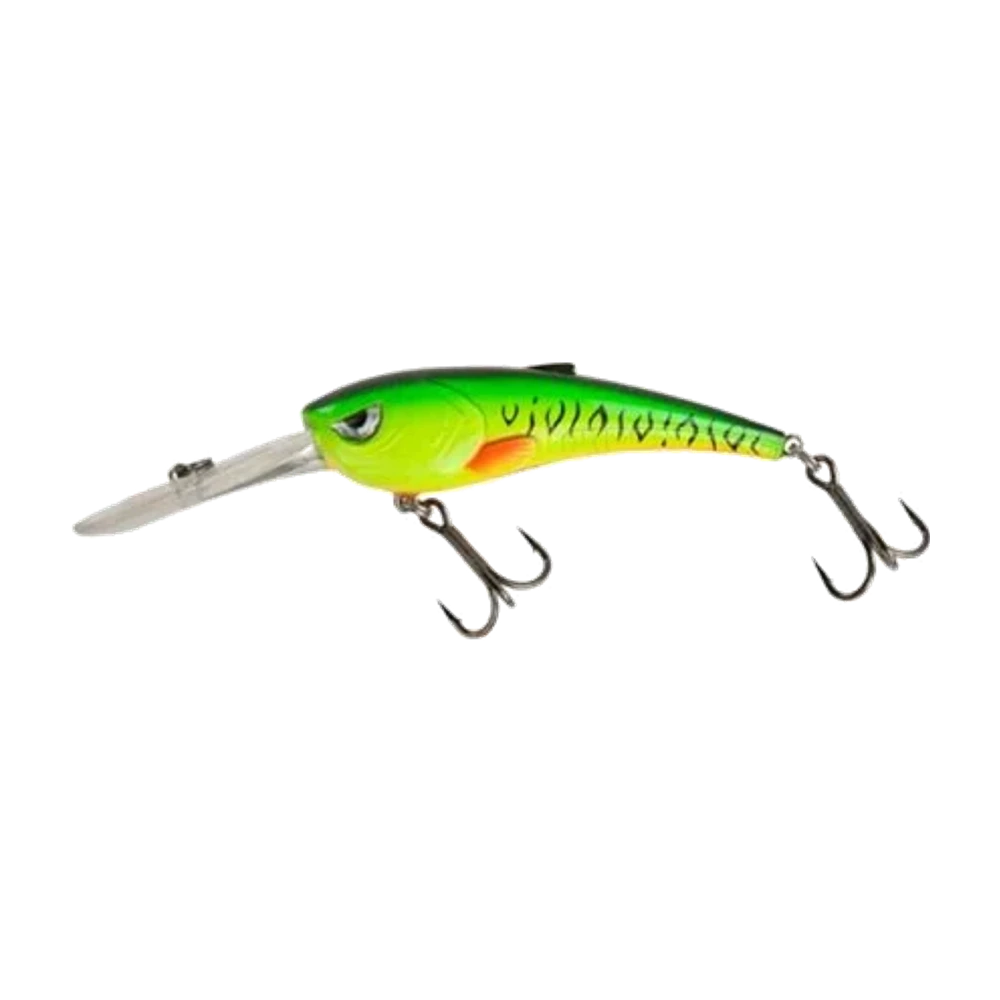
This lure shines under specific conditions. CarnaFish tells you in 10 seconds if today is one of them.
On a big river or a reservoir, the catfish angler's problem is not getting a bite: it is finding the fish. They are there, but spread over kilometres of bottom, often sitting far from any accessible bank, between five and eight metres down, on plateaus and drop-offs you cannot comb with a cast.
As long as you stay in one place, you fish a single point. Trolling turns the problem around: you cover water continuously, and it is the boat that does the searching for you. The CatDiver is a lure built for exactly that job — a short, very thick body and a wide lip that takes it deep and sends back vibrations you can feel in your hands through the rod.
Do not confuse it with clonking, which is the other great catfish approach: the MadCat Clonk Teaser is fished vertically under the boat, straight down, calling fish in with sound. Here it is the reverse: no calling, no vertical, you go and find the catfish where it lives by passing right under its nose.
Why such a chunky body
Next to a pike crankbait, the CatDiver looks out of proportion: short, very broad across the flank, with an oversized lip. Every element answers a constraint of trolling for catfish.
- The body volume produces a low frequency pressure wave. Catfish detect mainly through their lateral line and barbels, not by sight. What makes one react at a distance is a big displacement of water, not a flash.
- The wide lip imposes a stable depth. Once the line length is set, the lure holds its layer, including when boat speed varies slightly.
- Density and hardware are oversized. A fifty kilo catfish hooked 60 metres behind a boat bends any standard hardware. Split rings and trebles have to be reinforced models, checked after every fish.
The corollary is that this lure pulls enormously. It has no business on a normal casting setup, however powerful.
Setting the running depth: line length and speed
Trolling depth depends on three variables: the length of line behind the boat, the speed, and the diameter of the line. Here are working figures to use as a starting point, to be confirmed on the sounder.
| Line behind the boat | Speed | Approximate depth |
|---|---|---|
| 20 to 30 m | 2.5 km/h | 2.5 to 4 m |
| 40 to 50 m | 2.5 to 3 km/h | 4 to 5.5 m |
| 60 to 80 m | 3 km/h | 5.5 to 7 m |
Two simple rules: more line makes it go down, more speed makes it come up beyond a certain threshold. If you want to gain a metre without touching the line length, slow down slightly.
Using braid rather than mono changes the outcome too. Braid, finer at equal strength and with no stretch, offers less drag: at the same length the lure runs deeper and vibration transmission is instant.
The retrieve: trolling is steered with the motor
There is no rod work. Everything happens through the boat's path and your control of it.
- Find a structure on the sounder: a drop-off, a plateau, a hole, a tributary mouth, a current seam. Do not troll at random over flat, uniform bottom.
- Drop the lure back counting the metres of line released, then set the drag and put the rod in its holder.
- Check that the lure is working: the rod should be vibrating visibly and steadily. If the tip is dead, the lure has picked up a weed or fouled, and it has to come back up.
- Troll in S curves rather than straight lines. The lure on the outside of the turn speeds up and rises, the one on the inside slows and drops. That change of rhythm triggers a large share of the bites.
- Go back and forth over the zone where a bite happened, in both directions, before resuming your search.
On the water: when a bite comes, note the line length, the speed and the side of the boat straight away. Trolled catfish are often grouped on a precise layer; reproducing those three parameters exactly is worth more than changing lure.
The hookset and the fight, the two moments not to get wrong
On the troll, catfish often hook themselves against the drag and the inertia of the boat. That is no reason to leave it at that.
At the strike, put the motor in neutral or slow right down, pick up the rod, and drive a firm hookset sideways to bury the trebles in a bony mouth. Then let the fish pull against a drag set firm but not locked.
During the fight, keep the boat moving. A catfish brought towards a stationary boat dives vertically under the hull and rubs the line on the propeller or the keel. Better to move gently to open the angle back up.
At the boat side, the most expensive mistake is shortening the line. Keep several metres of it: a good catfish still has three or four violent dives in it once it sees the hull.
Not sure what to tie on?
Photograph your spot: CarnaFish reads the scene, cross-checks the conditions and gives you the zone, the lure and the retrieve. Free on iOS and Android.
Where this technique pays, and where it is pointless
It comes into its own on:
- Big navigable rivers, where catfish spread along long deep layers beside the channel.
- Reservoirs, over the drowned old river beds and the plateaus that border them.
- Post-spawn and summer, when fish are on the move and not pinned to cover.
- Coloured water, where sight counts for nothing: low frequency vibrations remain detectable.
It is unsuited to small narrow rivers, to areas cluttered with sunken timber — you lose an expensive lure every ten minutes — and to very localised spots under an undercut bank, where a vertical clonking approach or a static rig is far more effective.
CatDiver or Clonk Teaser
Both carry the same brand and target the same fish, but they do not answer the same question.
The Clonk Teaser is a vertical lure: you position yourself over a marked fish or a known spot, you call with the clonk, and you present the lure straight down over a few square metres. It is precision fishing, heavily dependent on the sounder and on prior scouting.
The CatDiver does the opposite: it is for when you do not know where the fish are, over a vast area, and you are willing to motor around for two hours to find the right layer. In practice a lot of sessions combine the two: troll to locate, then vertical to work the zone. Our guide to lure fishing for catfish covers how to link those two phases within a single day. And if you are unsure which zone to troll first, CarnaFish analyses a photo of the spot and answers.
Key takeaways
- A deep trolling lure, not a casting lure: it pulls too hard for a normal setup.
- Running depth is set by line length and speed, between 2 and 3.5 km/h.
- Troll in S curves: the speed changes through the turns trigger a large share of the bites.
- Note the line length and speed at every bite, then reproduce them exactly.
- Reinforced hardware is compulsory, and must be checked after every fish.
FAQ
How fast should I troll for catfish?
Between 2 and 3.5 km/h, with 2.5 to 3 km/h as the most productive baseline. Slower and the lure works poorly; faster and it rises up the water column and loses vibration amplitude.
How much line should I let out behind the boat?
Reckon 20 to 30 m for about 3 m of depth, 40 to 50 m for 4 to 5.5 m, and 60 to 80 m to reach 6 to 7 m. These values vary with line diameter and should be checked on the sounder.
Can the CatDiver be cast?
That is not what it is for. Its weight and drag call for a short powerful trolling setup; cast repeatedly it wears out your tackle and covers far less water than it would on the troll.
Braid or mono for trolling catfish?
Braid, 0.40 to 0.50 mm. It offers less drag at equal strength, so better depth, and it transmits the lure's vibration and the bites instantly, where mono damps them.
What is the difference with clonking?
Clonking is done vertically over a marked spot, calling the fish in with sound. Trolling is for searching large areas when you have no idea where the catfish are. The two complement each other within one session.
Should I change the stock hooks?
Check them every time and replace them with reinforced trebles if you have any doubt. A catfish hooked far behind the boat applies a continuous pull that will open any undersized hook.
The full catfish lure guideSeason-by-season strategy: which family of lure, when, and why.Go from theory to fish
CarnaFish reads your spot from a photo and gives you the game plan: zone, lure, retrieve. Free on iOS and Android.