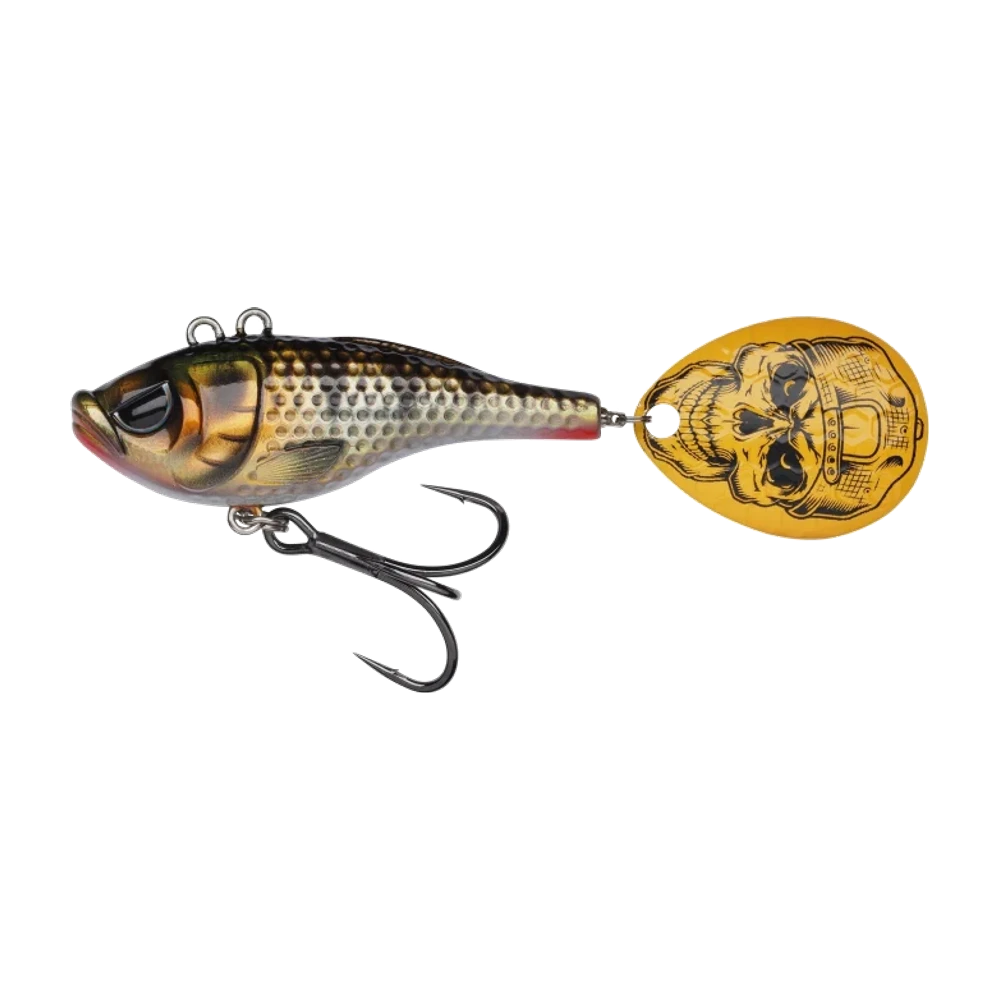
MadCat Golden Rattlin Spin: making noise to find catfish in dirty water
Rather not fish it blind? Photograph your spot — CarnaFish cross-checks the conditions and points you the right way.
Three days after a storm, the river is the colour of milky coffee. You can watch your hand disappear twenty centimetres under the surface. In those conditions everything that relies on sight is useless: colour means nothing any more, flash does not carry, and a perfectly realistic lure passes a metre from a catfish without it noticing.
The catfish, meanwhile, is perfectly comfortable. It has a highly developed lateral line and barbels that let it locate prey without ever seeing it. So the problem is not the fish: it is that your lure puts out nothing it can follow.
The Golden Rattlin Spin answers that precise situation. It is an oversized, heavy spinner with a blade that churns at low frequency and a rattle set in the head. It is not trying to look like anything: it is trying to be detectable at ten metres in opaque water.
Two signals, not one
Most noisy lures only have one string to their bow. This one combines two, and that is what makes it readable from a distance.
The pulse of the blade. A big Colorado style blade turns slowly and moves a lot of water. It generates a deep, low frequency pressure wave, in the same register as a big fish on the move. That is exactly the band a catfish's lateral line reads best, and it is what carries furthest in coloured water.
The internal rattle. The ball in the weighted head adds a high, irregular signal that does not carry as far but that pinpoints the lure once the fish is close. The blade attracts, the rattle says where to bite. Without it, a lot of hits land beside the lure.
A third element that often gets overlooked: the skirt. It is not there for the journey, it is there for the slow-downs. Every time you ease off for half a second it opens and closes again, and that is almost always the moment the bite comes.
The retrieve: straight, but not steady
- Cast upstream or across, never straight downstream: you want the lure coming back into the current, not with it.
- Count the drop. One to two seconds in shallow water, five to eight over a hole. Start before it hits bottom if the spot is snaggy.
- Retrieve slowly and steadily, just fast enough to feel the blade turning continuously in the rod tip. If you stop feeling the pulse you are too slow: the blade has stalled.
- Break the rhythm every five or six turns of the handle: half a second of stop, the lure drops slightly, the skirt opens, then you start again.
- Slow right down over the last three metres, under your feet. On rock armour, some catfish follow the lure to the margin and make up their mind there.
The critical point is the minimum rotation speed. Every weight has a threshold below which the blade stops turning and the lure becomes an inert lump of lead. Learn that threshold on your first two casts, on sight near the bank, then fish just above it all session.
| Version | Working depth | Typical ground |
|---|---|---|
| Light, around 55 g | 1 to 2 m | Backwater, gravel pit, shallow margin |
| Medium, around 85 g | 2 to 3 m | River with moderate current, dock mouth |
| Heavy, 110 to 125 g | 3 to 4 m | Strong current, head of a hole, bridge pier |
On the water: in very dirty water, do not change colour when nothing bites — change speed. A catfish that refuses is not seeing a bad colour, it is failing to intercept a wave going past too fast or too erratically. Half a turn of the handle per second less solves more difficult days than any lure change.
A searching lure, not a finishing one
That is the real place of the Golden Rattlin Spin in a box: it is there to tell you where the fish are, not to talk the most difficult one into biting.
On two hundred metres of bank you do not know, you fan it out, three casts every ten metres, at constant speed. When you get a bite or a follow, you know where the travel lane is — and you can then slow that zone right down with a soft plastic on the bottom.
Where it is at its best:
- Stained to opaque water, after a spate or in a naturally coloured river.
- Active shallows, between 1 and 4 m, typically at the start of a summer night.
- Rock armour margins and bridge piers, where the current creates a seam the catfish watches.
- Backwaters and docks in summer, when the water warms and the fish move up.
Where it is out of place: over a fifteen metre hole it makes no sense — the sink time becomes endless and you lose control of the water layer. In the clear water of a reservoir its bulk and noise work against it: catfish in those places are far more responsive to a discreet presentation. And in daylight, in full sun, on water with decent visibility, you are wasting your time.
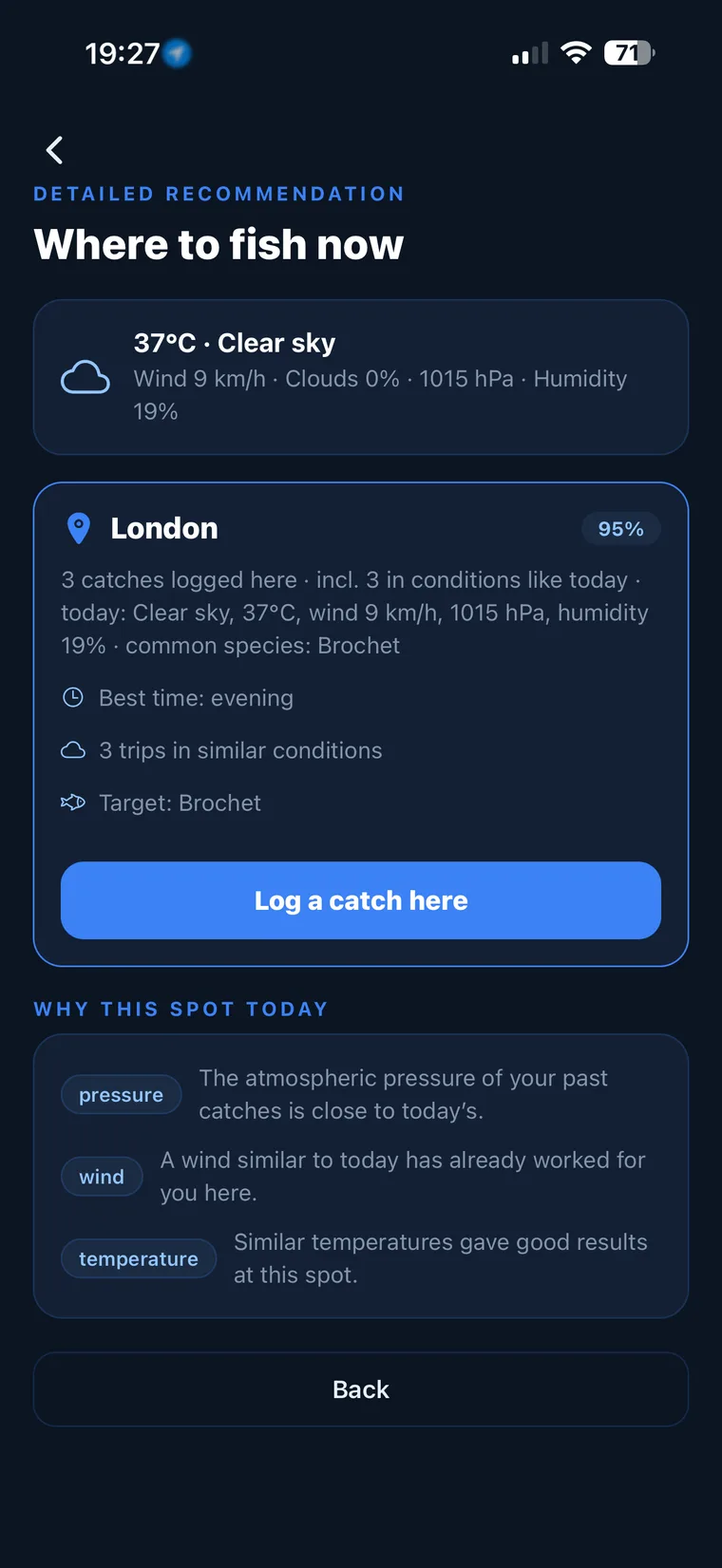
Not sure what to tie on?
Photograph your spot: CarnaFish reads the scene, cross-checks the conditions and gives you the zone, the lure and the retrieve. Free on iOS and Android.
Spin or soft tube
The MadCat Tube Teaser and the Golden Rattlin Spin get fished from the same bank, with the same rod, and they do not do the same job.
The tube works on the bottom, on slow pulls, over a narrow lane. It is built to insist where you know there is a fish: a persuasion tool, with low ground covered per hour.
The Spin sweeps. It fishes a mid water layer on a continuous retrieve, and covers in an hour what the tube covers in half a day. The logical sequence is to run the two together: the spinner to find the lane, the tube to work it.
Against boat fishing the comparison is clear cut: the MadCat Clonk Teaser calls mid-water fish with the sound of the clonk, in ten metres of water, straight down. The Spin also produces a sound signal, but it goes looking for fish sitting in shallow water that clonking never reaches. Our guide to lure fishing for catfish places these techniques in the calendar of the year. And if you are unsure which depth to attack when you reach an unfamiliar bank, CarnaFish analyses a photo of the spot and answers.
Key takeaways
- Two complementary signals: the blade carries far at low frequency, the rattle pinpoints up close.
- Find the blade's minimum rotation speed on your first two casts, then stay just above it.
- Break the rhythm every five or six turns of the handle: the bite comes on the restart.
- In dirty water, fix the speed before you fix the colour.
- A searching lure for 1 to 4 m: useless over deep holes and in clear water.
FAQ
Does a spinnerbait really work on catfish?
Yes, provided it is heavy enough and its blade moves a lot of water. Catfish locate prey with the lateral line: a big blade turning slowly produces exactly the kind of deep wave they detect best in coloured water.
What weight should I choose?
Around 55 g in shallow water with no current, 85 g on a river with moderate current, and 110 to 125 g to hold between 3 and 4 m in strong flow. The right marker is feeling the blade turning continuously at slow speed.
How fast should I retrieve?
Just above the blade's rotation threshold, meaning as slowly as you can while still feeling the pulse in the rod tip. If the vibration disappears, the blade has stalled and the lure is no longer signalling anything.
Do I need a fluorocarbon leader?
A short, very strong leader is essential, but on this lure coated braid does the job as well as fluorocarbon: in opaque water line visibility does not come into it, only abrasion resistance along the margins.
When should I fish this lure?
Mainly from late spring to early autumn, over 1 to 4 m of water, and preferably in stained conditions. The start of the night and the hours following a spate are the best windows.
Does it work in a clear reservoir?
Poorly. In clear, deep water catfish are warier and sit too low for this kind of lure. A slow presentation on the bottom or a vertical approach will be considerably more productive.
The full catfish lure guideSeason-by-season strategy: which family of lure, when, and why.Go from theory to fish
CarnaFish reads your spot from a photo and gives you the game plan: zone, lure, retrieve. Free on iOS and Android.