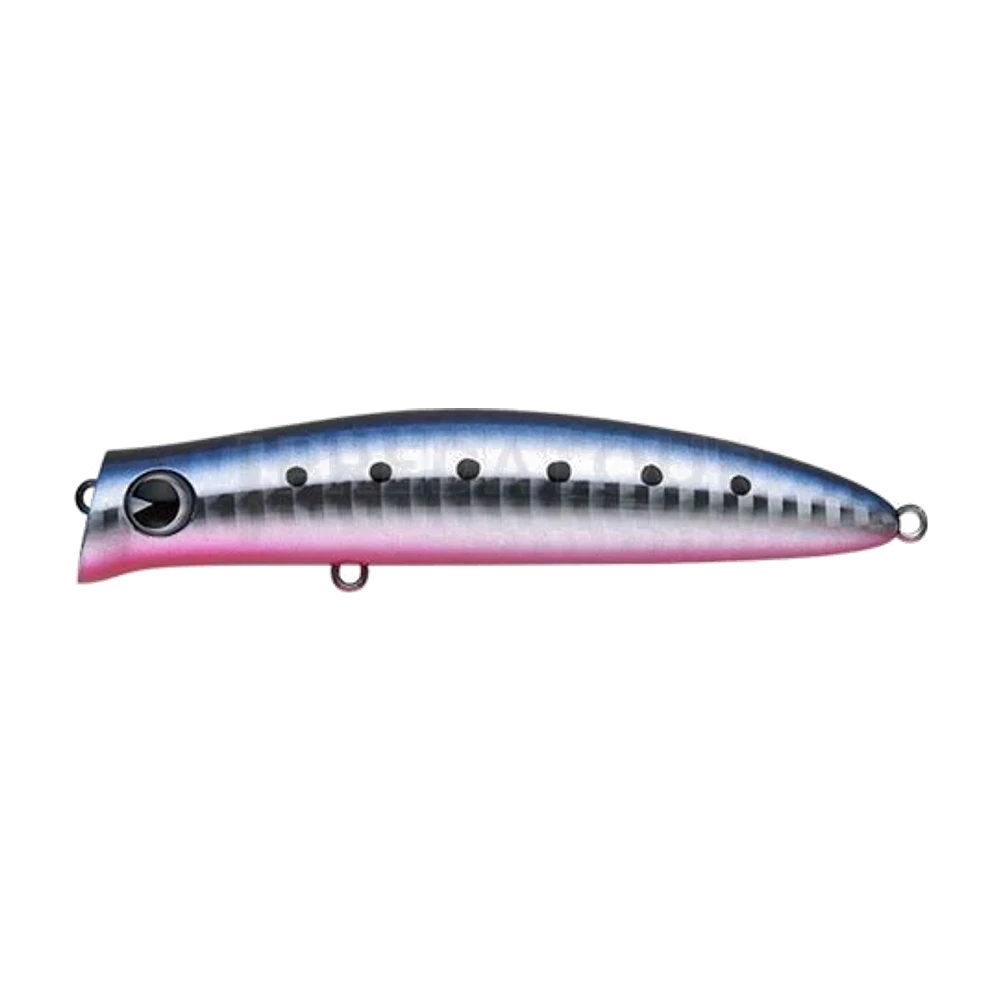
Ima Komomo: the minnow that still swims when you slow right down
Rather not fish it blind? Photograph your spot — CarnaFish cross-checks the conditions and points you the right way.
There is one situation on a beach or a rocky flat that everybody recognises: water creeping in slowly, forty centimetres of depth, a lazy current, and sea bass feeding without a sound ten metres off the bank. You cast, you retrieve, and nothing. Not because the lure is bad, but because you are forced to wind fast enough to make it swim — and that speed, over that depth of water, matches nothing the fish is actually eating.
The problem is mechanical. A minnow needs a minimum of pressure on its lip before the body starts to oscillate. Below that threshold it travels flat and lifeless, and you are dragging a piece of plastic. The Komomo was designed to push that threshold very low: it keeps rolling and flashing at a speed where most minnows are already dead.
It is a lure of patience, not of searching. It is not trying to cover ground, it is trying to stay believable for the twenty seconds it takes to cross the feeding zone.
A flat body, a short lip, and what that implies
Three design choices explain the behaviour, and it pays to understand them rather than put up with them.
The flank is flat, almost blade-like. A round body rolls very little and throws a diffuse flash; a flat body tips from one side to the other with very little energy. At low speed that is decisive: a trickle of water is enough to set the oscillation going, whereas a bulky body would need twice the pull.
The lip is short and only slightly angled. Its job is not to take the lure down but to bite into the water. The result is a shallow running depth, between twenty and sixty centimetres depending on the version, that does not collapse when you slow down. On a long-lipped diving minnow, slowing down makes the lure rise; here it holds its line.
The lure floats at rest. You can stop dead over a slab, let the current carry it, and start again. That buoyancy is also what saves you over cluttered ground: at a standstill the Komomo climbs instead of snagging.
Add an internal weight transfer system that throws a ball to the rear on the cast, and you get a light lure that still casts respectably into an offshore wind.
The retrieve: the slowest winding you are capable of
There is no complicated rod work. There is a rhythm, and it is slower than your instinct.
- Cast across the current, never straight out in front. You want the lure to cross the flow, not swim up it.
- Let the line come tight for a second or two before you start, giving the lure time to line up.
- Retrieve at one turn of the handle per second, then go slower still. Look for the point where you can barely feel the vibration in the rod tip. That is your working speed.
- Add a one to two second stop every five or six turns. The lure rises a few centimetres and sets off again. A lot of bites come on that restart.
- Slow down further over the last ten metres. Sea bass follow a long way in shallow water and often make up their minds right at your feet.
Two variants worth keeping in mind. On a dead flat sea, add a light squeeze of the wrist every three seconds: the lure barely breaks sideways then settles back, which is often enough to convert a follower. As soon as there is chop, though, forget the twitches and stay on a continuous retrieve — the fish already has plenty of movement to deal with.
On the water: if you can see your lure swimming, you are going too fast. In shallow water at night or at first light, set your speed by what you hear rather than what you see — when the faint slap of the lure on the surface disappears, you are at the right rhythm.
Choosing your version by depth of water
The Komomo comes in several sizes, and the choice is made on the water available before casting weight ever comes into it.
| Water under the lure | Size to favour | What you are after |
|---|---|---|
| Less than 50 cm | The most compact, 8 to 9 cm | Getting through without touching, a discreet profile |
| 50 cm to 1.5 m | Mid-size, 11 cm | A compromise between distance and stealth |
| More than 1.5 m, or a headwind | The longest, 13 cm | Casting distance and visible bulk |
Two useful corrections. In very clear water by day, drop a size even if you lose distance: on those spots the silhouette matters more than the ten metres gained. At night do the opposite and go up a notch — sea bass hunt on water displacement as much as on sight, and a slightly bigger profile passes very well.
Keep the tackle light: fine braid and a fluorocarbon leader of 0.28 to 0.35 mm, around a metre long. A heavier leader chokes the roll in exactly the speed range that makes this lure worth owning.
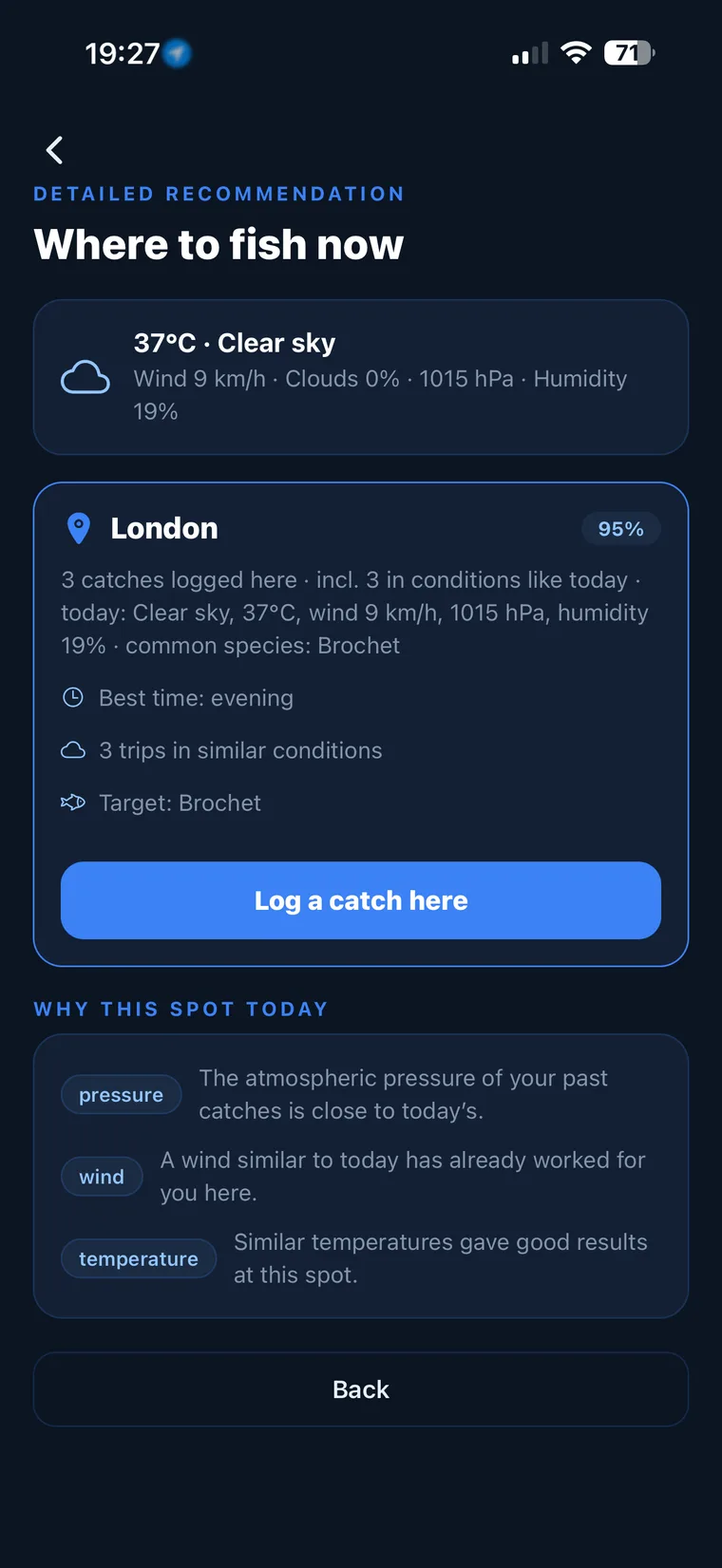
Not sure what to tie on?
Photograph your spot: CarnaFish reads the scene, cross-checks the conditions and gives you the zone, the lure and the retrieve. Free on iOS and Android.
Where it excels, and where it is useless
Its windows are clear-cut.
- Shallow sand or shingle ground on a flood tide, when water reclaims an area that was dry an hour earlier.
- Calm nights, where the slow retrieve and wide roll do all the work on their own.
- Kelp-cluttered margins: the shallow running depth and the buoyancy let you pass over the top without snagging constantly.
- The tail end of a blow, when the sea settles and fish move back onto the margins.
Its limits are just as clear. In a strong current lane it gets swept away and ends up spinning on itself. On a deep spot or a hole it does not get down far enough to be relevant. And in a big sea its light profile becomes unmanageable: you spend your time correcting instead of fishing.
Komomo or Sasuke: two spots, not two quality levels
This is the comparison that comes up most often, and it is settled on current, not on branding.
The Ima Sasuke is built to hold in a lane of moving water: its axis stays stable even when the current presses hard on its flank, which makes it a lure for tide races, narrows and estuaries. It needs current to show what it can do.
The Komomo is the opposite. It works where almost nothing is happening: calm water, shallow ground, minimal speed. Put it in a strong current and it blows out; put the Sasuke over forty centimetres of flat water on a very slow retrieve and it goes bland.
In a shore fishing bag the two complement each other cleanly: the Sasuke for the run of established current, the Komomo for the end of the flood tide, slack water and calm nights. If you want a third register, a Daiwa Shoreline Shiner Z Vertice covers long casts into a headwind, where the other two hit their ceiling. Our guide to lure fishing for sea bass explains how to run those registers back to back on a single tide. And if you are unsure which size to clip on when you reach the rocky flat, CarnaFish analyses a photo of the spot and answers.
Key takeaways
- The flat body and short lip give a readable action at very low speed, where a classic minnow stays lifeless.
- Retrieve more slowly than your instinct tells you, with a one to two second stop every five or six turns.
- Running depth of 20 to 60 cm: this is a shallow water lure, not a deep water one.
- Pick the size on depth of water first, casting distance second.
- It blows out in strong current: that is where the Sasuke takes over.
FAQ
How deep does the Ima Komomo swim?
Between 20 and 60 centimetres depending on the version and the retrieve speed. It is built for shallow ground: over a hole or a drop-off it stays too high to be relevant.
Can you fish the Komomo at night?
Yes, and it is one of its best windows. The very slow retrieve and wide roll produce a continuous signal that sea bass track easily in the dark. Fit a solid colour, white or black, rather than a detailed pattern.
What is the difference with the Ima Sasuke?
The Sasuke is built to hold in a sustained current, the Komomo to swim in calm, shallow water at minimal speed. They do not replace each other: they cover two different phases of the same tide.
Should you work the Komomo or just wind it in?
A very slow straight retrieve is enough in most cases. Add a light squeeze of the wrist every three seconds only on a flat sea, when fish are following without committing.
What leader should you use?
Fluorocarbon of 0.28 to 0.35 mm, around a metre, behind fine braid. Heavier and you choke the roll in precisely the slow speed range that makes the lure interesting.
Is the Komomo any good in a rough sea?
Hardly. Its light profile and shallow running depth make it hard to control as soon as chop builds. In those conditions a heavier, deeper-diving minnow takes the advantage back.
The full sea bass lure guideSeason-by-season strategy: which family of lure, when, and why.Go from theory to fish
CarnaFish reads your spot from a photo and gives you the game plan: zone, lure, retrieve. Free on iOS and Android.