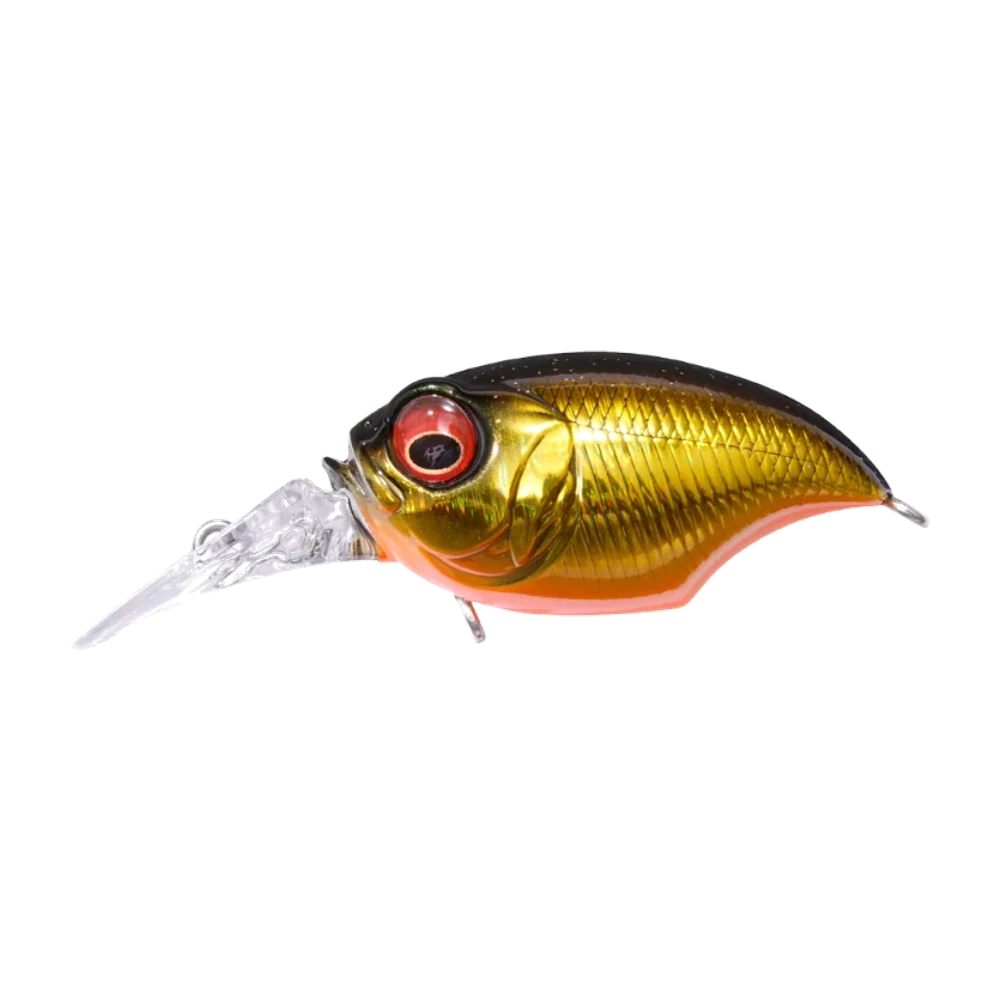
Megabass Griffon: the small tight-vibrating crank for wary fish
Before tying this one on, it helps to know if the spot actually calls for it. CarnaFish reads the scene from a photo.
There is a situation every bass angler knows: the water is clear, the bottom is clean, you can see fish along a margin — and your squarebill goes past them without a single one moving. You slow down, nothing. You change colour, nothing. The problem is neither the speed nor the shade: it is that your lure makes too much noise for what the fish will accept today.
The Griffon is the answer to that precise case. A short, compact crankbait whose vibration is deliberately tight and fast rather than wide and dull. It produces a high-frequency, low-amplitude signal, exactly the opposite of what most cranks offer.
High frequency against high amplitude
Two crankbaits can cover the same depth and produce opposite signals.
A wide-bodied squarebill moves a lot of water on every oscillation. Low-pitched signal, strong amplitude, long reach. That is built to call a fish from a distance, in stained water or on active fish.
The Griffon does the reverse. Its short body and compact lip produce a fast, very tight beat that you feel through the blank as a continuous hum rather than as distinct knocks. Three concrete effects:
- The signal looks more like a small fish than an alarm. On educated bass in a heavily fished pond, it is often the only thing that still gets through.
- The lure starts instantly. A short body has low inertia: on the first turn of the handle, it is already vibrating. You can fish it very slowly without it going dead.
- The deflection is sharp. Compact and fast, it kicks violently sideways when it hits a branch, instead of sliding softly around it.
An honest trade-off: it does not carry as far. In coloured water or over a big empty flat, a bulkier crank will find you more fish.
The retrieve: hunt the knock, not the straight line
A crankbait that touches nothing catches almost nothing. Your retrieve has to be built around contacts.
- Cast past the obstacle — a stump, a submerged branch, a rocky margin, a jetty pile — and retrieve so that you hit it, not skim it.
- Retrieve slowly and steadily, rod horizontal or slightly low, at about the nine o'clock position. You should feel the vibration constantly.
- On contact, stop for an instant and give back half a second of line. The lure lifts off the obstacle, kicks sideways, then picks its action back up.
- Start again immediately at the same speed. Whatever you do, do not change rhythm: the fish has already decided to follow, and your steadiness lets it commit.
- Over the last five metres, slow down further and let the lure rise slightly. Followers very often make up their minds at that moment.
On the water: if during a retrieve you lose the vibration for a fraction of a second without having touched any obstacle, set the hook immediately. On a tight-vibrating crank, a fish that follows very close and inhales the lure without hitting it shows up only as that interruption. Waiting to feel a knock means letting one fish in three go.
In cold water, below 10 °C, use the "long stop and go" variant: five slow turns, then a full two-second stop during which the lure rises gently. That slow vertical move triggers fish that are no longer chasing anything.
Settings: line, lip, hooks
| Setting | Choice | Effect |
|---|---|---|
| 0.20 mm fluorocarbon | fine | runs 20 to 30 cm deeper, freer vibration |
| 0.25-0.28 mm fluorocarbon | standard | best compromise near obstacles |
| 0.25 mm mono | floating | keeps the lure high, useful over low weed |
| Stock trebles | fine | preserves buoyancy and frequency |
| Heavy-wire trebles | heavy | kills the vibration, avoid |
Two simple, non-negotiable rules. Never fit a heavy snap: on a 12 g lure whose whole point is frequency, a chunky snap at the nose damps the vibration. Knot it direct, or use a small light round snap.
Do not replace the trebles with heavier-wire models. You would gain in strength what you lose in action, and on a compact crank the trade is never worth it. If you are breaking hooks, it is your rod that is too stiff, not your hooks that are too fine.
As for the rod, a parabolic action helps enormously. A crank hooks fish on its own: a stiff rod rips the fine trebles out of a bass's mouth instead of driving them home.
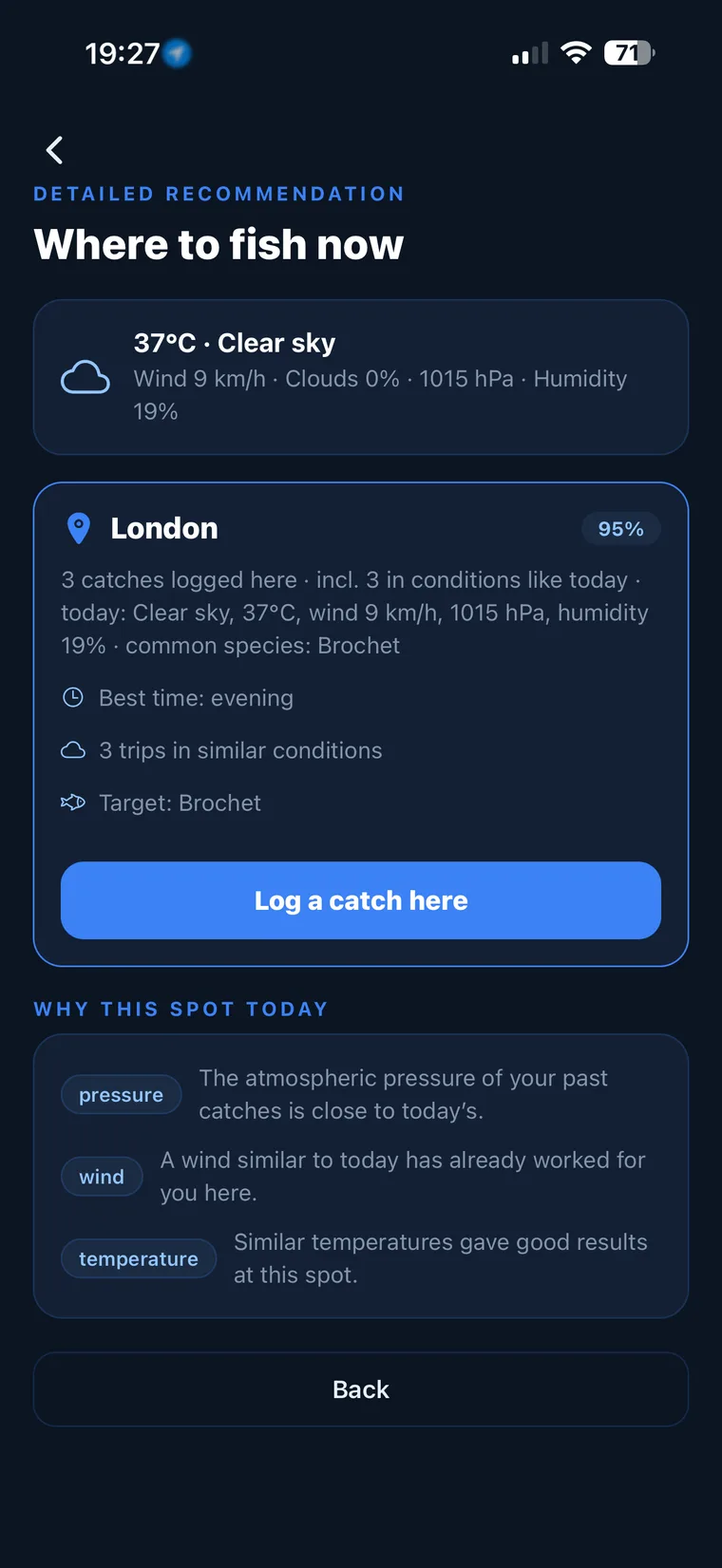
Not sure what to tie on?
Photograph your spot: CarnaFish reads the scene, cross-checks the conditions and gives you the zone, the lure and the retrieve. Free on iOS and Android.
Where it excels, and where you need something else
Its window is clear to lightly stained water, between 0.5 and 1.5 m, along cluttered margins. Stumps, fallen timber, sparse weed, gently sloping riprap, under jetties. It is also an excellent perch lure: the 6 cm format matches what they eat, and the tight vibration makes them react even in a lethargic shoal.
Its best periods are spring, when bass move up onto the shallows, and autumn, when they follow the fry along the margins.
It is not suited to anything beyond 2 m: this is not a bottom lure. It is also weak in very coloured water after a storm, where you need amplitude and noise — a Strike King Red Eyed Shad or a chatterbait work far better there. And in dense vegetation, its two exposed trebles make it a weed collector.
Griffon or squarebill
Against a Strike King KVD Squarebill, the difference is not depth — both cover roughly the same band — but the character of the signal. The squarebill moves more water, deflects more violently off wood and carries further: it is the better choice in stained water, on active fish, or to find fish quickly along a long margin. The Griffon takes the lead as soon as the water turns clear, the fish have seen plenty of lures, or you want to fish very slowly without losing the action.
Against an Illex Chubby 38, the relationship flips again: the Chubby is smaller, deeper-bodied, with pronounced buoyancy, cut for finesse perch and very clear water. The Griffon keeps a format that interests adult bass and a vibration that carries further.
Our beginner's guide to bass fishing sets out the periods when the margin crank beats the other families. And if you are torn between a crank and a soft plastic when you reach a cluttered margin, CarnaFish analyses a photo of the spot and answers.
Key takeaways
- Tight, fast vibration rather than wide: a discreet signal that educated fish will still accept.
- Short body, low inertia: it vibrates from the first turn of the handle, so it can be fished very slowly.
- Build your retrieve around contacts with obstacles; the deflection is the trigger.
- A vibration that stops without a knock is a fish: set the hook without waiting to feel it.
- No heavy line, no heavy snap, no heavy-wire trebles — all three kill the frequency.
FAQ
How deep does the Megabass Griffon run?
Between 1 and 1.5 m depending on the lip version, with standard fluorocarbon. Finer line and a low rod gain you 20 to 30 cm, which is enough to move from a margin to a slightly deeper plateau.
How does it differ from a squarebill?
The squarebill moves more water, produces a low-pitched signal that carries far and deflects violently off wood. The Griffon offers a tighter, more discreet vibration that works better in clear water and on fish that see a lot of pressure.
Does it catch perch?
Yes, very well. Six centimetres matches what an adult perch eats, and the high-frequency vibration provokes reactions even in shoals that are not very active. Just slow the retrieve down compared with bass use.
Should I change the stock hooks?
No. The fine trebles are part of the lure's balance: heavier models change the buoyancy and damp the vibration. If you are opening hooks on the hookset, switch to a softer-action rod instead.
What retrieve speed should I use?
Slow and steady. This lure vibrates from the first turn of the handle, so you do not need speed to bring it to life. Speed only serves to produce more contacts per unit of time on a cluttered spot.
Does it work in cold water?
Yes, provided you switch to stop and go: five slow turns then a two-second stop during which the lure rises gently. That slow vertical lift triggers fish that will no longer follow a lure moving in a straight line.
The full bass lure guideSeason-by-season strategy: which family of lure, when, and why.Go from theory to fish
CarnaFish reads your spot from a photo and gives you the game plan: zone, lure, retrieve. Free on iOS and Android.