6th Sense Swank 66X: the compact crank that swims flat
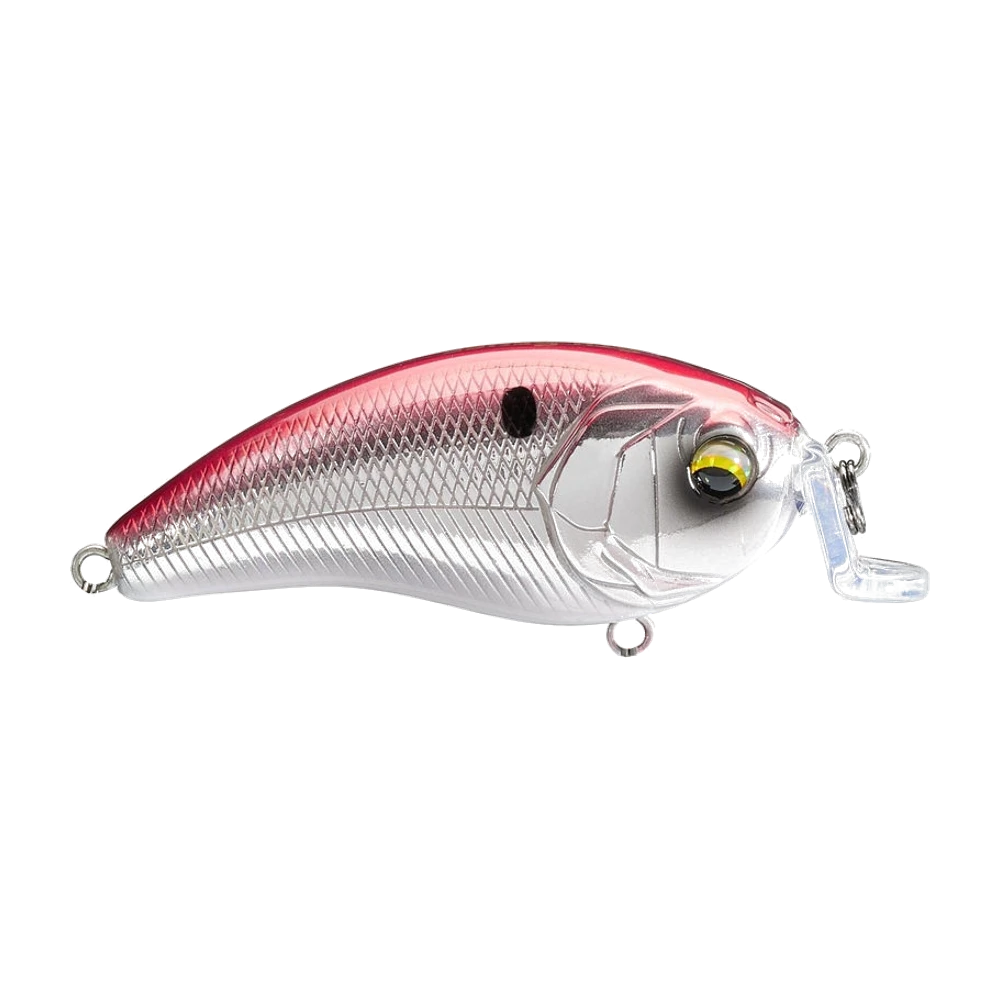
This lure shines under specific conditions. CarnaFish tells you in 10 seconds if today is one of them.
A metre-and-a-half flat carpeted in short grass, with bass buried in it that only come out to hit something that just shoved past them. This is pure contact fishing: the lure has to push through, deflect, knock, and above all not drag ten centimetres of silt on every pass. The Swank 66X was drawn for that job, and the part that makes the difference is its bill.
The L-shaped bill, and what it actually changes
A standard crankbait bill, round or square, is angled forward. It generates downward lift, and the lure digs in with its nose slightly down. That's efficient for getting deep, but it presents the lure on a diagonal.
For the Swank, 6th Sense describes an L-shaped bill designed to produce a more natural, more horizontal swimming posture. In practice the lure travels almost level rather than diving head first. Three consequences in the water.
The side-on silhouette reads more like a small fish swimming than an object diving. In clear water and on pressured fish, that detail counts for more than you'd think.
The lure strikes obstacles with its nose and bill rather than its chin, which changes the deflection angle: the Swank kicks sideways more abruptly than a squarebill, which tends to bounce upward instead.
Finally, that horizontal posture lets it cross short grass without the bill collecting a bundle of vegetation on every pass. The manufacturer stresses this ability to burn through heavy cover and rip through grass — without claiming it's a snag-proof lure: in genuinely thick weed, a single-hook bait stays cleaner.
A hard knocking rattle, and what that implies
The Swank 66X carries a rattle chamber described as loud and hard-knocking, with a deliberately pronounced tonal footprint. That isn't a neutral spec: it defines the lure's working window.
A hard rattle carries a long way and cuts through dirty water. This is the tool for stained water, the day after rain, wind-churned banks, and sessions where you're hunting a reaction rather than a decision. In very clear water on a heavily fished lake it's the opposite: the noise can push fish away as easily as pull them in. In that case a silent crank or a wood-bodied Rapala BX Brat will often be the better call.
How to fish it
Contact before trajectory
A shallow crank that touches nothing is useless. Cast so the lure reaches its running depth before it arrives at the obstacle, then retrieve at a medium pace, fast enough for the bill to load up. The instant you feel a rock, a stump or a branch, give a fraction of a second of slack: the lure kicks off, rises a little, and that's almost always when the bite comes.
The rest of the time, vary speed in bursts. Ten steady turns, three fast ones, a half-second stop. A lure that holds exactly the same rhythm for thirty metres eventually gets ignored.
In grass
Switch to braid with a short fluorocarbon leader, or straight braid if the grass is really there. Fluorocarbon alone stretches, and you lose contact feel at precisely the moment it becomes useful. When the lure picks up a strand, a sharp snap of the rod tip almost always sheds it without reeling in.
With the factory size 4 black nickel trebles, don't lock the drag down. A compact crank with two trebles, on a fish shaking its head two metres from the boat, pulls free mostly when the line is bar-tight. Leave some drag and follow with the rod: you'll lose fewer fish than by trying to clamp everything down.
When to pick the 66X over the 77X
The Swank comes in two sizes, and they don't do the same job. The 66X measures 6.6 cm / 2.6 in for 14 g / 1/2 oz: this is the size to reach for when the forage is small, in late summer and autumn over fry schools, or when fishing pressure forces you to downsize. It also interests perch, which can't really be said of its bigger brother.
The 6th Sense Swank 77X, at 7.6 cm / 3 in and 21 g / 3/4 oz, casts farther, punches through wind and targets bigger fish. Both run in the same 0.6 to 1.5 m / 2 to 5 ft band, so the choice isn't about depth: it's about forage size and the casting distance you need.
The classic mistake
Retrieving too slowly to "feel the bottom properly." A shallow crank with an L-shaped bill needs speed to hold its horizontal posture and to generate the tight wobble that triggers the reaction. Below a certain threshold the lure just moves forward with no signature of its own, and the rattle itself loses intensity. If you need to slow down, change lure families rather than throttling this one — a Strike King KVD Squarebill tolerates a slow pace better, and a soft bait better still.
Not sure what to tie on?
Photograph your spot: CarnaFish reads the scene, cross-checks the conditions and gives you the zone, the lure and the retrieve. Free on iOS and Android.
Colour by water and season
- Clear water, baitfish forage: shad or roach pattern, dark back and silver flanks. The goal is to stay credible during the swimming phase and let the contact do the rest.
- Spring, hard rocky bottom: brick-red or orange-brown craw. On a crank that knocks stone, imitating a disturbed crayfish fits the way the lure is being worked.
- Stained water, after rain: chartreuse with a black back. Maximum contrast, alongside a rattle that's already very audible.
The manufacturer advertises highly detailed finishes without publishing a stable colour list; think in tone families rather than reference names.
A contact crank, not a long-range search bait
The Swank 66X isn't a bait to throw blind across big expanses of open water: its whole point is to cross something. Rock, stumps, sunken branches, short grass, hard banks. If your spot offers nothing to hit, a deeper diver or a lipless will cover ground better.
And knowing which lure to pick tells you nothing about where to cast it. That's exactly what CarnaFish makes easier: a photo of the spot, and the app suggests the zone, the depth and the kind of presentation that fit the day. To learn how to spot those hard bottoms and banks before you even tie on, our guide to reading a fishing spot lays out the method.
Key takeaways
- The L-shaped bill keeps the lure level instead of nose-down, which changes both the silhouette and the deflection angle.
- A loud hard-knocking rattle chamber: an asset in stained water, a possible liability in very clear water on pressured fish.
- 6.6 cm / 2.6 in for 14 g / 1/2 oz, running 0.6 to 1.5 m / 2 to 5 ft: a shallow contact crank, not a diver.
- The 66X when the forage is small or perch are around, the 77X for distance and bigger fish.
FAQ
How deep does the Swank 66X run?
The manufacturer rates it at 0.6 to 1.5 m / 2 to 5 ft, the typical shallow-crank band. That's the same range as the 77X, which means size is chosen on forage profile rather than target depth.
How is it different from a standard squarebill?
The L-shaped bill gives a more horizontal swimming posture, whereas a square bill pulls the nose slightly down. The Swank kicks more abruptly sideways on contact with an obstacle, where a squarebill tends to bounce upward.
Does the Swank 66X get through weed?
It handles short grass and moderate cover well thanks to its level posture. In genuinely thick weed, no lure with two trebles stays clean, and a single-hook rig will serve you better.
Should I replace the factory hooks?
Not necessarily: the stock trebles are size 4 black nickel, advertised as sharp. If you fish very cluttered cover, some anglers prefer short-shank trebles to cut down on snags, at the cost of a little hooking surface.
Can it be fished slowly?
Poorly. This lure needs a medium to brisk speed to hold its posture and produce its tight wobble. If conditions demand a slow rhythm, another type of lure will serve you better.
Is it suitable for perch?
Yes, in this 6.6 cm / 2.6 in size, and that's one of its arguments against the 77X. Along a rocky bank in a metre of water it triggers perch that would ignore a bulkier crank.
The full bass lure guideSeason-by-season strategy: which family of lure, when, and why.Go from theory to fish
CarnaFish reads your spot from a photo and gives you the game plan: zone, lure, retrieve. Free on iOS and Android.