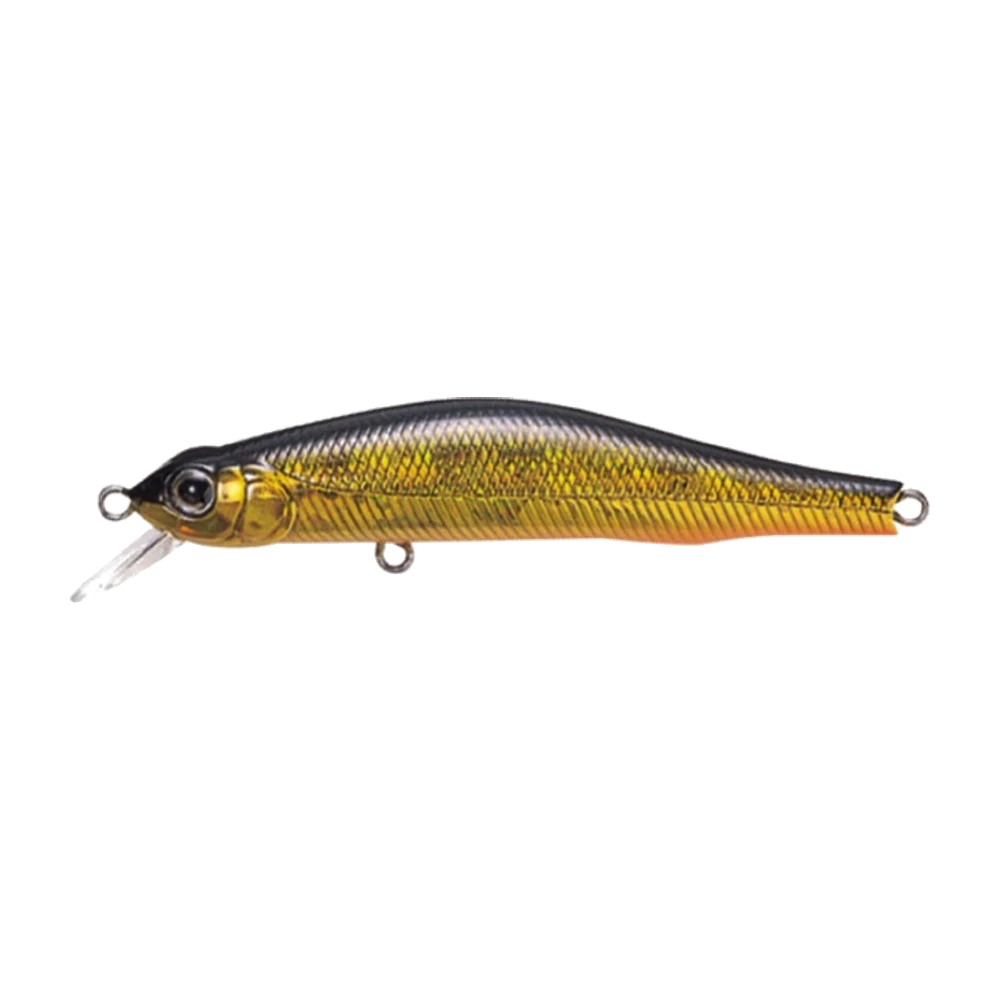
ZipBaits Orbit 80: the small jerkbait that casts like a big one
Not sure this lure fits YOUR spot today? CarnaFish tells you in 10 seconds, from a photo.
Every perch angler knows the situation: the fish are feeding out wide, thirty metres off the bank, and you have nothing in the box that goes far enough without being too big. Small hard lures of 7 to 8 cm rarely weigh more than 6 or 7 g. In a headwind they stop at twenty metres and tumble on the way down.
The Orbit 80 is built to answer exactly that problem. At around 9 g for 8 cm, it is abnormally dense for its size, and its internal mass-transfer system keeps it stable in flight. You cast a perch lure and you get pike-lure distance.
Everything else — the action, the rhythm, the suspension — follows from that construction choice. That is why it is not fished anything like the brand's other models.
Why it is not a minnow, even though it looks like one
In the ZipBaits catalogue the Rigge range has a clear place: they are minnows, lures designed to swim continuously with a tight roll, retrieved slowly and straight with a few accelerations. You can fish a Rigge 70 by doing nothing but turning the handle, and it will catch fish.
The Orbit does not work like that. Its lip is shorter and more steeply angled, its body more substantial, its buoyancy set neutral. On a pure straight retrieve it swims correctly but with nothing special about it: you are missing the point of the lure. Its value comes from the jerk, from the abrupt sideways displacement it produces, and above all from the dead stop that follows.
In practice the difference comes down to three things:
- Sideways displacement. The Rigge moves forward undulating; the Orbit breaks cleanly out to one side, then the other. It leaves the line of the retrieve.
- Behaviour on the stop. A floating minnow rises. The Orbit stays in its water layer, which lets you impose long pauses.
- Fishing rhythm. The Rigge is fished as continuous searching, the Orbit in sequences: cast, a few darts, pause, repeat.
Fish the Orbit like a Rigge and you lose the essential. And the other way round too.
The mass-transfer system, and what it actually changes
The principle is simple: one or more balls slide in an internal tunnel. On the cast they run back toward the tail and put the centre of gravity at the rear, which stops the lure tumbling in flight. On impact, and then from the first turns of the handle, they come forward again and give the lure back its swimming balance.
Two practical consequences that many people miss:
The first is that you have to "arm" the lure after the cast. If you start jerking immediately, the balls have not necessarily returned to position. Two or three firm turns of the handle are enough to reset the system and take the lure down to its depth.
The second is that the system makes noise. That is an extra signal — but on very clear water and pressured fish, it is sometimes one signal too many, and a silent lure will do better.
The retrieve: two darts, one stop
The movement is short. A classic mistake is to make big rod sweeps with this lure: you tear it out of its water layer instead of making it dart.
- Cast and let the lure settle for a second, long enough for the balls to return.
- Two or three turns of the handle to bring it to its running depth. You should feel the lip bite the water.
- Two sharp, short jerks, wrist only, rod tip pointed at the water. Ten to fifteen centimetres of travel, no more.
- Stop everything and count. Two seconds in warm water, up to six seconds when it drops below 12 °C.
- Take up the slack created by the pause before the next dart, without moving the lure.
That last step is the one most often skipped. If you do not take up the slack, your next jerk first has to straighten the line and reaches the lure damped: you no longer get a clean dart, just a pull.
On the water: for perch, when you get a bite and miss the fish, do not change lure — change the length of your dart. Go from two jerks to one, softer, with a pause twice as long. Nine times out of ten the perch that missed comes back to a slowed-down version of the same pass, not to a different model.
Setting the depth without changing lure
The Orbit 80 exists in several depth variants. But before you buy three of them, be aware that you already have a useful range to play with on what is tied on.
| What you change | Effect on the action |
|---|---|
| 0.25 mm fluorocarbon instead of 0.18 mm | Lure 15 to 25 cm higher, action slightly restricted |
| Rod held high during the retrieve | Gains 20 to 30 cm toward the surface |
| Low rod, tip in the water | Goes to the bottom of the stated range |
| Trebles one size heavier | Suspension turns into a slow sink |
| Faster retrieve between darts | Deeper action, but less stable pauses |
The point to keep: a jerkbait's suspension is a fragile balance. Every change you make to it pushes the lure toward floating or toward sinking. That is not a problem as long as you know which way you are going.
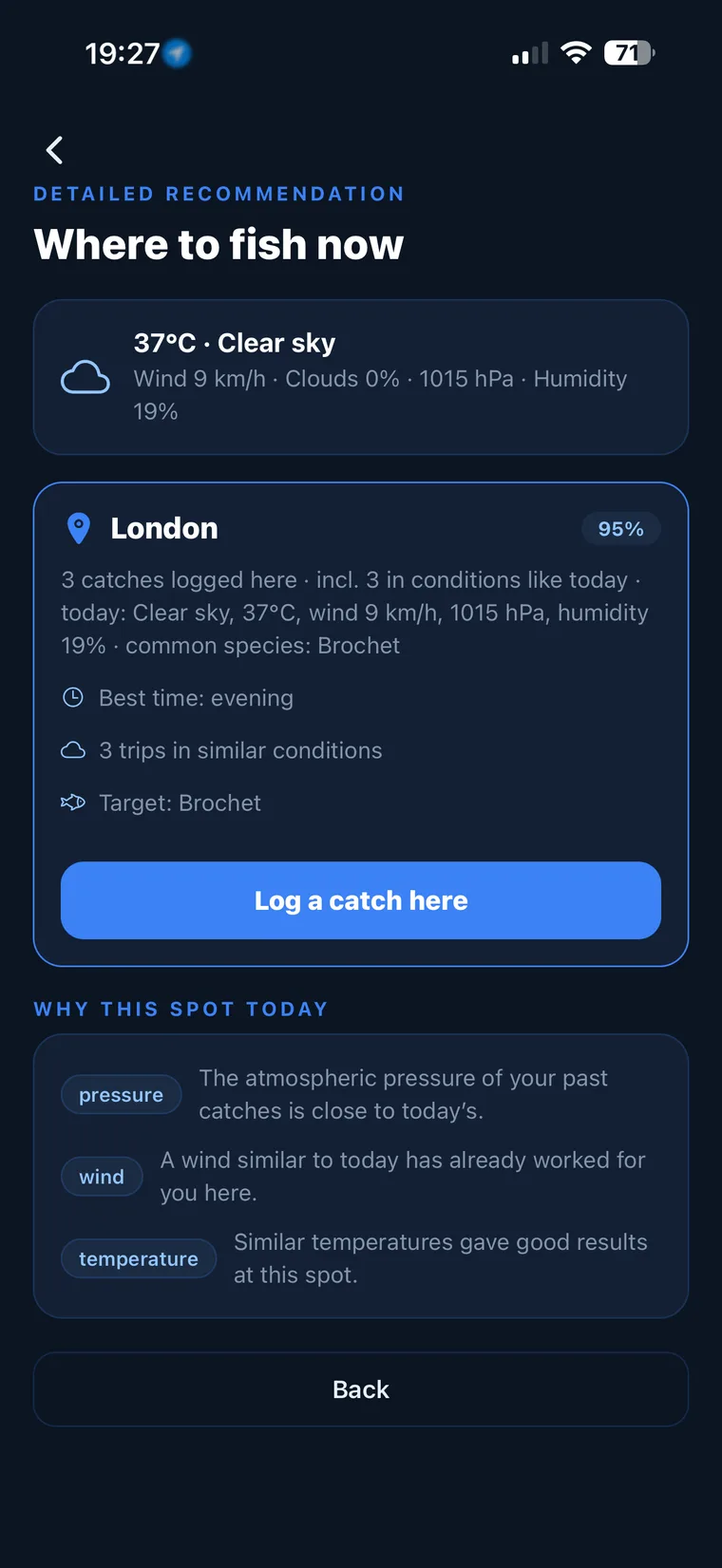
Not sure what to tie on?
Photograph your spot: CarnaFish reads the scene, cross-checks the conditions and gives you the zone, the lure and the retrieve. Free on iOS and Android.
Where it shines, and where not to expect it to
The Orbit 80 is a lure for fish holding in clear water, at distance.
- Lake and reservoir margins where perch sit on a drop-off twenty-five or thirty metres out.
- Clear to slightly stained water, between 8 and 20 °C. That is its broad window.
- Windy days, exactly where other small hard lures become unusable.
- Bass along the margin, on spots you cannot get close to without spooking the fish.
Conversely it is wrong in very coloured water, where flash and sideways displacement count for nothing, and in rivers with a strong current, where the pause — its main weapon — does not really exist since the lure just drifts. Avoid it in brush too: two exposed trebles cost more lures than they win fish.
Orbit 80 or Rigge 70: which comes out of the box
Take the Rigge 70 when you want to cover ground: fairly calm water, a close spot, active fish that follow a steady action. It forgives more and almost fishes itself. The Rigge 56 takes over on finicky perch and very clear water, in an even more discreet size.
Take the Orbit 80 when the spot is far out, when there is wind, or when the fish refuse a straight action and want a break in rhythm. Against a Lucky Craft Pointer 78, which plays in the same register, the Orbit offers a tighter, more nervous dart where the Pointer glides further sideways: on perch, the short dart usually goes down better.
Our guide to lure fishing for perch covers how to combine these two families in the same session. And if you are unsure how far out the fish are holding when you reach the bank, CarnaFish analyses a photo of the spot and answers.
Key takeaways
- Around 9 g for 8 cm: an unusual density that gives it the casting distance of a much bigger lure.
- The mass-transfer system means two or three turns of the handle before the first jerk.
- Short darts, ten to fifteen centimetres, never big rod sweeps.
- Always take up the slack after the pause, or the next jerk arrives damped.
- A lure for clear water and distant spots; useless in coloured water or strong current.
FAQ
What is the difference between the Orbit 80 and a Rigge?
The Rigge is a minnow: it is fished on a straight retrieve and swims continuously. The Orbit is a jerkbait with neutral buoyancy: it needs jerks and pauses, and its value comes from the sideways displacement and the stillness on the stop.
Why does it cast so far for its size?
Thanks to its high weight for 8 cm and a sliding-ball system that moves the centre of gravity back during flight. The lure stays in line instead of tumbling, which limits the loss of energy.
What line should you use with the Orbit 80?
Fluorocarbon of 0.18 to 0.22 mm for perch, up to 0.25 mm if you are targeting bass near structure. The thicker the line, the higher the lure runs and the less clean its dart.
How long should the pauses be?
Around two seconds above 15 °C, four to six seconds as the water cools. If you are getting bites without hooking up, lengthen the pause rather than changing lure.
Does it work in coloured water?
Not much. It is a lure that plays on flash and on how readable the sideways displacement is. As soon as visibility drops below a metre, a strongly vibrating lure covers the ground better.
Snap or direct knot?
Both work. A small fast snap does not noticeably degrade the action and saves time when you alternate models; just avoid heavy ones that weigh the nose down and upset the suspension.
The full perch lure guideSeason-by-season strategy: which family of lure, when, and why.Go from theory to fish
CarnaFish reads your spot from a photo and gives you the game plan: zone, lure, retrieve. Free on iOS and Android.