Megabass Uoze Swimmer: the swim jig that carries its blade underneath
Not sure this lure fits YOUR spot today? CarnaFish tells you in 10 seconds, from a photo.
There's a grey area between two lure families that many anglers never visit. On one side the swim jig: discreet, slipping through weed, imitating prey on the move. On the other the underspin, adding flash and vibration but giving up on cover. The Megabass Uoze Swimmer is built exactly on that border: a skirted swim jig head, with a willow blade hung under the belly.
No published dimensions, and that needs saying
Start with what's missing, because it's unusual and it matters when you order. Megabass publishes neither a length nor a weight for this bait. No spec table in the description, no range of sizes, no head weight. On a swim jig, where head weight decides running depth and the slowest usable speed, that's the single most useful figure — and it isn't there.
In practice: don't order this one without reading the weight on the retailer's listing. A light swim jig and a heavy swim jig fish different water, and nothing in the description fills that gap. The rest of this page covers the design, which is very well documented.
A fish head, not a jig head
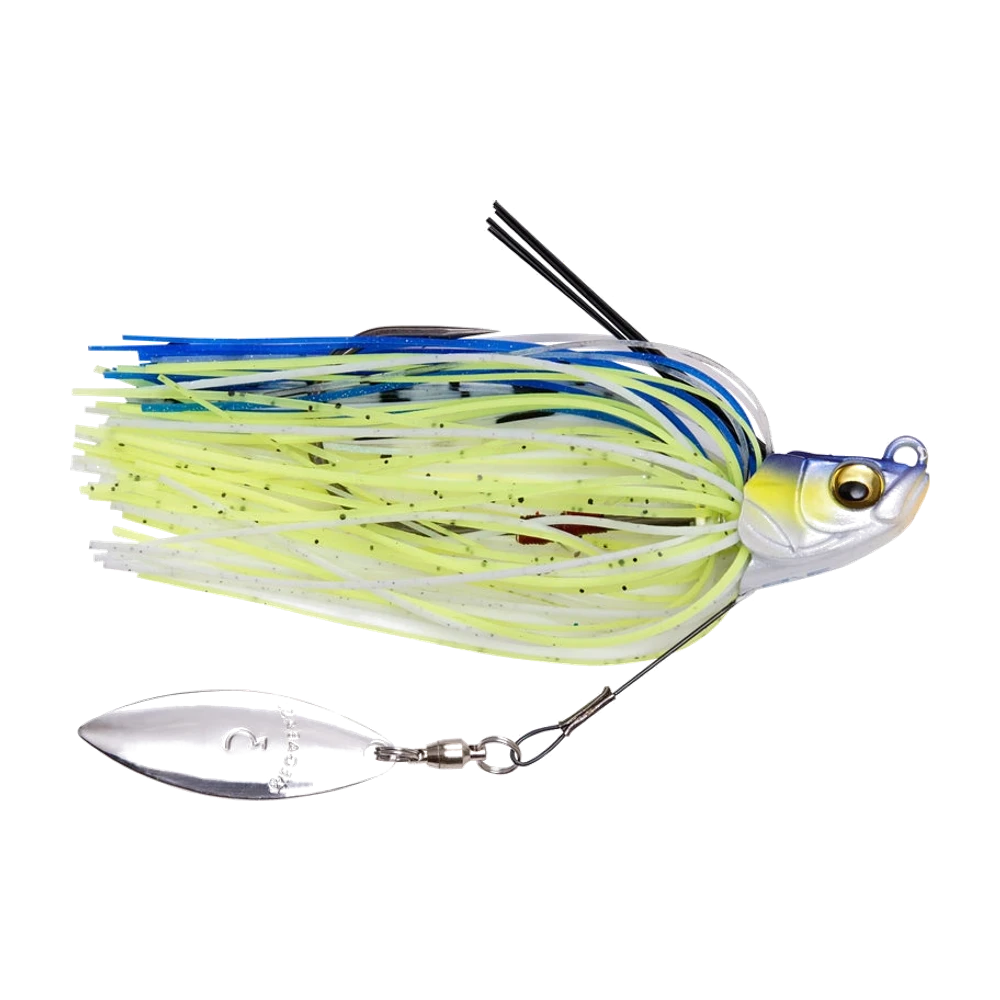
The first departure from an ordinary swim jig is visible straight away in the photo. The head isn't a painted bullet: it's a moulded baitfish, with sculpted gill plates in relief, a large gold eye and a blue-back, yellow-cheek, white-chin finish.
That isn't decoration. Megabass specifies a tapered head with flared gill plates, designed to cut through vegetation and water while creating a light, constant resistance. That resistance is the interesting part: it lets you feel the bait at all times through the rod. On a conventional swim jig you often lose contact as soon as you slow down, and you no longer know whether the bait is swimming or dragging behind a stem. Here feedback is continuous, which changes how you fish a weed edge at low speed.
The willow blade under the belly
This is the part that defines the lure. Beneath the body, a silver #3 willow blade hangs on the end of a shape-memory wire, with a swivel to let it spin freely. Two points worth making.
The #3 is a blade size, not a length. A willow that size stays modest: it produces a fine, fast flash rather than a heavy thump, which fits a lure aiming to stay believable rather than loud.
The shape-memory wire, specified as titanium, is what lets the blade sit under the lure and stay there, without the arm taking a permanent set on the first snag or the first fish. A soft steel arm in that position would be bent out of shape within three sessions.
The underside placement isn't incidental either: the blade works in the body's shadow seen from above, and fully in view from below — that is, to a fish holding deeper and watching the lure go past against the light.
Weedguard and hook
On top of the head, two black strands form the weedguard. Megabass describes a tension-tuned guard that compresses out of the way on the strike to let the hook through. That's the permanent compromise of any weedguard: too stiff and it protects well but costs fish, too soft and it lets you snag. Two strands only here, so a deliberately light guard — one for moderate weed rather than thick mats.
The hook is described as wide-gap, beefy, with a fluorine coating meant to reduce friction on penetration. No size is given, any more than the rest of the figures.
The classic mistake
Setting the hook by lifting the rod, out of jig-fishing reflex. On a blade-under lure fished on a straight retrieve, the fish comes in from the side or from below and the line is already tight: a vertical set only adds tension where there already is some, and often tears the bait free. Keep reeling for half a second, let the fish load the rod, then set sideways. It's the same motion as on a spinnerbait and it transfers directly.
Not sure what to tie on?
Photograph your spot: CarnaFish reads the scene, cross-checks the conditions and gives you the zone, the lure and the retrieve. Free on iOS and Android.
How to work it
The base register is a slow to medium straight retrieve: cast parallel to the edge, let it drop a second or two, then reel at a steady speed keeping the bait just above the vegetation. The blade turns from the first cranks, so you don't need speed to make it work.
The variation that triggers most is deliberate contact: let the bait touch a stem, a branch or the top of a weed bed, then give a short rod stroke to free it. That sudden break imitates panicking prey, and the strike very often lands at that exact moment.
A detail only time on the water teaches: on the stop, a blade-under swim jig doesn't drop flat like a bare jig. The blade brakes the rear and the lure sinks nose-down, blade fluttering. So mix in two or three one-second stops on every cast, especially over a hole in the weed. Half the bites land on that short fall.
In Europe this kind of lure also interests pike along weedy pond and gravel-pit margins. If you're fishing water known for them, add a suitable leader: there's no lip and no hard body here to keep teeth away from your knot.
Colour by water
- Lightly stained water: the chartreuse, white and blue skirt photographed here. The chartreuse stays visible as clarity drops, the white adds bulk and the blue breaks up the block of colour.
- Clear water: a pearl white or grey skirt, closer to a real baitfish. With a silver blade, the flash alone is plenty of signal.
- Heavy water or low light: a dark skirt, black or black and blue. Silhouette beats colour, and the blade's vibration does the rest.
Swim jig, chatterbait or spinnerbait
All three cover the same water layer but tell different stories. A Molix Chatter Bait throws a strong, low-frequency vibration off its front blade: that's the choice for dirty water, when the fish has to locate before it can see. A Booyah Covert Spinnerbait puts its blades above and behind, on an open arm that shields the hook but bulks up the profile.
The Uoze Swimmer takes a third route: the compact silhouette of a swim jig, so cover and discretion, plus flash added from underneath. It gives up signal strength against the other two and gains on a fish that has already refused a hard vibration. For a big mid-water profile instead, a Megabass Magdraft fills yet another slot.
That still leaves whether today's edge wants a fast retrieve or a slow one, which depends on water level, weed density and light. That's the read CarnaFish makes from a photo of the spot, suggesting the zone and presentation that fit. For the broader method, our beginner's guide to bass fishing sets out the banks worth covering first.
Key takeaways
- Megabass publishes neither length nor weight: check the head weight at the retailer before buying.
- The blade is a #3 willow — a size, not a length — mounted under the body on shape-memory wire.
- The tapered head with flared gill plates creates a light resistance that lets you feel the bait even slowly.
- Set sideways, never by lifting: the line is already tight on a straight retrieve.
FAQ
What does the Uoze Swimmer weigh?
Megabass doesn't publish it. The description contains no spec table, no length, no weight, no size range. On a swim jig that's the figure which decides running depth, so read the weight on the retailer's listing before you order.
What is the blade under the body for?
It adds flash and vibration to what would otherwise be a conventional swim jig. Seen from below it's fully in view for a fish holding deeper, while staying in the body's shadow from above. That's what places this lure between a swim jig and an underspin.
What does #3 mean on the blade?
It's a willow blade size, not a length in centimetres. A #3 willow stays fairly small: it gives a fine, fast flash rather than a heavy thump, which suits a lure built to stay discreet.
Will it go through thick weed?
Through moderate vegetation, yes: the head is tapered and the tension-tuned guard protects the point. In a thick mat, though, two guard strands and a belly blade end up collecting stems. For that kind of cover a hollow-body lure is still the better tool.
How should I set the hook?
Sideways, after letting the fish load the rod for half a second. On a straight retrieve the line is already tight, so a sharp vertical set adds tension at the wrong moment and often tears the bait free.
Does it suit pike?
Along weedy pond and gravel-pit margins in Europe, yes, this kind of lure interests them. Add a suitable leader then, heavy fluorocarbon at minimum: there's no rigid component here between the fish's mouth and your knot.
The full bass lure guideSeason-by-season strategy: which family of lure, when, and why.Go from theory to fish
CarnaFish reads your spot from a photo and gives you the game plan: zone, lure, retrieve. Free on iOS and Android.