Owner Flashy Swimmer with CPS: a blade grafted onto your own swimbait
The right lure in the wrong spot still catches nothing. CarnaFish spots the zone that works, from a single photo.
Some mornings the fish are everywhere and nowhere: baitfish showering along two hundred metres of bank, and a conventionally rigged paddle tail that triggers nothing at all. What is missing is not the profile, it is the signal. The Owner Flashy Swimmer answers exactly that gap — it is not a lure but a rigging platform that adds a blade and lead to a soft bait you already own.
What it is, and what it is not
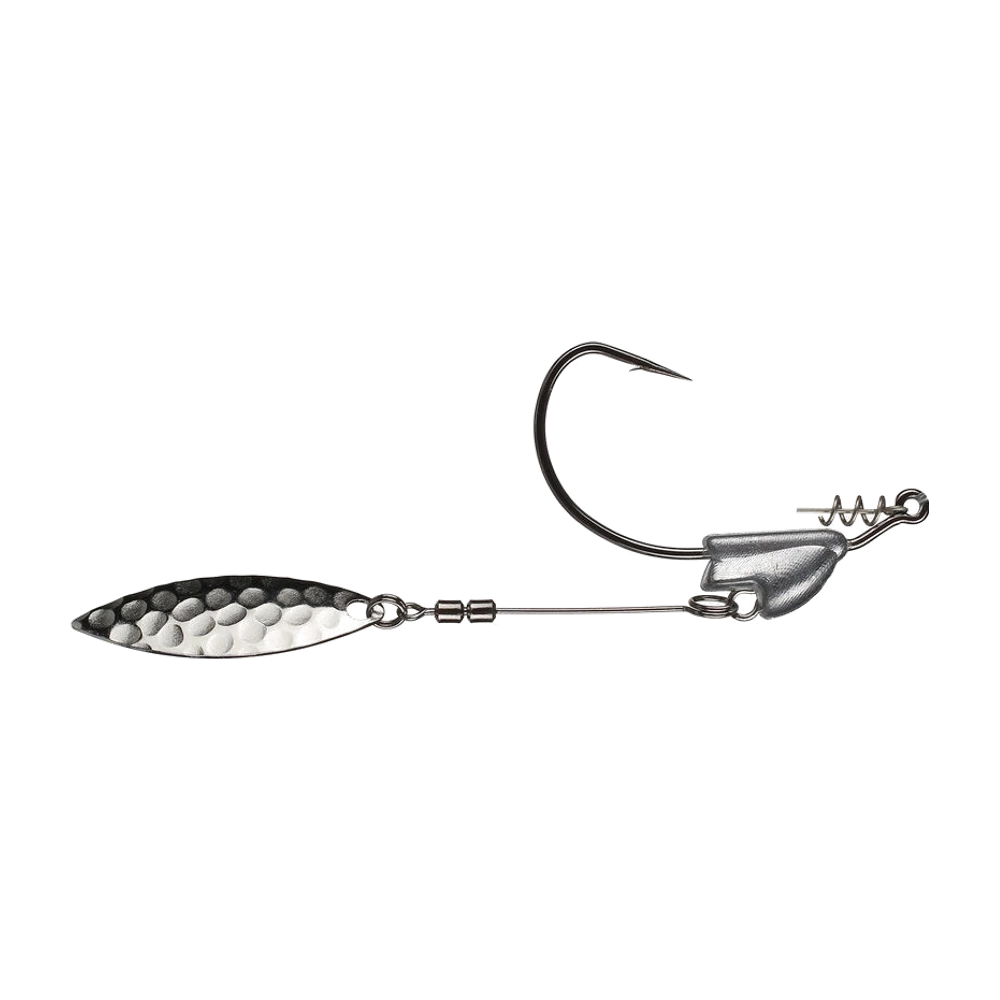
Be clear about what you are buying: a wide-gap single hook with a lead moulded fixed onto the shank, and a blade hanging off that lead. No body is included. Owner presents it as a way to add flash and fish attraction to your favourite soft swimbait, fluke or other swimming soft plastic.
It is a category of its own, halfway between a jig head and a spinnerbait, and that is precisely what makes it interesting: you keep the profile and colour of a soft bait you already trust, and only change its light and sound signature. If you have never fished this kind of set-up, the difference against a plain jig head is obvious the first time you pass a bait ball.
The #3 willow blade, and why it does not spin like a spinnerbait
Owner states a Willow Leaf blade in a hammered nickel finish, size #3. Read that carefully: the #3 is a blade size, not a quantity — there is only one.
It is linked to the fixed weight by a wire and a dual mini-swivel. The manufacturer specifies that this arrangement lets the blade pivot while keeping it riding horizontal through a steady retrieve. That is the technical point worth pausing on: on a spinnerbait, the blade turns above and ahead of the lure, creating lift and making it climb. Here it stays out to the side, flat, throwing lateral flashes without disturbing the soft bait's swim or lifting it.
The hammered finish sharpens that behaviour: instead of a single sheet of reflection as on a smooth blade, the dimpled surface breaks the light into many short flashes, far closer to the glitter of a school of small fish.
The fixed weight: two jobs in one piece
The lead is moulded directly onto the shank and does not slide. Owner credits it with two roles: getting the bait down into the strike zone quickly, and keeling the rigged plastic so it runs true at both fast and slow retrieves.
In the product photo you can see that this weight is not a ball but a flattened, profiled shape with a step underneath and an eyelet on the belly for the blade link. That low geometry puts the centre of gravity below the hook axis, and that is exactly what stops a soft bait from rolling onto its side when you speed up. The description gives no weight chart; check the figure on the exact item you order, because it settles the running depth far more than retrieve speed does.
Rigging the soft bait properly
The CPS centring spring
The detail you are paying for is Owner's TwistLOCK Centering-Pin Spring: a small corkscrew fixed at the eye, clearly visible in the photo. You screw the nose of the soft bait onto it before passing the hook through. Owner states that this system makes accurate rigging easier, and that is exactly what it does: the spring holds the nose centred and stops the body sliding down the shank after three casts.
Owner describes the hook itself as a Super Needle Point with an XX-Strong forged shank and an open gap. In practice you pass the point through the body and lay it just under the skin of the back for a snag-resistant rig; in the photo the hook is shown bare with the point exposed, which is an observation from a product photo rather than a recommended way to fish it.
The classic mistake
Rigging a body that is too long for the platform. If the plastic reaches well past the bend, the hookset gets lost in the body and the blade starts tapping the flank on every oscillation, which kills its rotation. Pick a soft bait whose hook point exits in the last third of the body, not before halfway.
The second common mistake is retrieving too slowly. Unlike a jig head rig, this platform needs a minimum of speed before the blade sets itself and pivots. Below that you are towing a piece of metal that hangs there and only brakes the swim.
Not sure what to tie on?
Photograph your spot: CarnaFish reads the scene, cross-checks the conditions and gives you the zone, the lure and the retrieve. Free on iOS and Android.
Where and when it replaces something else
Owner presents it as a good search-bait option, able to cover a lot of water in a short time, and as an alternative to the standard crankbait or spinnerbait. That is a fair description, and it also states the limits: on slow, settled fishing a plain weighted Texas rig will do better.
In Europe the obvious ground is bass over flats and along grass lines. But the set-up works very well for pike once you move up to a 12 to 15 cm body, provided you add a wire or heavy fluorocarbon leader: the lateral flash carries a long way across stained water where pike hunt by sight. For a ready-to-fish equivalent, a Booyah Covert Spinnerbait fills the same slot with a very different skirt profile, whereas an Optimum Boom Boom Weedless Swimbait on a plain weighted hook chooses discretion over flash.
If the blade jams or clicks against the body of the soft bait, do not change lures: just shift the plastic half a centimetre forward. Nine times out of ten the problem is a body pushed too far onto the spring, bringing its flank into the blade's path.
Soft bait colours by water
- Clear water: a pearl white or silver body, visually extending the nickel flash of the blade without adding a competing colour. It is the most natural combination over a bait ball.
- Stained water: a chartreuse body, or one with a dark back over a pale belly. The blade handles visibility; the body only needs to supply a readable silhouette.
- Low light: black or deep brown. The contrast between a dark body and the flashes off the hammered blade stays readable at the end of the day, when a pale shade dissolves into the gloom.
The description notes a two-per-pack format. For a platform that lasts — the lead and the blade do not wear out like a soft body — that is a sensible unit, provided you buy the right size first time.
A search bait only earns its keep if you know which band of water to search. That is exactly what CarnaFish is for: one photo of the spot, and the AI suggests the zone, the depth and the presentation that fit the conditions. And if you plan to scale this rig up, our guide to choosing a pike lure places this family among the other options.
Key takeaways
- This is not a complete lure: it is a weighted hook with a blade, and the soft body is your job.
- The #3 willow blade rides horizontal out to the side and does not generate a spinnerbait's lift: it adds flash, not climb.
- The fixed weight both drops the bait fast and keels the plastic so it does not roll.
- A minimum speed is required before the blade works: this is not a slow-fishing rig.
FAQ
Does the Flashy Swimmer come with a soft bait?
No. Owner supplies the weighted hook, the centring spring and the blade; the soft body is up to you. That is the point of the product: you use it with the paddle tails you already own and whose behaviour you know.
What blade size is fitted?
Owner states a Willow Leaf blade in size #3 with a hammered nickel finish. That #3 is the blade's size, not a quantity: there is a single blade, mounted out to the side on a dual mini-swivel.
How does it differ from a spinnerbait?
Blade position changes everything. On a spinnerbait the blade turns above the lure and generates lift; here it rides horizontal at the side and does not stop the soft bait from sinking. The Flashy Swimmer therefore keeps a fish profile, where a spinnerbait shows a silhouette of wire and skirt.
What weight should I pick?
The description publishes no weight chart, and several sizes exist at retail. Work from the target depth and the size of the body: too light and the bait swims high and rolls; too heavy and it runs under the active layer without ever showing itself.
Can it be fished very slowly?
Not really. The blade needs a steady retrieve to set itself and pivot. Below a certain speed it hangs without turning and only brakes the swim. For a slow presentation, a plain weighted Texas rig makes more sense.
Does it suit pike in Europe?
Yes, with a 12 to 15 cm body and a bite-resistant leader. The lateral flash carries far in stained water, which matches how a pike locates prey. Bear in mind that a single hook is not forgiving of a head-shaking fish: keep steady pressure throughout the fight.
The full bass lure guideSeason-by-season strategy: which family of lure, when, and why.Go from theory to fish
CarnaFish reads your spot from a photo and gives you the game plan: zone, lure, retrieve. Free on iOS and Android.