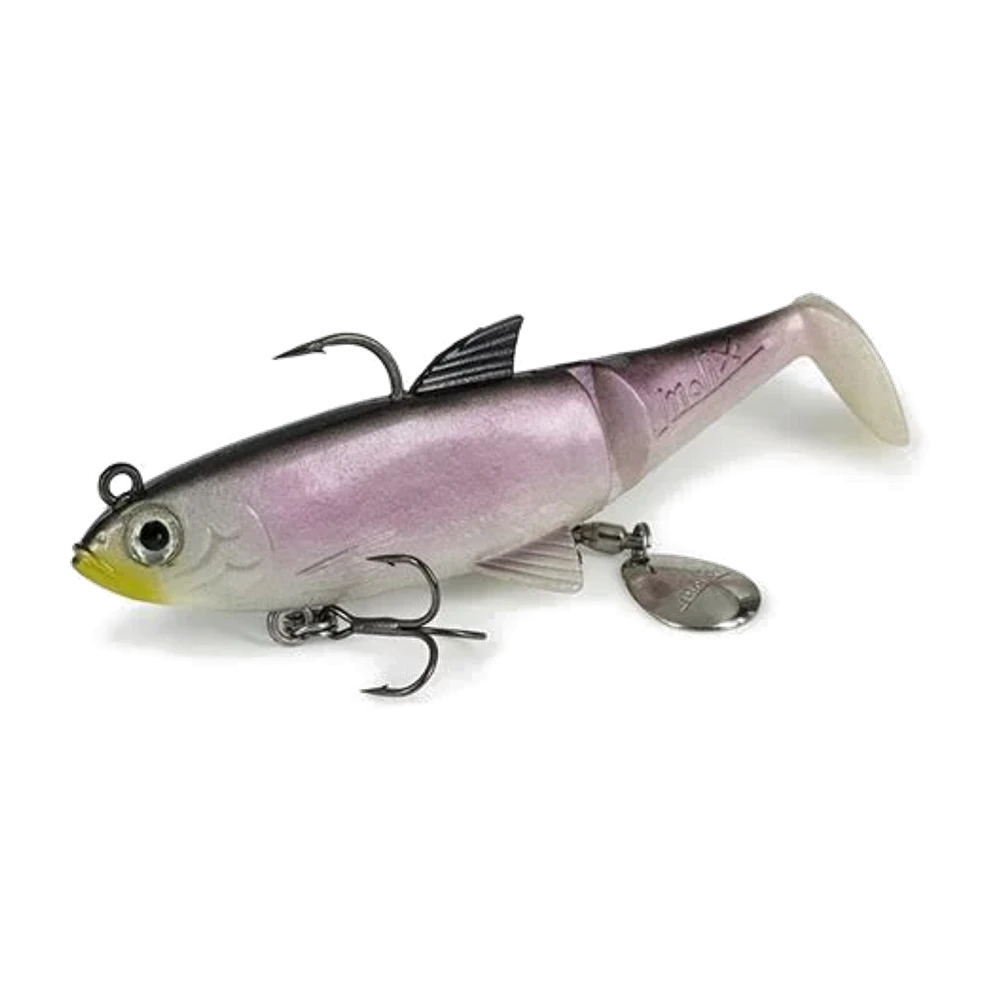
Molix Sato Shad: the slim-tailed shad for zander that refuse vibration
The right lure in the wrong spot still catches nothing. CarnaFish spots the zone that works, from a single photo.
There are days when the zander are there, visible on the sounder, settled at the foot of a drop-off, and they refuse absolutely everything. You change colour, you change size, you go heavier, you go lighter. Nothing. It is frustrating, because the problem is rarely the one you assume: it is not the colour, it is the intensity of the signal.
A shad with a big paddle tail sends out a lot. That is its quality: it gets noticed from a distance, it works even on a slow retrieve, it forgives mistakes. On an active fish, that is perfect. On a zander that has not eaten for three days and is holding fifty centimetres off the bottom without moving, that signal is simply too strong. The fish detects it, classifies it as wrong, and does not move.
The Sato Shad takes the problem the other way round: thin tail, slim tail wrist, deliberately discreet action. It does not get noticed at ten metres. It gets accepted at fifty centimetres.
What a thin tail actually changes
A soft shad's tail works like a blade: the wider it is, and the thicker the wrist carrying it, the more speed it takes to start it, and the wider the beat.
On the Sato Shad, the wrist is slimmed down and the paddle reduced. Three practical consequences:
- The start-up threshold is very low. The tail still beats at a speed where a classic shad stays inert. In practice, you can wind at a crawl without the bait turning into a dead lump of plastic.
- The amplitude stays contained. The body barely rolls; the vibration is high frequency and low amplitude. That is exactly the signal a small fish swimming calmly produces, not that of a panicking wounded one.
- The fall is faster and straighter. Less lift at the rear, so the bait goes down nose first without gliding for long. On a vertical presentation or a sharp pull, you get back to the bottom quickly and keep contact.
The body itself is fairly slim with a thin rear section, which helps the hookset: the point has less material to get through.
The retrieve: short pulls and a controlled fall
This is the sequence that works best on settled zander, from the bank or from a boat.
- Cast and let it drop on a half-tight line, following it with the rod tip. Count the seconds down to the bottom, you will need them later.
- On bottom contact, do nothing for two seconds. Let the line settle and take up its natural position.
- Give one short, sharp pull from the wrist, thirty to fifty centimetres only. Not a big rod sweep: a brief twitch that lifts the bait without throwing it two metres.
- Follow the fall by dropping the rod tip at the same speed the bait sinks. You need to keep the faintest contact without pulling.
- Wait for bottom contact, then two to five seconds of stillness depending on water temperature.
- Start again, taking half a turn of the handle between cycles, all the way to the bank.
In cold water, swap the pull for a simple drag: you pull the bait along the bottom over a metre, very slowly, lifting just enough for it to swim. The thin tail lets you drag it like that without the bait keeling over flat.
On the water: on this kind of fishing, the zander bite is not in the rod, it is in the line. Watch the point where your line enters the water during the fall. If it shifts sideways, stops, or goes slack before the count you were expecting, that is a bite. Set the hook without waiting to feel anything in your hand — by the time you feel it, it is often too late.
Choosing the size, and above all the weight
| Context | Size | Jig head | Note |
|---|---|---|---|
| Lake zander, 4 to 8 m, cold water | 10 cm | 10 to 14 g | Round head, straight drop |
| River zander, moderate current, 3 to 5 m | 10 cm | 12 to 18 g | Go up until you feel the bottom, no further |
| Perch on a drop-off, 2 to 4 m | 7.5 cm | 5 to 7 g | Football head for constant contact |
| Very wary fish, clear water, shallow | 7.5 cm | 3 to 5 g, or drop shot | Long fall, minimal animation |
The decisive setting, here again, is the lightest weight that still lets you feel the bottom. On a finesse shad, every superfluous gram crushes the falling phase — and on apathetic zander, the fall accounts for most of the bites. When in doubt, go one step lighter and lengthen your sink time.
The stinger (an extra treble on a fine wire trace) is worth fitting as soon as you log several bites that do not convert. Zander often nip the bait from behind without taking it in. The trade-off is that a stinger snags more on cluttered bottoms: keep it for clean ground.
Recommended line: fine braid of 0.12 to 0.16 mm for sensitivity, with a 0.28 to 0.35 mm fluorocarbon leader depending on the pike risk.

Not sure what to tie on?
Photograph your spot: CarnaFish reads the scene, cross-checks the conditions and gives you the zone, the lure and the retrieve. Free on iOS and Android.
Where it excels, where it is beside the point
It excels on apathetic zander in clear water, typically in midwinter or after a sharp cold snap, when vibrating lures have stopped producing. It also excels on pressured fish in heavily fished waters, where everyone is using the same big-tailed shads. On perch in clear water over hard bottom, it is an excellent finesse bait in the small size.
It is beside the point in three situations. In very dirty water or at night: the signal is too weak to be located, and you need a lure that vibrates hard. In strong current, where its discreet action is lost and you need more lift to keep the bait readable. And for fast searching over a large area: it is a slow bait, you will not find the fish with it, you will convert them once found.
Sato Shad or a big-tailed shad
It is the functional opposite of a Fox Rage Zander Pro Shad or a Keitech Easy Shiner 4. Those two bet on a wide tail that sends out a lot, which makes them excellent for searching, in stained water and on active fish: the zander picks them up from a distance and comes. The Sato Shad cannot do that and is not trying to.
The complementary logic is simple. You start the session with a strong-vibration shad to find the zone and the depth. If you catch, you stay on it. If you see fish but catch nothing, you switch to the finesse shad on the same spot, with a lighter weight and a rhythm twice as slow. It is a change of register, not a change of lure out of superstition.
Our simple jig head page covers head shape and seating the hook in the body, and the beginner's guide to zander on lures goes back over reading a drop-off. If you are torn between vibrating hard and playing finesse when you reach the bank, CarnaFish analyses a photo of the spot and answers.
Key takeaways
- Thin tail and slim tail wrist: a high-frequency, low-amplitude, very discreet action.
- It starts at a speed where a classic shad has stopped working: that is the edge on slow fish.
- A short thirty to fifty centimetre pull, a controlled fall, a two to five second pause.
- The lightest weight that still lets you feel the bottom: the fall holds most of the bites.
- A conversion bait for located fish, useless in dirty water, at night or for searching.
FAQ
What is the difference with a big-tailed shad?
The amount of signal. A big tail vibrates hard and is detected from a distance, which is ideal for searching and in stained water. The Sato Shad's thin tail produces a tight, discreet vibration that gets through better on a settled fish that has already refused everything else.
What jig head weight should I choose for zander?
The lightest that still lets you feel bottom contact: often 10 to 14 g on a lake between four and eight metres, more in a river with current. Going heavier for comfort kills the falling phase, where most of the bites happen.
Should I fit a stinger?
Only if you log several bites that do not convert, which happens often on zander in winter. A stinger clearly improves the hook-up rate but increases snagging: avoid it over bottoms cluttered with timber or blocks.
How do you detect a bite during the fall?
By watching the line, not by waiting for a feeling. A line that shifts sideways, stops before the expected sink time, or suddenly goes slack signals a bite. Set the hook immediately.
Does it work in dirty water or at night?
Badly. Its discreet action does not let the fish locate it at range when visibility is nil. In those conditions a strong-vibration shad or a rattling lure will be far more effective.
Can you fish it on a drop shot?
Yes, in the small size, and it is even a very good use on wary perch or zander pinned to vertical structure. The thin tail keeps shivering on the spot without the bait needing to move forward.
The full zander lure guideSeason-by-season strategy: which family of lure, when, and why.Go from theory to fish
CarnaFish reads your spot from a photo and gives you the game plan: zone, lure, retrieve. Free on iOS and Android.