Madai tenya: reading a Japanese rig before you buy it
Not sure this lure fits YOUR spot today? CarnaFish tells you in 10 seconds, from a photo.
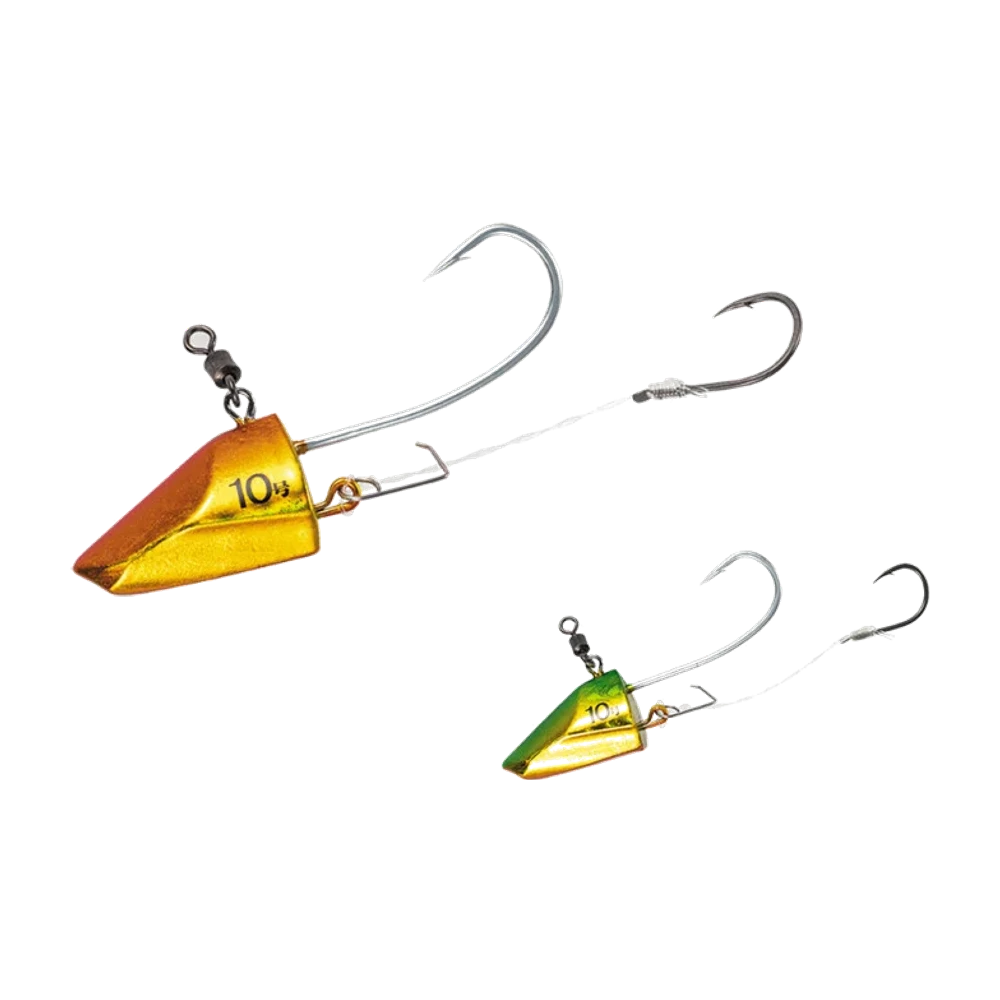
Walk up to the tenya rack in a Japanese tackle shop and you get thirty references that all look alike: a coloured lead head, a big hook up front, a small one behind on a short length of line. The labels show numbers followed by a character you cannot read, the colours run from fluo pink to bare lead, and nothing explains why one costs twice as much as the next.
The problem is not knowing how to fish a tenya — the technique is simple and our sheet on the Ultimate Fishing Tenya covers it from the drop to the hookset. The problem comes earlier: knowing what you are holding. Three pieces of information are written on every tenya, and once you can read them the choice becomes obvious.
That is what this sheet is for: decoding the rig itself, its size, its geometry and its head angle, before anyone talks about working it.
The number on the head: the go system
This is the most important and the most misread piece of information. The number stamped or printed on the head — the "10" in the photo — is not a weight, it is a size expressed in go (号), the traditional Japanese unit.
The conversion is fixed and simple: 1 go is 3.75 g.
| Marking | Real weight | Use |
|---|---|---|
| 3 go | around 11 g | Shallow, no current, very fine fishing |
| 5 go | around 19 g | 15 to 25 m, slow drift |
| 8 go | around 30 g | 25 to 40 m, the all-round baseline |
| 10 go | around 37.5 g | 30 to 50 m, moderate drift |
| 15 go | around 56 g | 50 to 70 m or sustained current |
| 20 go | around 75 g | Deep water, strong current |
With that table in your head you stop buying blind. And you understand why a Japanese angler talks about "going up to a 12" without ever mentioning grams.
The rule for picking one is the same as in any vertical fishing: take the lightest head that still keeps your line vertical. The moment your line starts trailing away behind the boat you are no longer fishing the bottom, you are dragging. Go up one or two go and the problem disappears.
The twin-hook geometry, and the reason for it
A tenya does not carry two hooks to double your chances. It carries two because the fish does not take the bait head first.
The main hook is fixed to the lead head, point up. Its job is to hold the bait straight along the shank. The second one, smaller, hangs on a short supple leader, three to six centimetres back. That trailing hook goes into the rear of the prawn's body.
The Japanese sea bream, like a bass over here, comes at a prawn from behind and nips it before swallowing it. With only a hook at the head, those first attacks leave you a mangled bait and no bite you can strike. The trailing hook sits exactly where the fish bites first.
Two practical consequences:
- Spacing matters. A trailing hook set too close to the head does not cover the back of the bait; set too far, it dangles and tangles in the leader on the drop. Three to six centimetres depending on the size of the bait — measure it before you buy.
- The trailing hook's leader must be supple but short. A stiff strand freezes the prawn in an unnatural posture. A long one wraps around the head on every descent.
Head angle and the descent
Look at a tenya from the side: the head is not round, it is cut on a bevel, more or less pronounced depending on the model. That bevel decides how the rig behaves on the drop, the only moment when it really works.
- Strong bevel, wide flat face: the whole rig planes noticeably, slides off to one side and sinks slowly. That is what you want in clear water, on wary fish, when you have the depth to let it work.
- Slight bevel, almost conical head: the descent is more direct and faster. Less seductive, but essential in current or deep water, where a gliding head gets swept away and never reaches the bottom under the boat.
It is the second buying criterion after size, and nobody mentions it on the shop floor.
On the water: buy your tenya in pairs of the same size but different head angles, rather than in pairs of different colours. On a boat drift, the variable that changes fastest over a day is neither colour nor weight, it is drift speed — and head angle is precisely what lets you compensate without changing weight. Two 10 go tenya, one gliding and one direct, cover more situations than six colours of the same model.
Not sure what to tie on?
Photograph your spot: CarnaFish reads the scene, cross-checks the conditions and gives you the zone, the lure and the retrieve. Free on iOS and Android.
Rigging something other than a prawn
The tenya was designed for natural bait, and that is still its best use. But its geometry works very well with a soft plastic, and it has become a common rig in the Mediterranean and along the Atlantic coast.
- Take a slim soft plastic, ragworm or sandeel style, 8 to 12 cm. Wide paddle-tail shads do not suit it: they swim on the lift and unbalance the whole rig.
- Thread it straight onto the main hook, exactly as you would a prawn, pushing it right up against the head. Any lure rigged crooked spins on itself during the descent and puts twist in your leader.
- Drive the trailing hook into the body, two thirds of the way back. That is what stops the lure sliding down the shank cast after cast.
- Add a strip of squid or an attractant if the fish are being difficult. A tenya is a bait rig in principle, and a soft plastic on its own loses the scent signal that accounts for a good part of its effectiveness.
The limit is an honest one: with a soft plastic you lose the sheer pull of a fresh prawn, and you gain durability and bites per bait. On a day when they are feeding well, natural bait stays ahead.
A word about the species
This rig was developed in Japan for madai, the Japanese sea bream, and that is still its original target. On European coasts it is fished mainly for bass and local sea breams, on a boat drift over hard bottom.
So the species field on this sheet says "Sea bass", which is the closest label in our classification. If you are after a shore technique, this is not the rig: a tenya assumes a boat, depth and a controlled drift. Our guide to bass fishing with lures covers shore approaches, and if you are torn between a tenya and a jig on a given spot, CarnaFish analyses a photo of the spot and answers.
Key takeaways
- The number on the head is a size in go, not a weight: 1 go is 3.75 g, so a 10 go weighs 37.5 g.
- The second hook is not a spare, it sits where the fish nips the bait first.
- Head angle decides the descent: strong bevel to glide, conical head for current.
- Buy two head angles in the same size rather than two colours of the same model.
- The rig takes a slim soft plastic, but then loses the scent signal of a prawn.
FAQ
What does the number written on a tenya head mean?
It is a size expressed in go, the Japanese unit. One go is 3.75 g: a tenya marked 10 therefore weighs around 37.5 g, a 15 around 56 g. It is never a direct weight.
Why does a tenya have two hooks?
Because the fish attacks the bait from behind and nips it before swallowing it. The small trailing hook, set three to six centimetres back, sits exactly where that first grab happens.
What size tenya should I choose?
Eight to ten go covers most trips between 25 and 50 m. The rule is to take the lightest head that keeps your line vertical: as soon as the line starts trailing away behind the boat, go up one or two go.
Can you fish a tenya with a soft plastic?
Yes, with a slim lure of the ragworm or sandeel type, 8 to 12 cm, threaded straight onto the main hook. Avoid wide paddle-tail shads, which swim on the lift and unbalance the rig.
What is the difference between a gliding tenya head and a conical one?
The bevel. A wide flat face makes the whole rig slide sideways on the drop, which is what tempts fish in clear water. A conical head sinks straight and fast, the only viable option in current or deep water.
Does the tenya work in Europe?
Yes, mainly for bass and sea breams, on a boat drift over hard bottom. Its original target remains the Japanese madai, and it has no place in shore fishing, where it lacks the depth and the drift it needs.
The full sea bass lure guideSeason-by-season strategy: which family of lure, when, and why.Go from theory to fish
CarnaFish reads your spot from a photo and gives you the game plan: zone, lure, retrieve. Free on iOS and Android.