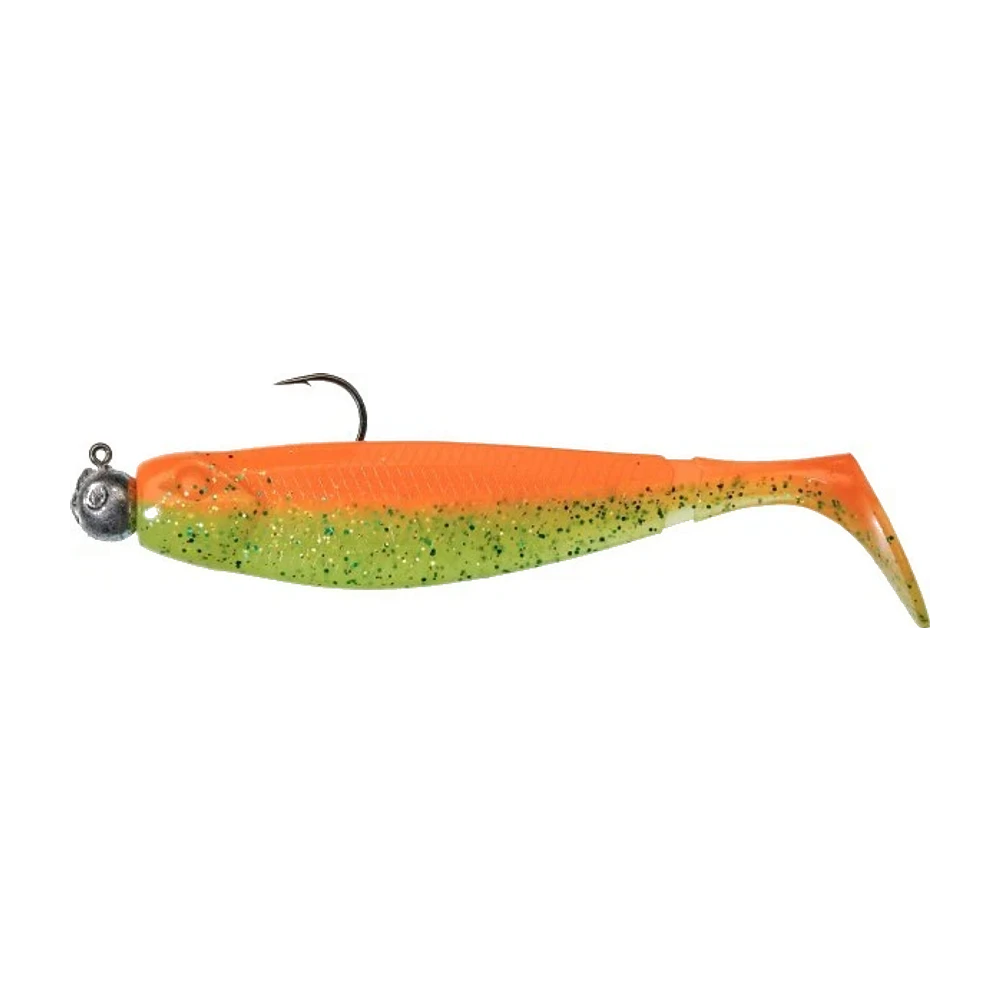
Gunki Stinger Shad: set your hooks up right and stop missing zander
Not sure this lure fits YOUR spot today? CarnaFish tells you in 10 seconds, from a photo.
Zander are not hard to make bite. They are hard to hook.
Most anglers who go home empty after a day on zander did not miss out on bites: they had six or seven and converted none or one. The fish took the lure, held it for a second, spat it out. Sometimes you felt a small tap. Often you felt nothing at all and only realised when you saw your line move sideways.
The Stinger Shad is named for a reason: it is a shad designed to be hooked up seriously, and it is through the hook setup that this problem gets fixed. Its shape and the softness of its body serve the same goal — getting the hook into the fish instead of leaving it buried in plastic.
The three zander bites, and the one you do not feel
Before talking about rigging, you need to know what you are trying to detect.
The clean tap. This is the bite everyone describes: a small sharp knock as the lure drops back. It is easy to hit, and it is the minority of cases.
The weight bite. You start your next lift and the lure is simply heavier, as though it had picked up a strand of weed. The zander has taken it and is not moving. If you wait to work it out, it spits.
The undetected bite on the drop. This is the most common and the most often lost. The fish intercepts the lure during its fall, rises with it or stays put: the line goes slack instead of coming tight. Without watching the line, you do not even know you had a bite.
That last one is why experienced zander anglers watch their line as much as they feel their rod. A line that fails to come tight when it should is a bite until proven otherwise.
A soft body that collapses on the hookset
A zander shad has to pull off two contradictory things: enough body to swim, and little enough material for the hook to come through on the strike.
The Stinger Shad bets on the softness of the compound rather than on a slim profile. On the take, a zander crushes the lure in its bony mouth; a rigid plastic acts as a buffer and the point never emerges. A body that folds lets the shank pass through.
Two practical consequences:
- Do not oversize your hook. Very heavy wire on a soft lure does not hook better; it levers and tears the body apart.
- Put the point in the right place. It should exit in the front third of the back, never in the middle of the body. The further back it sits, the more plastic there is to get through.
The retrieve: the three-beat lift
Zander eat on the drop in the vast majority of cases. The whole retrieve therefore consists of multiplying controlled descents.
- Cast and let it sink on a semi-tight line, rod at ten o'clock, following the line with your eyes. Count the seconds to the bottom and you will find the depth again on the next cast.
- One crisp lift from the wrist, about fifty centimetres, the tip travelling from nine to eleven o'clock. The lure leaves the bottom and the tail kicks on the way up.
- Follow the descent down by lowering the rod tip at the same speed as the fall. You keep light contact without pulling tight: this is when the bite comes.
- Take up the slack with one or two turns of the handle, wait for a second of firm bottom contact, then start again.
- At the slightest doubt, strike. A pointless hookset costs one cast; an ignored bite costs the fish.
On the water: do not strike upwards on a zander. Drop the rod tip towards the water, wind in every bit of slack until you feel the fish's weight, then strike sideways with the rod almost parallel to the surface. A vertical hookset on a slack line only moves the lure around inside the mouth; a sideways hookset on a tight line drives the point into the corner of the jaw, the only part of a zander's skull that holds well.
Weights and hook setup
| Situation | Jig head | Stinger hook |
|---|---|---|
| Lake, 2 to 5 m, no current | 10 to 14 g, round | not needed |
| Lake or gravel pit, 5 to 10 m | 14 to 20 g, round or football | depends on your miss rate |
| River, moderate current, 4 to 8 m | 18 to 25 g, football | recommended |
| Fish nipping the tail | same weight | essential |
| Vertical from the boat | 14 to 21 g | recommended |
On the extra hook: a stinger is a small treble or double linked to the jig head by a short trace and pinned into the rear flank of the lure. It is not worth running permanently — it adds snags and wrecks the lure. Fit it when you have identified a problem, meaning when you have had three unconverted bites in the same session. Our page on the stinger rig covers the principle, which transfers straight to zander by simply dropping one hook size.
As for tackle: a rod with a sensitive tip but a powerful butt, a fine braid in 0.12 to 0.15 mm with no stretch, and a fluorocarbon leader of 0.30 to 0.35 mm. The braid is not a luxury here: with nylon, the weight bite becomes almost undetectable beyond five metres.
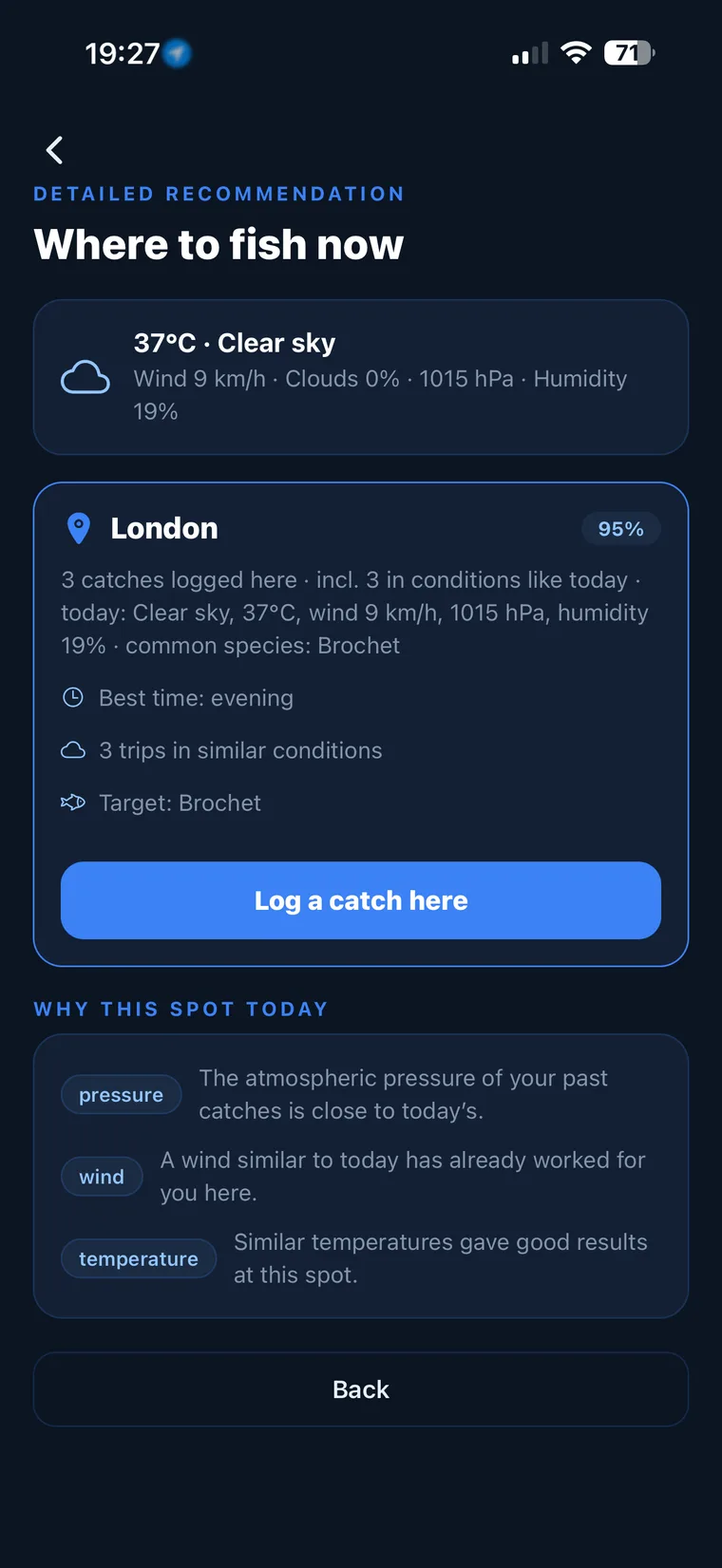
Not sure what to tie on?
Photograph your spot: CarnaFish reads the scene, cross-checks the conditions and gives you the zone, the lure and the retrieve. Free on iOS and Android.
Where it excels, where it is useless
This is a bottom lure, working in the thirty centimetres above the substrate.
- Hard bottoms and drop-offs: gravel, cobbles, channel edges, wherever zander settle during the day.
- Rivers and big lakes, where the available weights let you keep contact despite current or depth.
- Inactive fish, in deep winter or in high summer heat, when only a slow descent produces bites.
It is on the other hand useless for fishing mid-water on fish suspended off the bottom, where a straight retrieve through the layer suits better, and it is not a fast searching lure: you cover little distance and read the bottom metre by metre.
Stinger Shad or ribbed shad
Against a Fox Rage Spikey Shad, the logic is different. The Spikey uses its ribs to amplify the signal in stained water: it is a lure that makes itself heard. The Stinger Shad bets on softness and hook setup: it is a lure that gets itself hooked. In coloured water where the zander is struggling to find you, the first has the edge. In clear deep water where you get bites but no fish, the second fixes your real problem.
If your issue is silhouette rather than hooking, look instead at the Sakura Flat Shad, whose flat flank alters the trajectory of the fall itself. Our beginner's guide to lure fishing for zander goes back over the basics of reading the bottom. And if you are unsure what weight to fit when you get to the bank, CarnaFish analyses a photo of the spot and answers.
Key takeaways
- Most zander are lost on the hookset, not on getting the bite.
- Hook point in the front third of the back, never in the middle of the body.
- Follow the descent with the rod tip down: that is where the bite comes.
- Strike sideways on a tight line, never vertically on slack.
- Stinger hook only in response to an observed problem, not by default.
FAQ
Why do I miss so many zander?
Almost always because the hookset starts on a slack line. Wind in all the slack first until you feel the weight, then strike sideways. The other common cause is a hook point set too far back, which has too much plastic to get through.
What jig head weight should I choose?
10 to 14 g down to five metres with no current, 14 to 20 g between five and ten metres, 18 to 25 g in rivers. The right marker is feeling clear bottom contact without the lure slamming down: if you lose contact, go one step up.
Should I always run a stinger hook?
No. It adds snags and damages the lure. Fit it when you see the problem: three unconverted bites in the same session justify a stinger, not before.
Braid or nylon for this fishing?
Braid, without hesitation, in 0.12 to 0.15 mm with a fluorocarbon leader of 0.30 to 0.35 mm. The stretch in nylon makes the weight bite virtually undetectable beyond five metres and cushions the hookset.
What size of shad for zander?
Around 10 to 12 cm covers most situations. Drop towards 9 cm on pressured fish or very clear water, go up to 15 cm at the start of the cold season or when the baitfish present are large.
Do zander take on the way up or on the drop?
Overwhelmingly on the drop, as the lure falls back towards the bottom after the lift. That is exactly why the retrieve consists of multiplying controlled falls rather than reeling steadily.
The full zander lure guideSeason-by-season strategy: which family of lure, when, and why.Go from theory to fish
CarnaFish reads your spot from a photo and gives you the game plan: zone, lure, retrieve. Free on iOS and Android.