Strike King Rage Buzz Minnow: a soft plopper that clears weed
Before tying this one on, it helps to know if the spot actually calls for it. CarnaFish reads the scene from a photo.
There is one situation classic topwater baits handle badly: a weed bed just under the surface, twenty centimetres of water over it and fish underneath. A bladed plopper or a popper fouls on the second turn of the handle, a hollow frog goes through but makes no noise, and a standard soft bait sinks into the mass. The Rage Buzz Minnow is Strike King's attempt to combine the two: the plop of a plopper on a soft body you can rig weedless.
A cupped tail, and the sound that goes with it
The whole idea is in the tail. It is wide, hollowed into a cup, and Strike King states that it uses the brand's patented Rage Tail technology: on the retrieve it scrapes the surface, scoops water and throws it back, which produces a regular plop. The manufacturer goes as far as claiming a noise comparable to a hard bait, which is a Strike King sales claim and not a measurement. What can be said safely is that a soft bait's sound is necessarily duller and flatter than a metal blade's, and that this is sometimes exactly what is needed on fish already hammered with hard ploppers.
The description also presents this bait as an up-sized version of the brand's classic Rage Tail Shad. The logic is clear: same tail, more volume, more signal on the surface.
What the table publishes, and what it does not
There is a table, but it holds two columns and you have to read its header in full: length and quantity, not length and weight. It gives a single size, 3.75 in or 9.5 cm, and a pack of 5. No weight is published. On a topwater bait that is a genuinely missing figure, because mass directly drives casting distance and the minimum speed at which the tail starts working. We will not invent it.
A word on the family: this bait often sits on the buzzbait shelf. It is not a buzzbait. It has no wire arm, no blade and no skirt: it is a soft plastic whose moulded tail makes the noise. A shop label is not a source, the manufacturer description is.
What the product photo shows
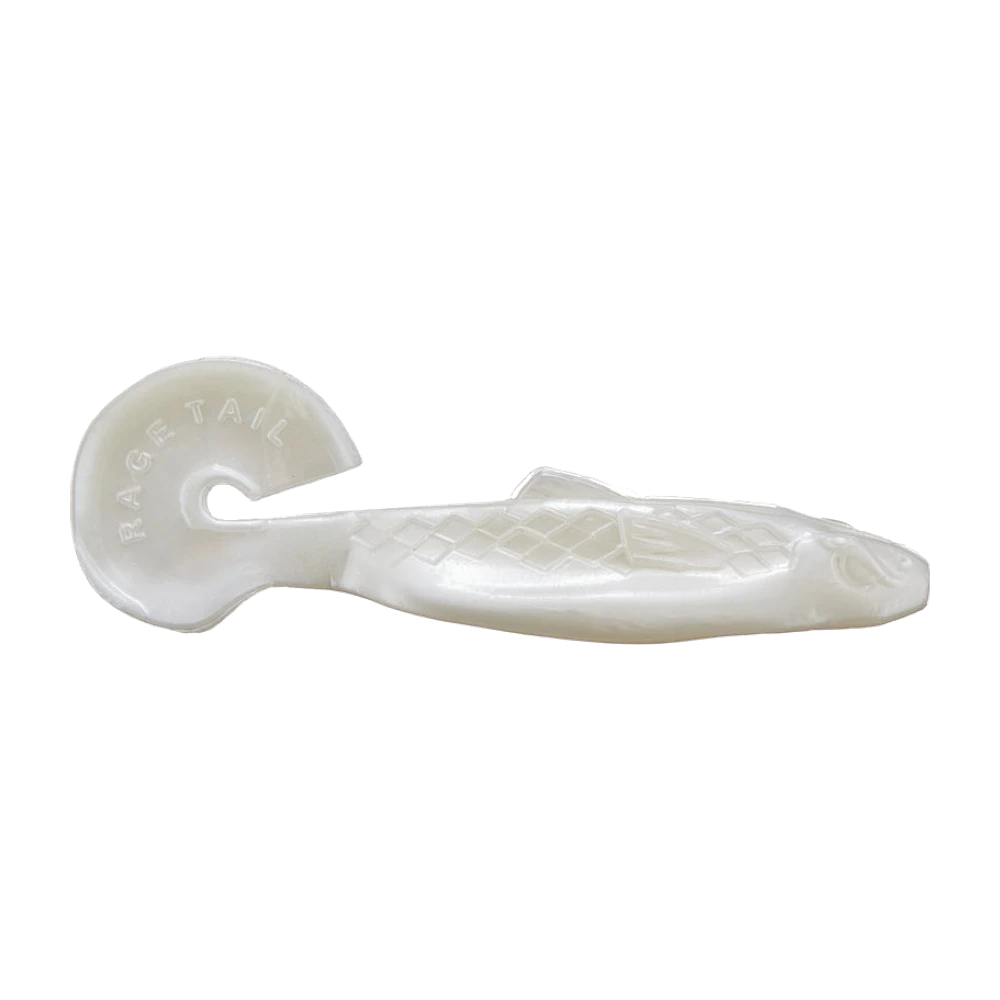
The example photographed is entirely pearl white, with no painted eye and no printed finish. The body imitates a baitfish: moulded scales, pectoral fins and a raised eye socket, plus a thin ridge running the length of the back. That ridge is not decorative, it is the channel the hook point tucks into. The tail is a wide curved cup carrying the words Rage Tail in relief. The bait is photographed bare, with no hook at all: it is a soft plastic sold in packs, to be rigged yourself. These are observations from a product photo, not specifications.
Rigging: single or double frog hook
Strike King states this bait is built for use with a single or double frog hook, with the points riding along the back. That is the key to the whole thing: points tucked in, the bait crosses weed without fouling, and the description claims a presentation that is both completely weedless and highly buoyant.
In practice, lay the hook alongside the bait to mark where the point must come out, thread it nose-first, bring the point out a third of the way along, then tuck it back just under the skin of the back, into the ridge. Tuck the point too deep and you miss bites; leave it too shallow and you foul. The point should show as a bump under the skin without breaking through.
The classic mistake: setting on the blow-up
It is the same rule as for a hollow frog, and it costs just as many fish. On a surface strike the fish often misses or has not closed its mouth when the water explodes. Set when you feel the weight, not when you see the boil. And with a frog hook whose points are tucked in, you need a firm set so the point drives through the body of the bait.
When a strike misses, change nothing: keep the same retrieve for a metre, then stop dead. The bait stays on the surface because it is highly buoyant, and a bass that missed very often comes back to it sitting still. That is the soft bait's edge over a hard plopper, which sinks the moment you stop.
Not sure what to tie on?
Photograph your spot: CarnaFish reads the scene, cross-checks the conditions and gives you the zone, the lure and the retrieve. Free on iOS and Android.
Where and when to use it
This is a shallow, warm-water bait, for when fish are high and tight to cover. Submerged weed flats, scattered lily pads, reed edges, silted backs of reservoirs: anywhere you see vegetation breaking the surface and would not dare cast a bait hung with trebles.
The retrieve is continuous and straight, with no rod action. Find the slowest speed at which the tail plops steadily and stay on it: slower and the bait goes silent, faster and it skips out and spins. Rod high at the start to get the tail going, then rod at mid height for the rest of the pass.
Colour by situation
- Baitfish hatches or clear water under bright light: the pearl white of the photo, imitating a distressed fry and reading well from below.
- Over a dense weed bed: a natural green-brown that blends into the scene and lets the silhouette do the work.
- Low light, dawn, coloured water: black, for a clean backlit silhouette, exactly as on a frog.
Against other topwater baits
The Rage Buzz Minnow plays on the ground of the River2Sea Whopper Plopper 130, which makes the same kind of plop but with a rigid prop and trebles — far more noise, and far less tolerance for vegetation. It also competes directly with a Zoom Horny Toad, the reference soft topwater, whose two kicking legs make a different, more continuous and less punctuated sound. And if you want the same body running under the surface, the Strike King Rage Swimmer covers the layer just below. In Europe this sort of bait on a big frog hook also takes pike holding under summer weed, provided you accept fishing without a steel leader.
None of this matters if the fish are not high in the column. Reading a weed edge and picking the right window is exactly what CarnaFish makes easier: a photo of the spot, and the app suggests a zone, a depth and a presentation for the moment. To learn how to decode a spot before casting, our guide to reading a fishing spot gives you the method.
Key takeaways
- It is not a buzzbait: no wire, no blade, no skirt, just a soft cupped tail that plops.
- The table publishes only length and quantity, 9.5 cm and 5 pieces: no weight, which is a real gap on a topwater bait.
- The dorsal ridge exists to house the point of a single or double frog hook, for a weedless pass.
- As on a frog, you set on weight and never on noise, and a firm set is needed to drive through the body.
FAQ
What size is the Rage Buzz Minnow?
The manufacturer publishes a single size, 3.75 in or 9.5 cm, in packs of 5. Watch the original table: the second column is a quantity, not a weight, and no unit weight is given.
What hook should I use with this bait?
Strike King states a single or double frog hook. The body shape is designed so the points lie along the back, in the moulded ridge, which makes the rig weedless. Pick a size that lets the point sit just under the skin of the back without breaking through.
Is it really a buzzbait?
No. It is often shelved there, but it has no metal parts at all: it is a soft plastic whose moulded tail makes the plop. A real buzzbait relies on a blade spinning on a wire arm.
How fast should I retrieve it?
Just fast enough for the tail to plop steadily, and no more. Slower and the bait goes silent, faster and it skips out of the water and starts spinning. Find that speed in the first few metres of the cast and hold it.
Why do I miss so many surface bites?
Because you set on the noise. Wait until you feel the fish's weight in the line, then set firmly: on a frog rig the point has to drive through the body of the bait before it reaches the jaw.
Does it take anything other than bass?
The description aims clearly at bass in shallow water. In Europe a pike holding under summer weed hits this kind of bait without hesitation, but a fine-wire frog hook and no steel leader make the outcome a lottery. It is a choice to make knowingly.
The full bass lure guideSeason-by-season strategy: which family of lure, when, and why.Go from theory to fish
CarnaFish reads your spot from a photo and gives you the game plan: zone, lure, retrieve. Free on iOS and Android.