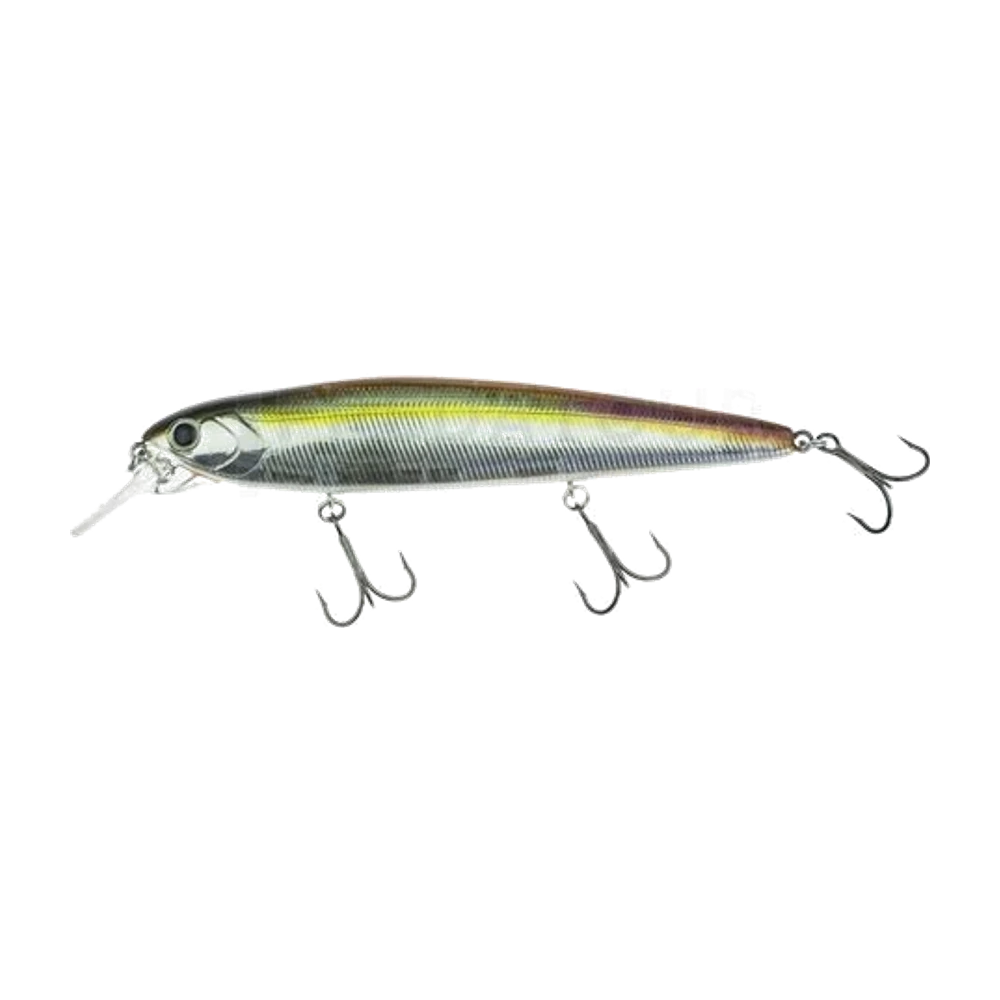
Nories Laydown Minnow: the jerkbait that tilts nose-down at rest
Rather not fish it blind? Photograph your spot — CarnaFish cross-checks the conditions and points you the right way.
A fallen tree is the best spot on a water and the worst place for a jerkbait. The bass is there, wedged between two branches, a metre down. You, meanwhile, have a lure carrying two trebles that you dare not throw in there — and if you throw it anyway, you get it back one time in three. The result: most anglers steer their jerkbait around the branches and fall back on a Texas-rigged soft plastic, accepting the loss of the reaction strike that only a hard bait produces.
The Laydown Minnow is built around that trade-off. Two features make it usable where others cannot go: slow positive buoyancy, which lets you float it up instead of pulling it out, and a tilted posture at rest, nose down, which replaces horizontal stillness with the image of a fish angling towards the bottom.
The tilt on the pause: what it tells the fish
Most jerkbaits chase the perfect waterline: at rest they stay strictly horizontal, like a suspended fish. That works on cold-water fish that watch for a long time.
The Laydown Minnow does the opposite. At rest it tips forward and tilts, head slightly down, then rises very slowly in that posture. Two readings are available to the bass, and both work:
- A fish grubbing on the bottom or on an obstacle, head down, oblivious to its surroundings. That is the posture of busy prey, and therefore vulnerable prey.
- A fish losing its balance and trying to hold itself up. On an ambush predator, asymmetry triggers more than regularity.
That posture also has an important mechanical effect in branches: the lure rises nose first, so the diving lip and the nose ring open the way and the trebles follow in its wake instead of being dragged sideways against a branch.
Working it in wood: float it up, do not pull
The sequence is different from that of an open-water jerkbait.
- Cast beyond the tree and retrieve until the first contact with a branch.
- On contact, stop everything. Do not pull. Let the lure float up twenty to thirty centimetres, tilting as it goes. That is the most productive phase of the cast.
- One short, sharp twitch to shift it sideways one way. The movement is tight, which limits the risk of sending it into another branch.
- Another pause of two to four seconds, tilted rise.
- Carry on looking for the next contact, until you are clear of the structure.
Away from branches, along a clean margin or over dead weed, the same logic applies with more twitches: two or three grouped twitches, then a long pause.
On the water: when the lure is caught in a branch, never pull straight along the line. Give it some slack and tap the tight line with a fingertip, like a guitar string. The vibration backs the trebles out, and the buoyancy does the rest by lifting the lure nose first. You will recover half the lures you would otherwise have ripped off.
Setting the running depth
| Setting | Effect | Context |
|---|---|---|
| 0.30 mm fluorocarbon | Highest running depth, faster rise on the pause | Branches under 1 m, tall weed |
| 0.25 mm fluorocarbon | Reference setting | General use |
| 0.20 mm fluorocarbon | Runs 20 to 30 cm deeper, slower rise | Margins at 1.5-2 m, clear water |
| Trebles one size heavier | Slows the rise considerably | Cold water, long pauses |
| Rod held high during twitches | Keeps the lure higher | Clearing a branch you have spotted |
The hooks are the setting with the most effect. Slow buoyancy turns into near-suspending with slightly heavier wire trebles — useful in winter, when you want pauses of five to ten seconds. Conversely, keep the stock trebles as soon as you fish in wood: you need that rise to get yourself out.
Where it excels, and where it is the wrong call
Its three home grounds:
- Laydowns, stumps and sunken branches between 50 cm and 1.5 m. That is its whole reason for existing.
- Spring and autumn in clear to lightly stained water, when the bass are on the margins and still react to a hard bait.
- Precision fishing on a single spot: when you know a fish is there and want to show it five different images in the same place.
It is poorly suited:
- In water below 8 °C, where its constant rise stops you holding a depth through the very long pauses the fish needs. A true suspending model does better.
- For wide, fast searching, where its limited casting distance and slow rhythm mean you cover little ground.
- In murky water, where its tight signal does not carry far enough; a spinnerbait or a lipless will call from further away.
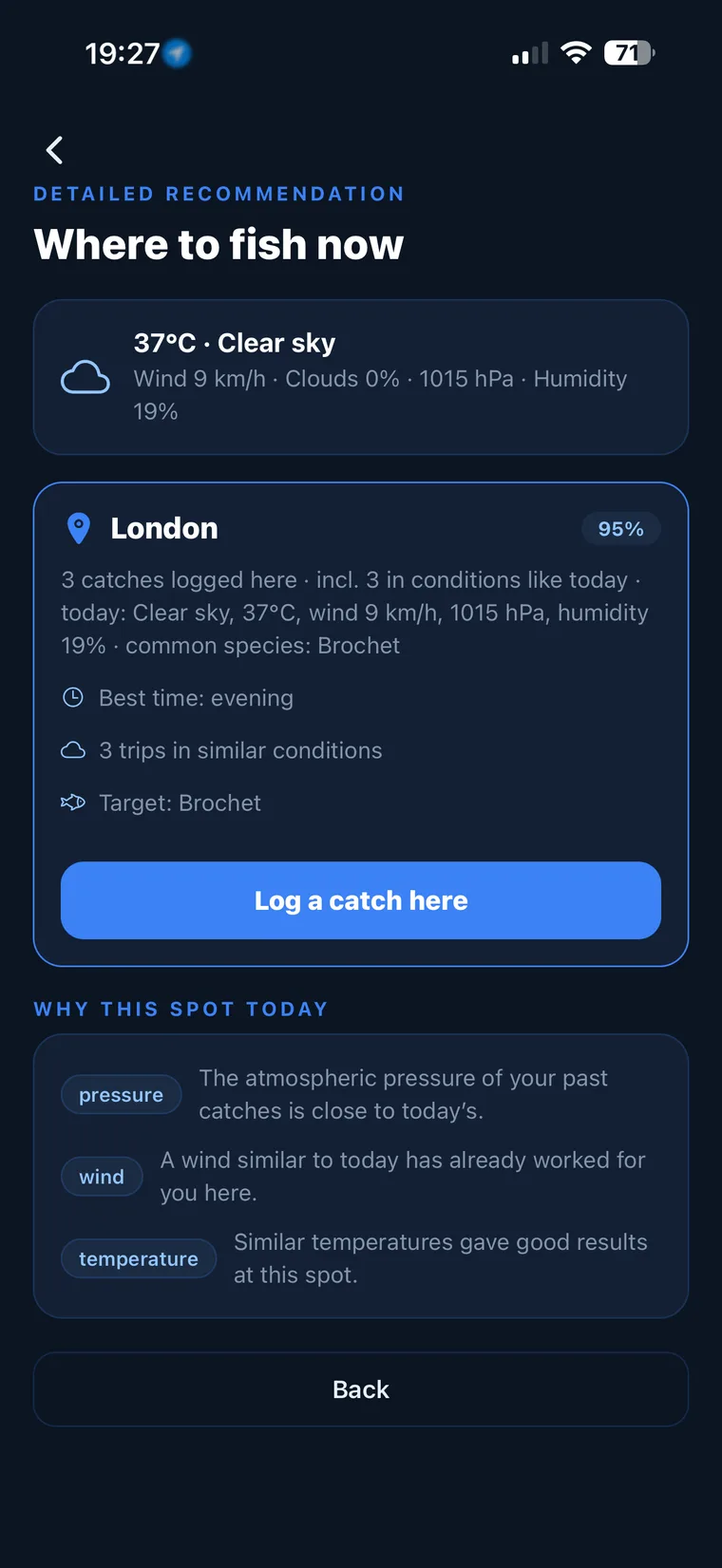
Not sure what to tie on?
Photograph your spot: CarnaFish reads the scene, cross-checks the conditions and gives you the zone, the lure and the retrieve. Free on iOS and Android.
Colours
- Clear water, full sun: translucent, bleak, pale roach. The fish sees the lure for several seconds at a time during the pauses.
- Under cover, in the shade of a tree: dark back and contrasting flank, the silhouette is what counts.
- Overcast or lightly stained water: a touch of chartreuse or red under the throat, visible while the lure sits tilted.
Laydown Minnow or suspending jerkbait
The Lucky Craft Pointer 100 is the archetypal true suspending bait: at rest it stays strictly in its layer of water, horizontal, for as long as you care to wait. It is the best tool in cold water on apathetic fish, and the Laydown Minnow does not replace it there.
The Megabass Vision 110 offers something else again: a rollier action and a long glide after the twitch, with greater casting range. That is the choice for searching with a jerkbait along big windswept margins.
The Laydown Minnow is defined by what neither of the other two does: it gets itself out of the wood. Its slow, nose-first rise is a release tool as much as a retrieve. The day you find a laydown loaded with fish and do not want to switch to soft plastics, this is the one that goes in the box. Our beginner's guide to bass fishing explains how to read those spots before you cast. And if you are unsure what depth to attack along a cluttered margin, CarnaFish analyses a photo of the spot and answers.
Key takeaways
- At rest the lure tilts nose down and rises slowly in that posture: that is the image that triggers.
- In wood, the stop is what gets you free. Never pull straight along the line on a snag.
- Tight lateral darting: ideal for working between two branches without burying it.
- Heavier trebles slow the rise and stretch out the pauses in cold water.
- The wrong call in very cold water, in murky water, and for searching fast.
FAQ
What does "laydown" mean for this jerkbait?
The word covers both the fallen trees in the water, which are its home ground, and the tilted posture the lure adopts at rest instead of staying horizontal.
Does this lure float or suspend?
It has slow positive buoyancy: it rises gradually during the pause, tilting as it goes. You can bring it close to a suspending bait with slightly heavier wire trebles, but you then lose its ability to free itself from wood.
How do you free a jerkbait from a branch?
Give it slack and tap the tight line with a fingertip. The vibration backs the trebles out and the buoyancy lifts the lure nose first. Pulling straight along the line is the surest way to bury it for good.
How long should the pauses be?
Two to four seconds in branches, where the rise also serves to free the lure. On clean margins and in colder water, stretch it to five or six seconds and compensate with slightly heavier hooks.
What line should I use?
Fluorocarbon of 0.25 to 0.30 mm. The 0.30 mm keeps the lure higher and speeds up the rise, which is an advantage in wood. The 0.20 mm takes it 20 to 30 cm deeper for slightly deeper margins.
Can you use it in winter?
It works down into cool water, but below 8 °C its constant rise becomes a handicap: the fish wants very long pauses at a fixed depth, and only a true suspending jerkbait delivers that.
The full bass lure guideSeason-by-season strategy: which family of lure, when, and why.Go from theory to fish
CarnaFish reads your spot from a photo and gives you the game plan: zone, lure, retrieve. Free on iOS and Android.